

Politics
Rare Opportunities Emerge For Congress To Actually Help Americans As Cracks Form In Status Quo
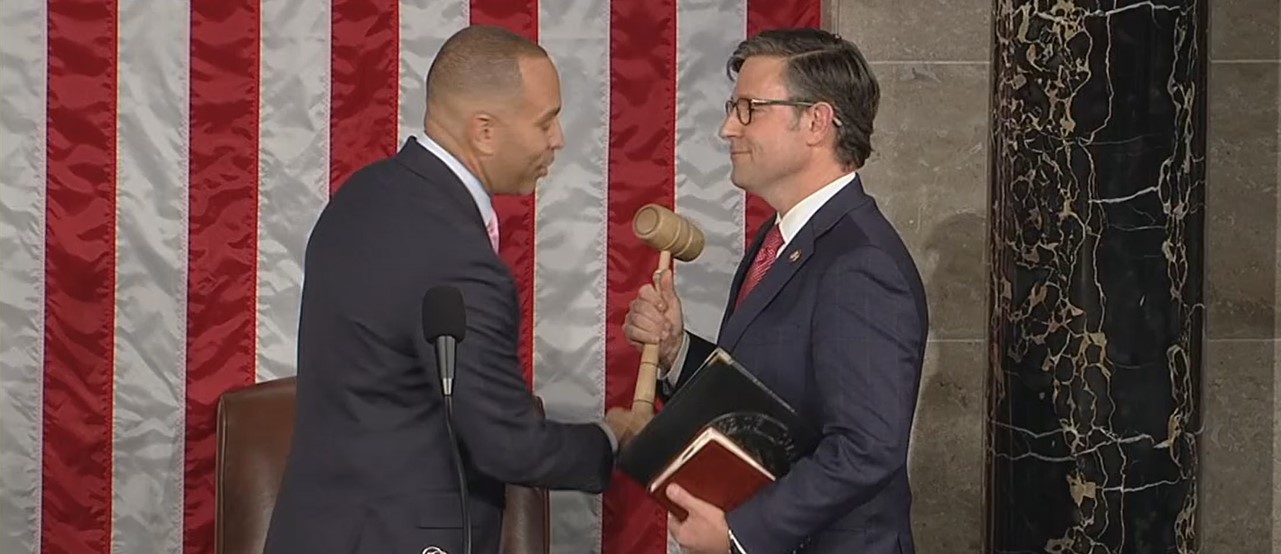
House Minority Leader Hakeem Jeffries (D-N.Y.) hands over the speaker's gavel to House Speaker Mike Johnson (R-La.), Oct. 25, 2023. (Screen Capture/CSPAN)
Congressional Democrats could use their new majority to partner with reform-minded Republicans on issues that the old-guard never bothered to touch.
Lawmakers on both sides of the aisle sought to reform mass surveillance, artificial intelligence, congressional insider trading and other unresolved issues, which could see drastic changes once Democrats regain control in January. Warrantless spying, artificial license plate readers, health and insider stock trading will all still be on the table in the next Congress.
Independent Vermont Sen. Bernie Sanders expressed willingness to work with Republicans to make major changes, stating that the midterm elections made it clear that Americans want reforms.
“I think this election made it very clear that the American people want change. They’re tired of the status quo,” Sanders told the Daily Caller News Foundation. “They’re tried of big money controlling what’s going on, and I think there are some Republicans who understand that. And I very much look forward to working with them.”
Crypto
President Donald Trump signaled shortly after the Democrats’ sweeping midterm victory that he could work with Democrats on artificial intelligence (AI) safety, so long as it does not impede the United States in the race against China.
“I don’t mind guardrails. But I don’t wanna put us in a deep second position. We’re leading number one. And China has no guardrails, by the way,” he told CBS News in early November.
One source close to the Trump administration told the DCNF that there will likely be compromises on AI safety and data center development.
“Obviously the Democrats are mad,” Republican Louisiana Sen. John Kennedy told the DCNF. “I mean, that’s clear. And I’m not saying that the Democrats in Congress won’t consider a crypto bill, but it would not be the same crypto bill. And my friends in the crypto world, we had an agreement and they should have taken it.”
A new group of bipartisan lawmakers, led by Reps. Don Beyer, Sara Jacobs and Celeste Maloy, proposed an outline for the Safe and Accountable Federal Evaluations of Artificial Intelligence (SAFE AI) Act, a bill that would establish federal safety standards for frontier AI models, according to a press release from Beyer’s office.
“That’s why the bipartisan SAFE AI Act puts real guardrails on frontier models, with civil penalties for violations and targeted emergency authority to stop dangerous models when they pose a serious and immediate danger. Our proposal is a floor – not a ceiling, empowering states to adopt stronger protections for their communities. And it is built to adapt as the technology changes, so Americans’ safety never depends on a company’s promise,” Jacobs said in a written statement.
The most vocal enemies of the crypto industry, such as Democratic Ohio Sen.-elect Sherrod Brown and Democratic Massachusetts Sen. Elizabeth Warren will return to power in a Democratic Congress in January, with Warren likely to return as the Senate Banking Committee chair, Yahoo Finance reported.
Although she will likely hound the Trump administration and family over its relationship with the crypto industry, Warren and the administration may find common cause on one issue: debanking, Andrew Bailey, the head of strategy at the Finney Foundation for Open Technology, told the DCNF.
Debanking is the loss of one’s relationship with financial services, often due to political, religious or other associations, according to the Cato Institute.
Bailey noted that during a February 2025 hearing, Warren credited Trump for recognizing a “real problem” when the president criticized Bank of America’s alleged debanking practices, according to Congress.gov. She said federal financial regulators, including the Federal Reserve and the Treasury Department, could do more to issue “clear Anti-Money laundering rules” and guidance for banks to follow to discourage debanking.
The Republican-led House Financial Services Committee released a report in 2025 about how the Biden administration allegedly debanked the crypto industry, according to a final report released by the committee.
“Bitcoiners tend to think the solution is to create a money beyond the control of institutions so that people can’t be debanked. But common ground is a good place to start, and it’s not always something we can find. So I’m encouraged there, and I think it’s a top agenda item for her,” Bailey said, noting that Warren will also likely investigate World Liberty Financial, a cryptocurrency platform founded by the sons of billionaire Trump advisor Steve Witkoff and Trump’s sons, Don Jr. and Eric.
Although many anti-Democrats will take positions of power, the crypto industry believes it helped elect more pro-crypto lawmakers than ever, according to Stand With Crypto, a crypto advocacy organization launched with the help of cryptocurrency exchange Coinbase.
“Some crypto champions won and some lost, but we have more pro-crypto candidates elected to Congress than we’ve ever seen in a new member class before. That’s progress,” Kara Calvert, the vice president of policy for Coinbase, wrote shortly after the midterms.
“I think Democrats learned their lesson two years ago, like don’t go after crypto fully. But it remains to be seen if they take the bait or not,” Ron Hammond, head of policy at crypto trading firm Wintermute, and a former Blockchain Association government relations director, told the DCNF about the opportunity for the administration, crypto industry and Democrats to work together in the new Congress.
Department of Defense reforms
Democrats and Republicans may see eye-to-eye on auditing the Pentagon and establishing a fiscally responsible budget for defense.
Sanders and Republican Iowa Sen. Chuck Grassley reintroduced the Audit the Pentagon Act on July 30, which was cosponsored by Warren, Democratic Oregon Sen. Ron Wyden, Democratic Maryland Sen. Chris Van Hollen, Republican Utah Sen. Mike Lee, Republican Kentucky Sen. Rand Paul and others. The bill proposed withholding 2% from any Pentagon component that fails an independent audit and returning those funds to the federal treasury for deficit reduction.
Democratic Wisconsin Rep. Mark Pocan introduced the bill in the House alongside Republican Arizona Rep. Andy Biggs in February.
The Pentagon spent almost $141 billion on a Northrop Grumman ballistic missile project that was supposed to cost $77 billion. Officials spent more than $126 billion on a General Dynamics submarine program which has run $17 billion over budget.
Incoming House Armed Services Committee Chairman Adam Smith has made oversight of waste, fraud and abuse in the Pentagon a priority for the 120th Congress. He collaborated with committee Republicans to draft the National Defense Authorization Act (NDAA), a series of annual defense-related federal laws that narrowly passed the House in July.
Smith joined all of the Armed Services Republicans in June to advance a $1.15 trillion defense policy bill out of the committee, despite expressing concerns over its price tag and Secretary of War Pete Hegseth’s leadership. Hegseth said he legislation was necessary for national security and for military families, even though he disagreed with some of the provisions, according to Roll Call.
The top committee Democrats voted against the NDAA on the House floor because of its $1.6 trillion cost. He also argued that Republicans added provisions to continue its “rightwing culture war assault on the LGBTQ community.”
“The problem is the $1.6 trillion price tag—a 60 percent increase in the defense budget at a time when our country is running a nearly $2 trillion deficit. Our country faces threats and DoD has modernization needs, but I will not support making massive cuts to critically important domestic programs and slashing taxes to meet those needs. We need to be more fiscally responsible and DoD needs to become more innovative and efficient,” Smith said in July.
“We need to develop a realistic national security strategy and approach that doesn’t require a $1.15 trillion discretionary budget request and another partisan budget reconciliation process that includes an additional $60 to $350 billion for defense,” Smith continued.
Trump pressed congressional Republicans to pass a $350 billion defense spending package through the reconciliation process before Democrats take control in January. Paul, Republican Missouri Sen. Josh Hawley, Republican Alaska Sen. Lisa Murkowski, Republican South Dakota Sen. Mike Rounds, Republican Wisconsin Sen. Ron Johnson and Senate Majority Leader John Thune have expressed skepticism and hesitation about passing this additional funding through reconciliation.
Thune argued that passing such a reconciliation bill would not be feasible because it could risk a government shutdown.
Rounds, a member of the Senate Armed Services Committee, feared that Democrats would vote against a stopgap funding bill if Republicans passed the reconciliation package. He argued that if Republicans negotiated in good faith on a stopgap funding bill, Democrats would agree to a deal.
Johnson said that passing a reconciliation package would have to be fully offset with other spending cuts.
Warrantless spying
Many Democrats agreed with reform-minded Republicans to make changes to Section 702 of the Foreign Intelligence Surveillance Act (FISA), a tool that allows the government to collect and search American citizens’ data without a warrant if they were in contact with targeted noncitizens.
House Democrats and 19 Republicans voted against extending Section 702 during a June 11 vote, one day before it lapsed. Kennedy and Republican Sens. Rick Scott of Florida, Tommy Tuberville of Alabama and Eric Schmitt of Missouri, Lee, Hawley and Paul voted against its extension before it expired in June over privacy concerns.
Democratic senators told the DCNF that Section 702 needed reforms, including a warrant. Congressional Democrats initially opposed its reauthorization over Federal Housing Director Bill Pulte’s temporary appointment as director of national intelligence before the Senate confirmed Jay Clayton.
Clayton’s confirmation did not change many Senate Democrats’ minds on Section 702’s reauthorization. Senate Minority Leader Chuck Schumer, along with Warren and Democratic Sen. Chris Murphy of Connecticut told the DCNF in June they would not support its reauthorization after the chamber confirmed Clayton.
Republicans in both chambers, including Lee and Republican Tennessee Rep. Tim Burchett, said they would not support the spying tool without a warrant requirement.
Sanders repeatedly opposed reauthorizing Section 702 for several years, arguing that it gives the government excessive power to conduct warrantless surveillance on Americans.
Top Democrats on the Intelligence Committee could also work with establishment Republicans to reauthorize Section 702 without reforms. House Intelligence Committee ranking member Jim Himes urged Senate Republican leadership Tuesday to reauthorize Section 702 before the lame duck ended. Senate Intelligence Committee Vice Chair Mark Warner and Democratic Arizona Sen. Mark Kelly told Politico they supported the renewal without a warrant.
“My preference would be, let’s just take the win that’s on the table, get it done in the lame-duck,” Himes said. “If that fails, we’ll do something in the first quarter.”
Republican Reps. Lauren Boebert of Colorado and Thomas Massie of Kentucky introduced the “Surveillance Accountability Act” on April 23, which would require federal law enforcement to show probable cause before accessing Americans’ private digital data. Neither will serve in the next Congress after losing their reelection bids.
Trump called for the passage of Section 702 in an April 15 statement, though he spent years opposing the program. He signed the reauthorization of Section 702 into law during his first term on Jan. 19, 2018.
Weeks before the U.S. entered the conflict on Feb. 28, administration officials arranged a meeting with lawmakers in early February to promote FISA programs without changes.
The president’s position changed after the 2024 election, when Trump called to “KILL FISA” because it was used illegally to spy on his campaign. A Department of Justice (DOJ) inspector general’s report found “significant inaccuracies” in the FBI applications for FISA warrants against a Trump campaign adviser, and the DOJ later conceded that two of the four orders were invalid.
Flock cameras
Members on both sides of the aisle have introduced legislation to restrict automated license plate readers (ALPRs) and Flock cameras.
Democratic New York Rep. Alexandria Ocasio-Cortez, Democratic Oregon Sen. Jeff Merkley and Sanders introduced the Ban Flock Act in October to prohibit the federal government from purchasing, using or possessing an ALPR, accessing its data or using federal funds to purchase ALPRs. It would block certain federal grant funding for state and local governments that use ALPRs or contract with ALPR companies, such as Flock Safety, although it does not outright prohibit local agencies from purchasing the technologies with local tax dollars.
Republican Florida Rep. Anna Paulina Luna said in July she was working on legislation to ban the cameras, though the legislation never came forth.
Burchett introduced the “Protection Against Mass Surveillance Act” in July, which would ban federal agencies from using automated surveillance. If passed, no agency would be permitted to “purchase, deploy, operate, access, or contract any automated surveillance system.”
Hawley, the chairman of the Senate Judiciary Subcommittee on Crime and Counterterrorism, and ranking member Dick Durbin opened an investigation into Flock cameras and shared the same concerns about ALPRs.
In his letter to Flock Safety CEO Garrett Langley, Hawley mentioned how prosecutors charged a police officer in Milwaukee, Wisconsin, for allegedly searching his ex-girlfriend’s license plate 124 times and her former boyfriend’s plate 55 times. A Florida resident spent 13 days in jail and faced eight felony counts, including three counts of vehicular homicide, for a crime she did not commit.
Hawley and Durbin invited Langley and the CEOs from Axon Enterprise, Motorola Solutions and Verkada to testify in September about their products’ access to Americans’ data, although none of them showed up. None of the CEOs were subpoenaed.
Durbin is retiring at the end of his term and will be replaced by Democratic Illinois Sen.-elect Juliana Stratton, who has characterized Flock cameras as a “mass surveillance system.”
Democratic Illinois Rep. Raja Krishnamoorthi and Republican Texas Rep. Michael Cloud introduced the No FLOCK Act in September to restrict ALPR use to specific public safety and toll-enforcement purposes. They could only be used to enforce toll systems, identify stolen vehicles, locate missing or endangered people, identify vehicles registered to felons or investigate vehicles involved in felony offenses.
Krishnamoorthi’s office did not immediately respond to the DCNF’s request for comment.
Health
Both parties remain far apart on their core health care messages.
The Trump administration has prioritized remediating the deep rot in Medicaid, disrupting Democrats’ social services-turned-patronage networks in cities like Minneapolis, Los Angeles and Seattle. The COVID pandemic revealed corruption at the Food and Drug Administration (FDA) and a lack of rigor at the Centers for Disease Control and Prevention (CDC) that Republicans have not forgotten, which offends a Democratic Party closely aligned with an overwhelmingly liberal public health sector.
But the majority of American families of all political stripes express worries about runaway costs. A pre-midterm election poll by the Kaiser Family Foundation in October found that 25% of Americans are “very worried” about affording health care and an additional 35% said they were “somewhat worried.”
The problem has become so vexing and so enormous — health care now subsumes 18.7% of Gross Domestic Product (GDP) — that all options appear to be on the table.
Democratic Michigan Sen.-elect Abdul El-Sayed pitched Trump on single-payer health care, the left’s longtime goal of socialized medicine, albeit with flattering “TrumpCare” branding.
As far-fetched as that may sound, there are market interventions prescribed in the “Great Healthcare Plan” that Trump unveiled in January that could appeal to leftwing Democrats.
Democrats looking to make good on their promise to make life more affordable could codify into law the Most-Favored-Nation (MFN) deals that Trump made with 27 drug companies to bring their American prices into line with prices in other developed countries.
Sanders is poised to chair the Senate’s lead health committee.
As the leader of the Senate Health, Education, Labor and Pensions (HELP) Committee, Sanders could make good on his long-stated goal of ending the way the pharmaceutical industry exploits America for research and development then overcharges American patients — a goal he shares with Trump.
Paul will become that committee’s top Republican and a vocal supporter of free market principles.
And other industry-friendly Democrats like Rep. Frank Pallone of New York, longtime Democratic leader of the House Energy and Commerce Committee, and Rep. Richard Deal, longtime Democratic leader of the House Ways and Means Committee, have indicated their preference to investigate the terms of the MFN deals rather than capitalize on their momentum. They allege they amount to “sweetheart deals” because the threat of tariffs was used to extract lower prices. Companies like Pfizer, Eli Lilly and Novo Nordisk received three-year tariff exemptions in exchange for lower prices and commitments to manufacture in the U.S. Some companies received exemptions from pilot programs in Medicare to lower drug prices, which were also initiated by the Trump administration.
Some Democrats, including El-Sayed, Ocasio-Cortez and Maine Rep. Chellie Pingree, have flirted with independents who prioritize better nutrition and curbing pesticide use after the Trump administration sided with agrochemical giant Bayer to immunize the company from lawsuits from cancer patients. Still, they’ve avoided touching on vaccine safety — a third rail for liberals.
Insider trading ban
Banning or severely restricting congressional insider trading received significant bipartisan support.
The House passed the Stop Insider Trading Act in July to generally ban members of Congress, their spouses and children from purchasing new individual stocks, require public notice before they sell stocks and ban them from purchasing covered investments, which are publicly traded companies or comparable economic interests. The bill would allow members of Congress to hold onto their existing holdings and sales of those existing holdings require between seven and 14 days of public notice.
All House Republicans and 13 Democrats voted for it, while most Democrats opposed it because they believed it did not go far enough. The Senate blocked the legislation in a Sept. 30 procedural vote, as Democrats believed the bill should have banned government officials from trading altogether.
Hawley agreed that the House’s version should have included stronger language.
Former Speaker Nancy Pelosi’s wealth grew at least 2,292% through stock trading during her 37 years in Congress. She had a $2,675,036 minimum net worth in the year she began serving and a $63,996,050 minimum net worth in 2024. Her maximum net worth in 2024 was an estimated $311,443,000, her filings show.
Democratic California Rep. Ro Khanna’s family traded shares valued at about $24 million to $147 million, according to The New York Times. Republican Texas Rep. Michael McCaul’s family bought and sold between $28 million and $75 million in individual stocks since January 2025 over the course of 1,100 transactions.
Republican Oklahoma Sen. Alan Armstrong traded about $8 million to $41 million worth of shares across nearly 700 individual trades, according to the Times.
Republican Texas Rep. Chip Roy, who is exiting Congress in January, was a primary sponsor of the Restore Trust in Congress Act, which would have prohibited members of Congress, their spouses and children from owning or trading individual stocks.
The bill included 35 Republican co-sponsors including Luna, Burchett and Cloud.
Democratic Colorado Rep. Jason Crow called for Congress to take action on banning stock trading for lawmakers during a Nov. 17 press conference.
“Americans, right, left, and center, are fed up with a system that’s captured by corporate lobbyists, with a system that’s captured by super PACs, with a system that over and over again, shows that it can’t do the big things that Americans overwhelmingly support because of the chokehold of corporate money and lobbyist money on this town,” Crow said. “There are many things that members of Congress can just do today to show they will walk the talk. That’s why 57 incoming members and I have taken the Political Integrity Pledge to refuse corporate PAC money, to push for a ban on stock trading by Members of Congress, to ban lobbying by former Members of Congress for at least five years, and to support the overturning of Citizens United.”
“We can do those things when we start the 120th Congress. We are dedicated and committed to pushing leadership, to pushing our colleagues, and to making sure communities back home know that we represent them and not the special interests. We will not accept no for an answer on this.”
More than a dozen incoming and current Democratic House members pledged to use their majority in the next Congress to pass a congressional stock trading ban during a Nov. 17 press conference. Democratic Reps.-elect Matt Little of Minnesota, Sam Forstag of Montana and Luke Bronin of Connecticut called for action to be taken to ban stock trading, arguing Congress should not be a place to get rich.
“Back in my home district, there’s no disagreement about the fact that Congress should not be a place that you go to get rich. This should be a place that you go for public service and actually makes our lives better as working people,” Forstag said. “When the average member of Congress is worth $4 million, we should all be outraged. We shouldn’t just be angry. We should do something about it. So, let’s ban congressional stock trading.”
Lobbying
Scott asked for unanimous consent to immediately pass a bipartisan effort permanently bar former members of Congress from becoming lobbyists. The measure failed to pass after Republican North Carolina Sen. Thom Tillis objected to it.
The Banning Lobbying and Safeguarding Trust (BLAST) Act would impose a lifetime ban on former members lobbying Congress after leaving office. Scott introduced the bill in May with Warren.
The legislation also targets “shadow lobbying,” which is advocacy aimed at influencing government policy or decisions without formally registering as a lobbyist. Penalties include up to five years in prison and civil fines up to $50,000 per violation.
Former House members are required to wait one year and senators need a two-year cooling-off period before becoming a lobbyist.
Tillis did not seek reelection after Trump threatened to back a primary challenger. The North Carolina senator angered Trump after he voted against the One Big, Beautiful Bill, which Trump signed into law on July 4, 2025.
Grassley and Democratic Michigan Sen. Gary Peters put forth bipartisan bills to target loopholes that allow foreign governments to influence U.S. policy with limited disclosure. One of their bills, The Lobbying Disclosure Improvement Act, would require registrants to state whether they are claiming the exemption from the stricter Foreign Agents Registration Act (FARA).
The Disclosing Foreign Influence in Lobbying Act would require the disclosure of any foreign government or political party that participates in directing, planning or controlling lobbying activities. Hawley, Durbin, Republican Texas Sen. John Cornyn and Democratic New Hampshire Sen. Maggie Hassan co-sponsored the legislation.
Democratic North Carolina Rep.-elect Richard Ojeda said he wanted to introduce legislation to require body cameras for lobbyists.
“If you could get on your computer and watch every conversation that your member of Congress is having with lobbyists, I can guarantee that they’d be far less likely to sell you down the river,” Ojeda told The Washington Sun. “And make no mistake about it, there are people that sell you down the river.”
Ojeda acknowledged he is unsure whether the bill would pass.
Dozens of incoming House members signed the Political Integrity Pledge, which calls for a lobbying ban for former congressional members. During their Nov. 17 press conference, the incoming and incumbent Democratic House members pledged to use their majority to pass a lobbying ban for former members.
Carried interest loophole
Trump and many Democrats have criticized the carried interest loophole, which allows private equity, venture capital and hedge fund managers to have their share of fund profits taxed at the 20% long-term capital gains rate rather than ordinary income rates. It is generally taxed at preferential long-term capital gains rates rather than ordinary income rates.
Critics call the interest a loophole because managers often contribute little personal capital and earn it largely as compensation for services.
Closing the loophole could make headwinds after Democrat regain the majority given that Trump supported changes. Trump told congressional Republicans in February 2025 that ending the loophole was one of his top tax priorities, according to The Wall Street Journal. House Republicans on the Ways & Means Committee left changes out of their initial reconciliation tax bill in May 2025 following heavy lobbying from private equity, venture capital, real estate and oil groups.
Over two dozen House Republicans sent a letter in May 2025 urging Ways and Means Committee Chairman Jason Smith to protect corporate interest tax rules, arguing that raising taxes on carried interest would hurt investment and small businesses. The lawmakers who signed onto the letter included Reps. French Hill of Arkansas, August Pfulger of Texas and Richard Hudson of North Carolina.
“[W]e have serious concerns about proposals to raise taxes on carried interest,” the letter stated. “This tax increase would harm millions of partnerships in real estate, private equity, and venture capital by disincentivizing entrepreneurial risk-taking and investment, potentially jeopardizing jobs in every state and district. For our progressive colleagues, eliminating carried interest is only the first step toward eliminating capital gains treatment entirely, with their ultimate goal being a wealth tax on unrealized gains.”
Democratic Sens. Ron Wyden of Oregon, Sheldon Whitehouse of Rhode Island and independent Maine Sen. Angus King introduced the Ending the Carried Interest Loophole Act in 2023 to eliminate the concept of carried interest. The bill had no Republican sponsors or cosponsors.
Hawley publicly supported ending the loophole, becoming the only prominent Republican lawmaker to publicly side with Trump on the issue, according to the WSJ. He told reporters in 2025 that lawmakers ought to close the carried interest loophole to raise revenue.
All content created by the Daily Caller News Foundation, an independent and nonpartisan newswire service, is available without charge to any legitimate news publisher that can provide a large audience. All republished articles must include our logo, our reporter’s byline and their DCNF affiliation. For any questions about our guidelines or partnering with us, please contact [email protected].