

Education
Supreme Court Appears Likely To Teach Colorado It Can’t Discriminate Against Catholic Schools For Not Compromising Values
Wikimedia Commons
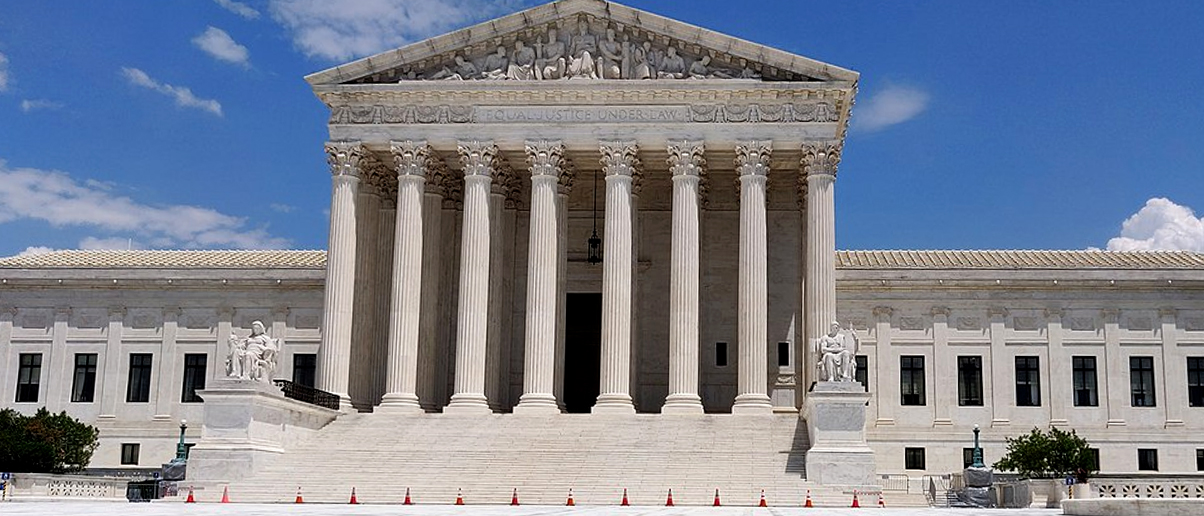
WASHINGTON — The U.S. Supreme Court appears likely to rule in favor of Catholic preschools in Colorado after hearing oral arguments Tuesday that barring them from the state’s Universal Preschool Program over religiously influenced admission requirements violates the First Amendment.
The Colorado Universal Preschool Program (UPK) was established during the state’s 2022 Legislative Session to offer “voluntary, high-quality universal preschool to every Colorado child in the year before kindergarten.” It allows typical Colorado families to receive up to 15 hours of free preschool weekly, boasting an average savings of $6,300 per child, per school year to alleviate the costs of comparable full-time child care, estimated to be around $20,000 annually.
Since the nearly $350-million program funded primarily by a nicotine and tobacco tax was launched in 2023, 87,000 children have been enrolled. The Democratic-leaning state, meanwhile, has moved from 27th to third in national preschool enrollment for four year olds and fifth for three year olds.
Beyond meeting other standards and requirements, participating preschools must sign a nondiscrimination agreement to “provide eligible children an equal opportunity to enroll and receive preschool services regardless of race, ethnicity, religious affiliation, sexual orientation, gender identity, lack of housing, income level, or disability.”
Finding such sexual orientation and gender identify requirements to be at odds with the admissions policies of Catholic schools aligning with Church teachings. However, the plaintiffs — the Catholic Archdiocese of Denver, two local parishes with preschools, one of which having since closed, and the Colorado parents of seven children, Dan and Lisa Sheley— filed a lawsuit arguing that the First Amendment necessitates the granting of a religious exemption.
Doing so, they argue, would allow an estimated 1,500 children across at least 30 affected Catholic preschools to participate in the program.
The initial complaint was filed Aug. 16, 2023, in the U.S. District Court for the District of Colorado. After Senior Judge John L. Kane, a 1977 appointee of former President Jimmy Carter, denied the motion for an injunction of the state’s right to enforce its nondiscrimination rules in June 2024, the case moved to the U.S. Court of Appeals for the Tenth Circuit.
A three-judge panel voted unanimously Sept. 30, 2025, to affirm the lower court’s ruling, determining Colorado’s nondiscrimination requirement is “a model example of maintaining neutral and generally applicable nondiscrimination laws while nonetheless trying to accommodate the exercise of religious beliefs.”
The plaintiffs then petitioned the Supreme Court on Nov. 13, 2025, to take up the case, which was agreed to April 20, 2026.
Colorado, the plaintiffs argue in their petition, “knowingly excluded Catholic preschools solely on account of their religious exercise,” in particular “their religious practices of ensuring that all enrolling families are supportive of the Catholic Church’s teachings on sex and marriage and of treating enrolled four-year-olds in accordance with their biological sex.”
Being forced to violate one’s religious conscience to access the public benefit, then, they continue, is an imposition on the ability to freely exercise religion, a violation of constitutional pprotections. Notably, the “record is devoid of a single instance of an LGBTQ family’s seeking admission” to any of the plaintiffs’ schools.
Acknowledging “the settled principle that government may not target religion for disfavored treatment,” Colorado, responding in its own brief, counters by claiming the preschools are pursuing a “new rule that would trigger strict scrutiny whenever public-benefits conditions incidentally burden religiously motivated conduct.”
While it offers exemptions for disabled and impoverished children, for example, the state challenges the possibility of public funds subsidizing religious discrimination against children in LGBTQ-identifying families.
Ahead of oral arguments, the Court limited the scope of the case being argued to two questions. The first asks if proving a law lacks neutrality under the Constitution’s Free Exercise Clause requires allowing absolute authority or exemptions for identical secular conduct. The second asks if the rule against excluding religious institutions from public benefits applies only to explicit government bans on their participation. Central to these questions are two landmark cases previously decided by the Supreme Court.
The 6-3 majority opinion in Employment Division v. Smith, written in 1990 by conservative Justice Antonin Scalia, states that the Free Exercise Clause does not exempt an individual from complying with a neutral law merely because it happens to brush against a religious practice. The 6-3 majority opinion in Carson v. Makin, written in 2022 by conservative Chief Justice John Roberts, determined that while a state is not required to subsidize private education, doing so through a tuition assistance program cannot disqualify such schools solely over their religious character or instruction.
Nicholas Reaves, the case’s lead attorney and senior counsel at the Becket Fund for Religious Liberty (“Becket”) summarized the plaintiffs’ arguments before the Court, questioning how Colorado could justifiably deny equal access to a “universal” government benefit. The Washington, D.C.-based nonprofit law firm with a mission to “protect the free expression of all faiths. … from Anglicans to Zoroastrians” notably enjoys an undefeated record, having won all 13 cases it argued before the Court since 2012 — six being unanimous.
Colorado, on the other hand, has been on the losing side of three religious freedom cases taken up by the conservative-leaning Court in recent years: Masterpiece Cakeshop (2018), 303 Creative (2023), and Chiles v. Salazar (2026).
“The Archdiocese of Denver schools exist to pass on the faith to the next generation,” Reaves told the nine justices to kick off the roughly two-hour session. “To do this, they ask all families who enroll to be open to and supportive of the Church’s teachings. Because of this sincere religious exercise, the State has denied Colorado families the ability to use universal preschool funding at Catholic schools.”
“Colorado has flexibly interpreted the mandate to accommodate important secular interests, but it’s called the same law a hard limit when Petitioners sought a religious accommodation,” he added.
Representing the federal government, Principal Deputy Solicitor General Sarah Harris later pointed out that, “[u]nder the Court’s line of cases … [w]hen you are forced to forgo public benefits as a price of engaging in a religious exercise, that is 100% a form of coercion of your religious beliefs.”
The Court’s three liberal-leaning justices each raised concerns that the Catholic schools were seeking “special” exemptions from state prohibitions on discriminating against families based on protected characteristics.
“I would just want to focus on your main argument, which is, even though religious people are being treated the same way on the face of the statute, that’s not enough. They need a special accommodation,” Justice Elena Kagan, a 2010 appointee of former President Barack Obama, stated. “They need to be treated differently from other people … because of their religious faith, to have a special accommodation.”
“[Y]ou can imagine situations where the government is keeping out religious schools, but it’s not using the word ‘religion’ or the word ‘sectarian,'” Reaves replied in part before Kagan claimed, “I think it would be a bit far-fetched to say that the government is doing this surreptitiously to get at religious schools.”
Justice Ketanji Brown Jackson, a 2022 appointee of former President Joe Biden, then probed, “[I]t seems to me you’re asking for a special rule for religious schools, that when Colorado says anyone who receives these funds has to be open to everyone and can’t discriminate, what you’re asking for, in the context of this Free Exercise claim, is a special rule for religious schools to be able to not follow that condition … or no?”
“[A]t the end of the day, we are seeking the same thing that lots of other schools are allowed to do. Over 1,000 other schools participate in the program— ,” Reaves began to reply before Jackson questioned why Colorado’s participation agreement requirement was considered by the plaintiffs to be discrimination. Reaves then recalled previous reasoning by the Court. “[W]hat this Court said was, if there’s a sincere religious exercise that’s being burdened, the government has to show a really good reason for doing that.”
Justice Sonia Sotomayor, a 2009 appointee of Obama, fixated on the Church’s teachings on sexuality, rather than any explicit denial by Colorado, as the reason why the plaintiffs were not joining UPK.
“The Catholic schools are not being excluded on their face. They’re choosing not to participate because they won’t get an exemption, correct?” she challenged. “So this is their choice.”
Continuing after Reaves argued “[t]hey’re being excluded by Colorado, Sotomayor said, “Well, no, because Colorado permits them to apply if they will accept all children. They’re saying, ‘We don’t want to accept the children of a certain class of people, homosexual people.’ … Colorado is not saying, ‘You have to teach equality.’ It’s not saying, ‘You have to teach it’s OK to be homosexual.’ You don’t have to … change your values in any way. You can teach whatever it is you want to teach, but if parents choose to subject their children to this teaching, you have to acceot that child. Is that correct?”
After Reaves began to respond that, “for the Catholic Church, it’s not about excluding anyone based on who they are,” Sotomayor countered.”They’re saying, ‘We’ll exclude your children if their parents are homosexual, because their parents are doing something we don’t agree with.'”
“Your Honor, it is a case-by-case determination at the end of the day. These families can come, and I also think it’s telling that, you know, since this program has began and even before this program, families who disagree with the Catholic Church’s teachings are not banging down the door to try to enroll in,” he later responded in part. “[A]t the end of the day, this is a benefit for families. This is not a benefit that goes to the school. This is a per capita benefit.”
On the other hand, Justice Amy Coney Barrett, a 2020 appointee of President Donald Trump, notably prefaced a question by referencing “the history of disputes that have been in front of this Court between Colorado and religious entities” featuring “religious objections to this kind of non-discrimination mandate in the case of traditional religious beliefs about sexuality and gender.”
“But Colorado does say in its brief that the Archdiocese (ph) objections caught it by surprise, that they didn’t see them coming,” she continued. “So I wondered … given the history that I just described, [it is] kind of surprising that … they were caught by surprise. It’s hard to see how this wasn’t seen coming.”
“I think the way that Colorado tries to explain why they were caught by surprise is because Catholic schools had participated in prior programs with somewhat similar nondiscrimination requirements,” Reaves later clarified, “[B]ut, I mean, the record is clear that they’re different in that they don’t cover enrollment; they don’t cover certain protected characteristics. So I think Colorado’s argument is turning on the fact that there are some instances where Catholic schools have signed a nondiscrimination requirement.”
“It’s just not the same as this one, and I think it’s even telling the district court in this case said it wasn’t inconsistent for the Catholic schools to participate in those programs, but to have a religious objection to UPK,” Reaves added.
Representing the defendant, Colorado Department of Early Childhood Executive Director Lisa Roy, was Professor Helen Norton, the deputy solicitor general on constitutional and civil rights for Colorado’s attorney general.
“Colorado welcomes religious preschools to UPK,” she began. “The only thing Colorado asks is that they comply with the same conditions that every publicly funded preschool must meet, religious and secular alike. UPK is neutral towards religion.”
Responding to the chief justice’s questioning how this case was unlike previous religious discrimination cases before the Court, Norton stated the other cases discussed “examined the curriculum of applying schools, and if they found that curriculum to be religious in content, the school was excluded. That is religious discrimination. And that is not UPK.”
After Justice Samuel Alito, a 2006 appointee of former President George W. Bush, pressed the question of how many instances of LGBTQ couples wishing to enroll their children in Catholic preschools, however, she deflected, claiming, “We are here because the Petitioners declined to participate in the program and filed a pre-enforcement action asking for a blanket exception from the equal opportunity requirements. This in a program that was created because Colorado wanted to make certain preschools, all preschools, available to children that couldn’t previously afford them. The fact that there aren’t any complaints in the record is a feature of the fact that Petitioners have chosen not to participate in the (ph) program’s newness.”
Justice Kagan, however, signaled resignation with the current leaning of the Court and its jurisprudence.
“[G]iven the fact that this Court is never going to really question the sincerity of anybody’s beliefs, it’s going to be pretty easy for religious groups or religious individuals to come forward and say, ‘This would be a substantial burden on my religious belief or on my religious practice,'” she posed to Norton. “So then, again, everything’s going to be about ‘How important is this religious belief to you,’ versus ‘How important is this interest here in nondiscrimination law to the state?’ And, again, that seems like an inquiry that the Court, like, ought to be thinking, ‘Why would we put ourselves in the middle of that in all these cases? With respect to public schools alone, these inquiries could go on forever.”
Among the outside parties who submitted amicus briefs in support of the plaintiffs were the U.S. solicitor general, the U.S. Conference of Catholic Bishops (USCCB), and 43 congressional Republicans; 179 congressional Democrats, meanwhile, filed a brief supporting Colorado. Notably, one of the involved parties, Denver Archbishop James Golka, joining with other Catholic bishops, met with and prayed over Trump in the Oval Office on Oct. 22. He later expressed regret over the perceived politicization of how the encounter was publicized.
“Colorado’s exclusion has taken a toll,” Golka wrote Oct. 26 in The Denver Post. “Catholic parents have been forced to pay thousands of dollars out of pocket–while watching their neighbors get state money to attend schools with different religious beliefs. Other families, unfortunately, have had to pull their children from Catholic preschool, citing the cost. It is thus no surprise that our preschools are struggling.”
“Since UPK began, enrollment is down 20% across the archdiocese, and two of our preschools have closed their doors—including Wellspring Catholic Academy, which primarily served minority and low-income families,” Golka added.
“Yet the tragedy here is not merely measured in dollars and cents,” he continued. “Colorado’s attack on Catholic education threatens the broader culture. In our age of hyper-secularization, moral relativism, and technological reductionism, we urgently need schools that teach students who they truly are: immortal souls, beloved by God, capable of the good and the virtuous. Too often today our society teaches them the opposite.”
Archbishop Golka did not respond to a request for comment from the Daily Caller News Foundation. Furthermore, the chairman of the USCCB Committee on Catholic Education declined to be interviewed.
The Supreme Court is expected to hand down a ruling by the end of its 2026-27 term in June.
All content created by the Daily Caller News Foundation, an independent and nonpartisan newswire service, is available without charge to any legitimate news publisher that can provide a large audience. All republished articles must include our logo, our reporter’s byline and their DCNF affiliation. For any questions about our guidelines or partnering with us, please contact [email protected].