

National Defense
China Sends Navy After US Warship As Separate Maritime Standoff Erupts Near Taiwan
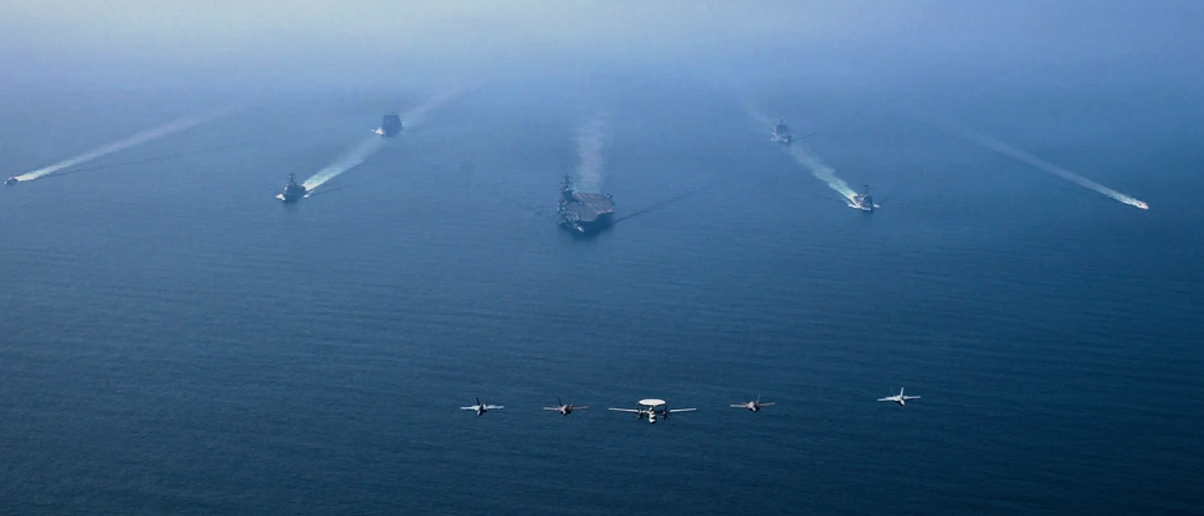
Image not from story. (U.S. Navy Photo)
Things are continuing to heat up in the Taiwan Strait as naval confrontations become more frequent and aggressive, though the first shot has not yet been fired.
China dispatched naval forces to shadow an American warship near a disputed South China Sea shoal Tuesday as Taiwan confronted a Chinese Coast Guard vessel accused of entering restricted waters with its tracking system disabled, according to the Chinese military and Taiwan Coast Guard. The incidents underscore the growing risk of military confrontations in the region, where Chinese forces are increasingly challenging American and allied vessels.
The USS Charleston, an Independence-class littoral combat ship, entered waters near Sabina Shoal in the disputed Spratly Islands early Tuesday, prompting Chinese naval forces to track and monitor the vessel, according to the PLA Southern Theater Command Navy.
“Taiwan has been getting its act together on defense at last, fielding capabilities designed to deny an invasion fleet (or a blockade fleet) access to the island across the Taiwan Strait,” James R. Holmes, the J. C. Wylie Chair of Maritime Strategy at the Naval War College, told the Daily Caller News Foundation. “No access, no Chinese victory, and Taiwan stands. Beijing has been so domineering that it has united the countries along the first island chain against it, including ourselves since we are a resident power in the Western Pacific.”
“Beijing has been sustaining a significant naval presence in the Philippine Sea, including seabed survey ships in recent months and, notably, coast guard cutters,” Brent Sadler, a senior research fellow for naval warfare and advanced technology at the Heritage Foundation, told the DCNF. “China’s military maritime activity around Taiwan also provides ships and their crews with real-world operational experience in waters where they could be directed to operate during a future crisis or conflict. These activities, however, should be viewed in context. They are evolutionary steps in the PLA’s effort to develop the capabilities and operational proficiency Xi Jinping expects of the PLA by his 2027 Centennial Military Building Goal.”
Beijing accused the American vessel of entering Chinese territory without permission and dispatched naval forces to track its movements, according to the Chinese military.
The Chinese Embassy in Washington and the Taipei Economic and Cultural Representative Office in the United States (TECRO), which functions as Taiwan’s de facto embassy in the United States, did not respond to a request for comment.
“Since August 2022, the People’s Liberation Army (PLA) has established a ‘new normal’ of military activity around Taiwan, with multiple warships and military aircraft operating in the vicinity of the island on a daily basis,” Christopher H. Sharman, a professor at the Naval War College, told the DCNF, speaking in his personal capacity and not on behalf of the college or the Department of War. “This campaign of PRC military coercion periodically intensifies through surges in activity under the banner of named exercises. Other surges receive little international media attention. The newest addition to Beijing’s coercive toolkit is the routine deployment of China Coast Guard vessels east of Taiwan. These law enforcement platforms could provide Beijing another means to enforce PRC domestic laws against vessels operating in international waters.”
The latest incidents also follow growing tensions between Beijing and Manila, which have repeatedly clashed over competing territorial claims in the South China Sea.
Washington maintains a mutual defense treaty with the Philippines that extends to armed attacks against Philippine military forces and public vessels, including Coast Guard ships, throughout the South China Sea, according to the State Department.
China’s expansive claims over the South China Sea have also faced international legal challenges. A 2016 arbitration ruling rejected Beijing’s claims to historic rights over maritime areas beyond those permitted by international law, according to the State Department.
“The U.S. side should immediately cease such activities,” Chinese naval spokesperson Yin Gang said, accusing Washington of violating Chinese sovereignty and threatening regional stability, according to the PLA Southern Theater Command Navy.
“The reality is that Beijing is increasing its relative military superiority across the Taiwan Strait but has not yet acquired an advantage so decisive that it knows it can strike and take Taiwan at a reasonable cost, which also requires the PLA being able to deter the U.S. from interfering militarily or defeat U.S. forces that may be dispatched to help Taiwan’s defense,” Steve Tsang, director of the SOAS China Institute at the University of London, told the DCNF. “Until Beijing judges it can achieve this at an acceptable cost, it is unlikely to start a war. Starting one and not being able to finish it on Beijing’s terms is not beneficial to Xi Jinping, so he won’t order it.”
The United States has historically conducted freedom of navigation operations in the South China Sea to challenge excessive maritime claims and defend international navigation rights, according to the State Department.
However, the Pentagon has not publicly identified Tuesday’s voyage as a formal freedom of navigation operation.
Further north, Taiwan reported a separate confrontation after Chinese Coast Guard vessel 3102 approached the Pratas Islands, also known as Dongsha, with its Automatic Identification System (AIS) switched off, according to the Taiwan Coast Guard.
Taiwanese authorities detected the vessel around 5 a.m. and dispatched the patrol ship Taichung to intercept it. The Chinese vessel subsequently entered restricted waters around 8 a.m., prompting Taiwanese personnel to issue repeated warnings, according to the Taiwan Coast Guard.
The confrontation quickly escalated into a war of words over Taiwan’s sovereignty. The Chinese vessel broadcast that the Republic of China, Taiwan’s official name, did not exist, according to the Taiwan Coast Guard.
“It is important to note that Beijing’s ambition to bring Taiwan under the government of the PRC has been a persistent feature, indeed a core national interest of China, for decades,” Allen R. Carlson, an associate professor of government at Cornell University, told the DCNF. “What has changed over time is the capabilities Beijing has to possibly unilaterally bring about such an outcome, especially when it comes to short-range missiles and naval capacity. This is not something that has changed dramatically in just the last year but rather is a long-term development of capabilities.”
Taiwanese personnel responded by declaring their country sovereign and independent, demanding that the Chinese vessel immediately leave Taiwanese waters, according to the Taiwan Coast Guard.
The encounter was ongoing when Taiwan released its statement Tuesday. Taiwanese authorities said they had expelled Chinese Coast Guard vessels from waters surrounding Pratas on 12 occasions involving 15 vessel encounters throughout 2026, according to the Taiwan Coast Guard.
Beijing nevertheless continues asserting jurisdiction over disputed islands and surrounding waters, while Taiwan maintains that its sovereignty is not subject to Chinese authority, according to statements from the Chinese military and Taiwan Coast Guard.
“China is bluffing and, for many reasons, is not ready for war and will not intentionally start one,” Gordon G. Chang, a distinguished senior fellow at the Gatestone Institute and China expert, told the DCNF. “China has never been more trade-dependent in its history and cannot afford to disrupt international commerce; an invasion of Taiwan would be extremely unpopular in China, and as a result the regime is extremely casualty-averse; the Chinese military has been decimated by continuing purges and is in no condition to start major hostilities; China’s generals and admirals are reluctant to fight; and China’s actions are creating a formidable coalition against itself, and soon the Chinese will realize they cannot take on everyone.”
All content created by the Daily Caller News Foundation, an independent and nonpartisan newswire service, is available without charge to any legitimate news publisher that can provide a large audience. All republished articles must include our logo, our reporter’s byline and their DCNF affiliation. For any questions about our guidelines or partnering with us, please contact [email protected].