

Business
Next Front In Fight For Second Amendment Rights Could Be Corporate Boardrooms
joneboi/Wikimedia Commons
Future battles for the Second Amendment may be decided in the offices of bank CEOs as opposed to in Congress or courtrooms.
During a speech to the Second Amendment Foundation’s Gun Rights Policy Conference on Sept. 27, Public Square (a company providing payment processing and financial services to companies that are discriminated against by traditional banks and financial technology firms) general counsel Jim Giudice warned that the fight for gun rights would be more about securing access to financial services as opposed to trying to strike down bans on firearms like Glock pistols and AR-15 rifles. In interviews conducted by the Daily Caller News Foundation, the extent of the issues firearms industry-related companies experienced with debanking became apparent.
“I want people to understand the reason why going through the regulatory state and using these other levers of political and cultural pressure is going to be the vector of choice is because we have been so successful in the courts,” Giudice told the DCNF, noting that a “monumental” legal victory was looming when the Supreme Court decides Viramontes v. Cook County, a Second Amendment challenge to a ban on modern semiautomatic firearms.
“What I think is important but also difficult, when folks read about or learn about Operation Chokepoint-type behavior, they can certainly see on its face, okay, this certainly seems like an abuse of government power and authority,” Giudice added. “But for people that don’t live and breathe every day inside of the financial services industry, it can be difficult to really understand. Well, what does this actually mean in practice and then therefore, what do we actually do to combat it?”
Operation Chokepoint and the later “debanking” of firearms manufacturers, distributors and federal firearms licensees (FFLs), was a campaign to cut lawful gun businesses off from ordinary banking, credit and payment processing after agencies and then banks used “high risk” and “reputational risk” labels instead of changing laws like the Gun Control Act. The regulatory effort took place after Republicans defeated gun-control legislation in Congress in the aftermath of the December 2012 mass shooting at Sandy Hook Elementary School.
While the first Trump administration halted the operation, some financial institutions continued to pressure companies in the firearms industries to adopt certain practices or face the closure of their accounts for years afterwards.
“We continue to advocate for passage of legislation to make Trump policies permanent law, like Fair Access to Banking bill, for example,” National Shooting Sports Foundation Senior Vice President and General Counsel Lawrence Keane told the DCNF, adding, “If the next administration is not favorable towards the industry, I think we fear that we will see backsliding by the big banks, you know, the way things were during, you know, the Biden administration or even earlier to the first Trump administration.”
Republican Kentucky Rep. Andy Barr introduced HR 987, the Fair Access to Banking Act, in the House of Representatives on Feb. 5, 2025. Republican North Dakota Sen. Kevin Cramer introduced companion legislation, S 401, on Feb. 4, 2025. Neither version of the legislation, which prohibits the use of “reputational risk” by financial institutions when making credit decisions, has advanced past the committees they were assigned to.
Keane noted that NSSF had become aware of a company manufacturing firearms sights that was de-banked. The DCNF asked the NSSF for additional details about the case and to contact the company, but was informed the company elected not to go public.
“A firearm industry related business reached out to NSSF to inform them that it had opened accounts with a bank only to see it closed several days later,” a NSSF spokesperson told the DCNF. “NSSF provided guidance to that businesses and they are exploring options at other banks. However, this is indicative of banks not adhering to the published guidance by the U.S. Treasury’s Office of the Comptroller of the Currency, the agency that regulates America’s banking industry.”
Giudice noted that regulatory agencies could be used as a lever against financial service companies that did business with companies in the firearms industry. He noted that Credova, which was founded as a way to provide financial services to the firearms industry that has been discriminated against by traditional banking and financial services companies, was investigated by the Consumer Financial Protection Bureau (CFPB), which was proposed and built up by Democratic Massachusetts Sen. Elizabeth Warren prior to her election to the Senate, during the Biden administration.
“Throughout that entire investigation, one of the things, I mean, this is literally one of the investigating attorneys, like, she said this early in the process, like she doesn’t think you should be allowed to finance firearms. And frankly, we were really kind of taken aback by that because the role of a federal regulator, like you don’t get to make those determinations,” Giudice told the DCNF. Giudice later told the DCNF that after the 2024 election, when Donald Trump Jr. joined the board of Public Square, the CFPB tried to pressure Credova into accepting a settlement.
After President Donald Trump took office, the CFPC sent Credova a letter dated Aug. 19, 2025, which stated the probe was politically motivated and alleged that the office of Democratic New York Attorney General Letitia James exercised “utterly inappropriate influence” during the CFPB’s probe. Warren, who vowed to target the National Rifle Association during her 2020 presidential campaign, and James did not respond to requests for comment from the DCNF.
“We literally would like beg them, like, can you please tell us how we’re not getting this right? Please show us an example that is right, like, literally, like show us what right looks like,” Giudice said. “Like if this isn’t right, like what is? Like we’re literally asking you, the rulemaking authority on the subject, tell us how to do this right. We’re not trying to do it wrong. We’re trying to do it exactly how you’ve said. Please show us what right looks like.”
Keane also noted that NSSF had been pushing for financial industry non-discrimination laws at the state level. In a July 30 release, Republican West Virginia Attorney General J.B. McCuskey announced an investigation into whether three companies had wrongfully denied financial services to Kent Cartridge Company, a shotgun-shell manufacturer in Kearneysville, West Virginia, under that state’s version of the legislation.
First Internet Bank of Indiana, Ramp.com and Bill.com all issued responses confirming they did not and would not deny services to a company in the firearms industry, according to an Aug. 10 release from McCuskey’s office. A spokesperson for McCuskey previously told the DCNF that the matter was considered closed and that there would be no need to file lawsuits under the provisions of the Firearm Industry Nondiscrimination (FIND) Act, which would also require the state to sever any relationships with financial services companies that discriminate against businesses in the firearms industry.
The Highland Park Peace Project in Illinois assembled a database of companies that do business with manufacturers who make so-called “assault weapons,” with the intention of “targeting the companies that do business with them,” including law firms and retail outlets, according to the group’s website. Co-founder Daniel Perlman told the Chicago Tribune in July that he was taking a “commercial” approach in view of potential Supreme Court decisions striking down bans on modern semiautomatic firearms.
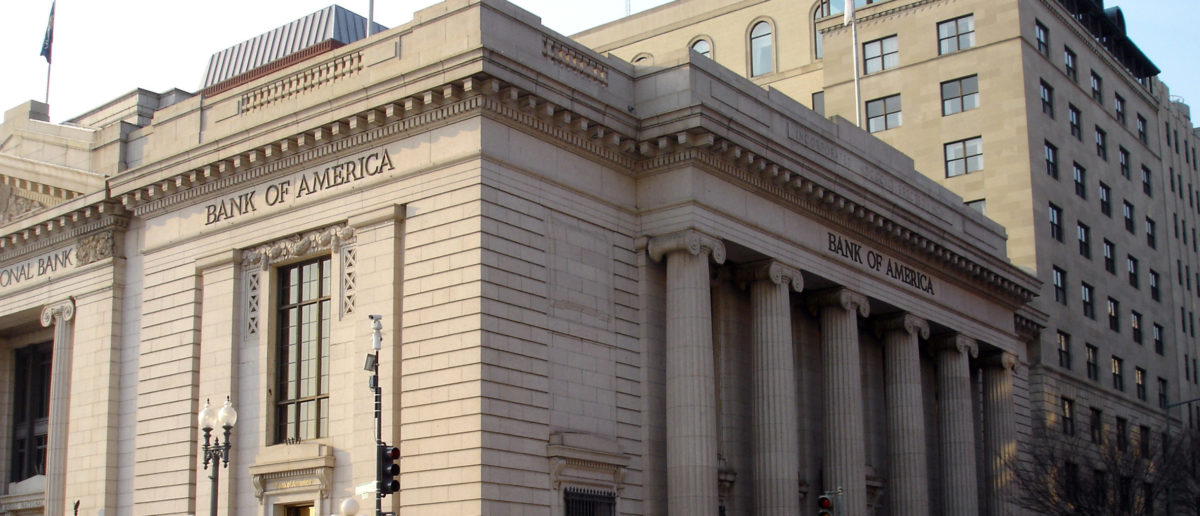
Trump attacked Bank of America CEO Brian Moynihan over the company’s alleged “debanking” of conservatives for their political beliefs during a January 2025 speech at the World Economic Forum. Bank of America came under fire for closing bank accounts of conservatives, including constitutional law professor John Eastman.
JPMorgan Chase closed the account of the National Committee for Religious Freedom, an organization led by former Ambassador Sam Brownback, in 2022, demanding that the group disclose its donors. First lady Melania Trump wrote in her memoirs that she and her son Barron were debanked in 2021 after Trump’s first term, but she did not name the institution that closed her accounts.
All content created by the Daily Caller News Foundation, an independent and nonpartisan newswire service, is available without charge to any legitimate news publisher that can provide a large audience. All republished articles must include our logo, our reporter’s byline and their DCNF affiliation. For any questions about our guidelines or partnering with us, please contact [email protected].