

Foreign Affairs
Longtime US Ally South Korea Bends Knee To The Green Altar
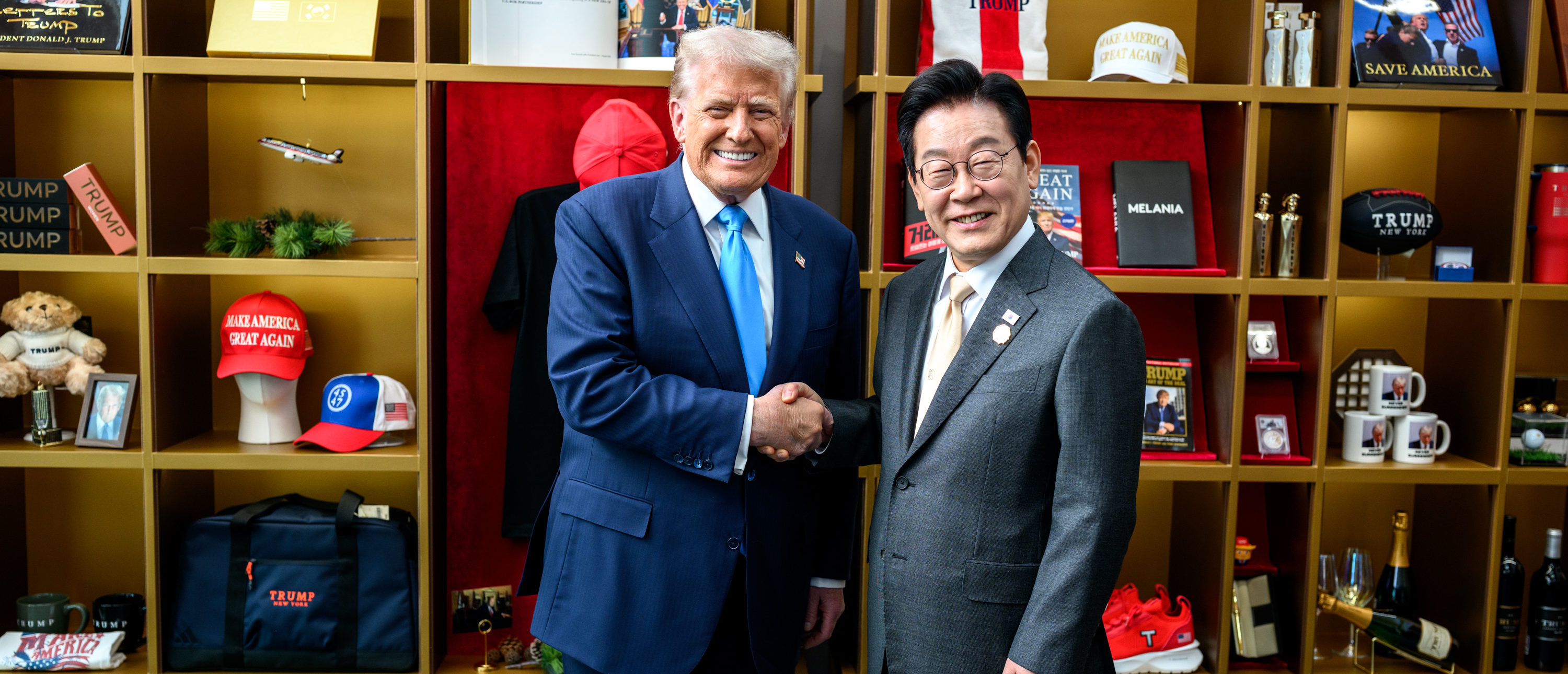
President Donald Trump and President Lee Jae Myung, Official White House Photo by Daniel Torok
Longtime U.S. ally South Korea is putting green energy on a $747 billion pedestal.
The government plans to invest 1,000 trillion won in its Korea-Green Transformation (K-GX) strategy through 2035, alongside another 220 trillion won in private-sector investment, according to Yonhap News Agency.
South Korean President Lee Jae Myung called for South Korea to become a leader in the global green economy, saying the country should move beyond “chasing others” and instead become an “architect” of the green market, Reuters reported.
Seoul plans to expand renewable energy capacity to 100 gigawatts by 2030 and have electric and hydrogen-powered vehicles account for more than 70% of new vehicle sales by 2035. The government is also targeting steel, petrochemicals, refining, cement and semiconductor manufacturing for decarbonization, per the South Korean government’s website.
The strategy echoes Europe’s years-long push to electrify its economy and move away from fossil fuels. European Commission President Ursula von der Leyen doubled down on that strategy in April, calling for Europe to shift electricity generation toward renewables and nuclear power while electrifying the broader economy “as rapidly as possible.”
South Korea plans to support 10 green industries, including electric vehicles, batteries, solar, wind and small modular nuclear reactors, according to the government website. Seoul also wants to mass-produce hydrogen-reduced steel and build domestic supply chains for clean-energy technologies.
The massive green push comes as Lee’s liberal government faces growing criticism in Washington over its treatment of American businesses, while military, economic and diplomatic disagreements have strained the decades-old U.S.-South Korean alliance.
U.S. lawmakers and national security officials have raised concerns that Lee’s government is discriminating against American businesses, including Coupang, Amazon Web Services, Microsoft and Google. A House Judiciary Committee investigation highlighted what it described as South Korea’s “history of discriminatory treatment against American-owned businesses.”
The South Korean Embassy disputed those allegations, previously telling the DCNF that Korean laws are applied without discrimination and that Seoul places the “highest value” on its strategic partnership with the United States.
The friction extends beyond business. South Korean authorities barred former U.S. Ambassador-at-Large Morse Tan from leaving the country amid an investigation into alleged defamation of Lee, while officials also raided the command-and-control center at the U.S. military’s Osan Air Base seeking information related to a domestic investigation.
Disagreements over military exercises, trade and North Korea have also tested relations between Washington and Seoul. The alliance dates back more than seven decades, with tens of thousands of American troops stationed in South Korea.
Despite those tensions, South Korea has pledged hundreds of billions of dollars in American investment. Seoul selected a planned 6.3-gigawatt natural gas plant in Texas as the first project under its $350 billion U.S. investment pledge and is weighing investments in as many as eight large U.S. nuclear reactors and a long-delayed liquefied natural gas project in Alaska.
The K-GX strategy will use sector-specific decarbonization roadmaps and assess projects receiving climate financing based on their expected greenhouse gas reductions, Reuters reported. Seoul says the massive program is intended to turn carbon neutrality into a new source of economic growth while addressing climate risks and energy security.
All content created by the Daily Caller News Foundation, an independent and nonpartisan newswire service, is available without charge to any legitimate news publisher that can provide a large audience. All republished articles must include our logo, our reporter’s byline and their DCNF affiliation. For any questions about our guidelines or partnering with us, please contact [email protected].