

Foreign Affairs
A Second ‘Scramble For Africa’ Is Unfolding As Wars Tear Across The Continent
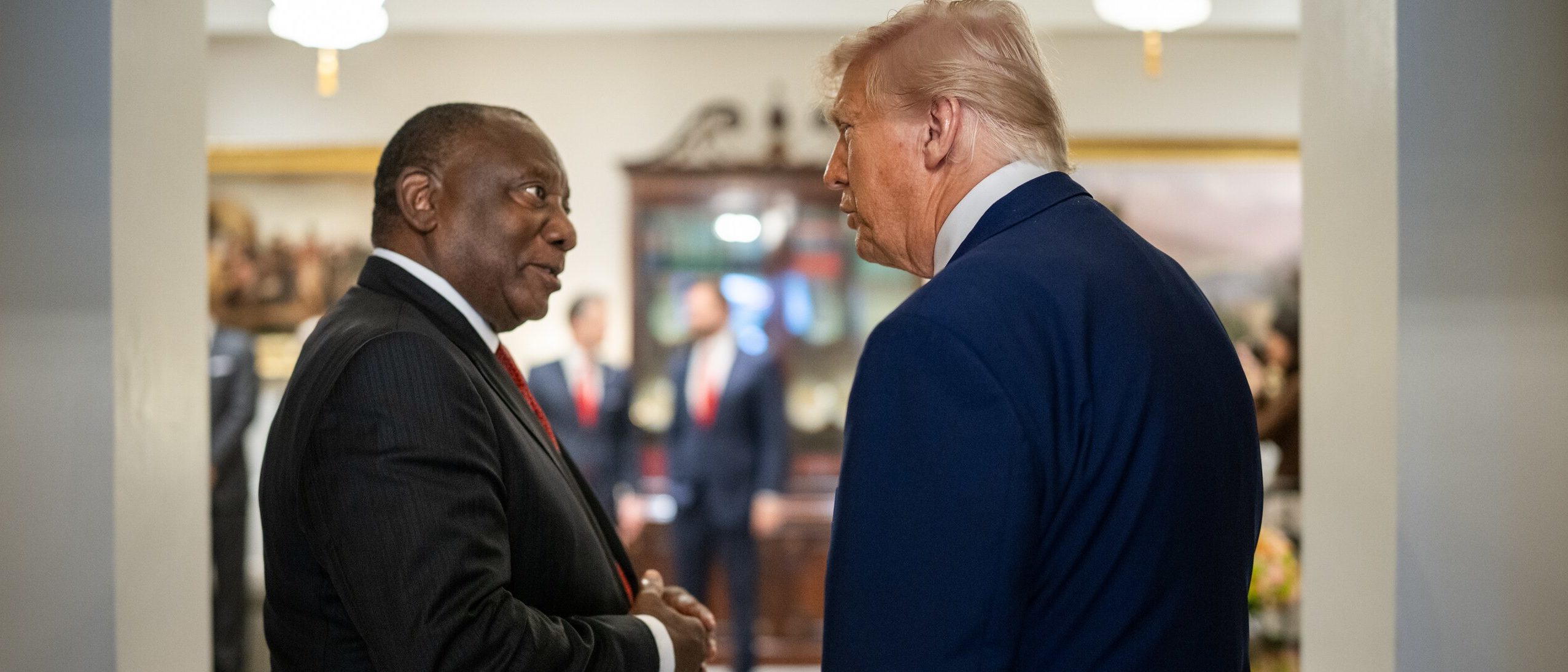
President Donald Trump greets President of South Africa Cyril Ramaphosa, Wednesday, May 21, 2025, at the West Wing of the White House. (Official White House Photo by Daniel Torok/Wikimedia Foundation)
Africa is being pulled deeper into a web of wars and insurgencies just as the United States and China intensify a high-stakes competition for the continent’s minerals, infrastructure and political influence.
Renewed fighting in Ethiopia and South Sudan is adding to existing wars in Sudan, the Democratic Republic of the Congo, Somalia and the Sahel. At the same time, Washington and Beijing are backing competing infrastructure and mineral supply-chain projects across the continent, part of a broader competition that researchers have likened to another “scramble for Africa.”
“It is probably net neutral regarding great power competition [between China and the U.S.],” Joshua Meservey, a senior fellow at the Hudson Institute specializing in African geopolitics and counterterrorism, told the Daily Caller News Foundation. “Beijing also requires security and stability for its commercial-first approach, though it has become adept at avoiding expending much diplomatic or military energy in dealing with the conflicts as it leaves that largely to others. The U.S. has fewer infrastructure projects and less trade with Africa so it has fewer vulnerabilities in that regard, but it has security cooperation arrangements all across the continent as well as other equities that are threatened by instability.”
The United States is trying to diversify critical-mineral transportation and supply chains through projects such as the Lobito Corridor, a U.S.-backed rail and infrastructure network designed to move copper and cobalt from Zambia and the Democratic Republic of the Congo through Angola to the Atlantic Ocean, according to the U.S. International Development Finance Corporation (DFC).
The DFC is providing a $553 million loan to rehabilitate more than 800 miles of railway for the project. It explicitly describes the investment as a way to diversify away from Chinese-controlled economic corridors and says the project could increase rail capacity from 400,000 metric tons annually to 4.6 million.
The United States is scrambling to build alternative mineral supply chains while China already controls many of the world’s critical-material chokepoints. China produced 99% of the world’s gallium, 82% of its natural graphite and tungsten, and 71% of its rare earths in 2024, according to the U.S. Geological Survey.
Beijing has increasingly used that dominance as leverage, restricting or banning exports of critical minerals including gallium, germanium, graphite, antimony, tungsten and multiple rare earths. The U.S. remained dependent on China for 67% of its consumption of rare-earth compounds and metals, 53% of antimony and 43% of graphite in the latest detailed USGS analysis.
China is advancing a major corridor in the opposite direction through the Tanzania-Zambia Railway, or TAZARA, connecting Zambia’s mineral-producing regions to Tanzania and the Indian Ocean.
TAZARA describes its Chinese-backed revitalization as a $1.4 billion capital investment program, the largest rehabilitation effort in the railway’s history, undertaken with China Civil Engineering Construction Corporation, according to the Tanzania-Zambia Railway Authority.
Beijing already possesses an enormous commercial footprint across the continent, with China-Africa trade reaching 2.49 trillion yuan in 2025 and increasing another 23.7% during the first quarter of 2026, according to China’s State Council Information Office.
Chinese President Xi Jinping pledged 360 billion yuan in financial support for Africa between 2025 and 2027, including credit, assistance and investment by Chinese companies. Beijing additionally pledged 1 billion yuan in military assistance and training for thousands of African military and law enforcement personnel, according to China’s Ministry of Foreign Affairs.
The competition extends beyond mines and railroads. Djibouti hosts Camp Lemonnier, the United States’ principal enduring military installation on the continent, while China established its first overseas military base nearby, according to the Department of War.
China’s position in Africa was built in large part through President Xi Jinping’s Belt and Road Initiative, launched in 2013 to expand Chinese-backed infrastructure and trade links abroad. Beijing has used the program to finance and build railways, roads, ports and other infrastructure across Africa, and its current China-Africa plan calls for further Belt and Road investment in transportation, logistics and ports, according to China’s Ministry of Foreign Affairs.
The comparison to a second “Scramble for Africa” is imperfect, but the competition is real. African governments are sovereign, yet many still rely heavily on outside powers for infrastructure, financing, security assistance and humanitarian aid, giving Washington and Beijing significant leverage.
That competition is now colliding with a deteriorating security environment. Wars, insurgencies and political instability increasingly threaten the very mines, railways, ports and trade corridors both countries are spending heavily to secure.
The humanitarian system is also operating with fewer resources. UNHCR entered 2026 after receiving 24% less funding in 2025 than in 2024, leaving the agency with only 37% of its total assessed needs funded last year, according to the agency’s 2025 Global Report.
“The various African conflicts each pose a unique problem for the U.S.,” Meservey told the DCNF. “The current fighting in Ethiopia may pose the greatest risk as it could easily fuse with the Sudan war, accelerate tension among U.S. partners who are on opposite sides of the conflicts, threaten the Red Sea shipping lane, and make it extremely difficult for the U.S. to pursue commercial arrangements in the region given how all-encompassing the conflict could be in East Africa.”
Ethiopia is facing perhaps the most immediate danger of returning to a major civil war. The African Union warned that fighting in northern Ethiopia was spreading beyond Tigray, a region along the country’s northern border, into neighboring Afar and other nearby areas, while new political and military alliances were forming, according to the African Union.
Tigrayan forces also seized several airports in Tigray, a northern region of Ethiopia, as fighting intensified across the area, according to the United Nations. U.N. Secretary-General António Guterres warned that further escalation could produce a broader and more devastating conflict.
The renewed fighting threatens the Pretoria Agreement, the 2022 African Union-brokered settlement that ended a two-year war between Ethiopia’s federal government and forces from Tigray. The agreement remains the “cornerstone” of peace and reconciliation in Ethiopia, the African Union said.
South Sudan is also facing renewed political and military instability after years of an increasingly fragile post-civil-war settlement. The United Nations said earlier this year that the security situation was deteriorating amid increasing ceasefire violations, direct fighting between forces aligned with the main parties to the peace agreement and the detention and prosecution of opposition leader Riek Machar, according to UNMISS.
“In Sudan, we continue to press for a humanitarian truce and sustained aid access so that lifesaving humanitarian assistance provided by the U.S. and other donors can reach those in need,” a State Department spokesperson told the DCNF. “We are also working with our partners to encourage the parties to agree to a permanent ceasefire and civilian transition, and to also ensure external military or financial support to the warring parties is cut off.”
President Salva Kiir formally dissolved the Transitional Government of National Unity on Sept. 22 to move the country toward elections scheduled for December, according to South Sudan’s state-run South Sudan Broadcasting Corporation. Kiir subsequently installed a caretaker government and opened an inter-party dialogue over the electoral process, according to the Office of the President of South Sudan.
Sudan, meanwhile, has already been consumed by war for more than three years as the Sudanese Armed Forces battle the paramilitary Rapid Support Forces.
Continued fighting and worsening insecurity in Darfur, Kordofan and other parts of Sudan pushed more than 55,000 Sudanese refugees into eastern Chad during 2026 as of Sept. 25, with more than 400 people per day crossing at Adré and Tiné during the preceding week, according to UNHCR. The agency also warned that fighting, airstrikes and drone attacks in Kordofan and Blue Nile were driving further displacement.
The United States has already spent heavily responding to the catastrophe. Washington provided $880.3 million in humanitarian assistance to Sudan in 2024, accounting for approximately 43% of humanitarian assistance from all donors that year, according to the USAID Office of Inspector General.
The watchdog found that the dangerous operating environment limited direct oversight and increased risks including theft and diversion. USAID did not continuously complete some planned monitoring before responsibility for active Sudan humanitarian awards was transferred to the State Department, according to the USAID Office of Inspector General.
Farther west, al-Qaeda-linked Jama’at Nusrat al-Islam wal-Muslimin, commonly known as JNIM, continues to put intense pressure on Mali and the wider Sahel.
The Malian military confirmed that armed militants attacked its position in the Dioura sector of the Mopti region on Sept. 10 and said its forces launched a response, according to the Malian Armed Forces. The military subsequently said it had launched air and ground operations against the attackers, but its publicly available statement did not provide a Malian military casualty figure.
The wider terrorist threat has increasingly spread beyond Mali. The U.N. Security Council’s Counter-Terrorism Committee says JNIM and Islamic State-linked militants have expanded across large areas of Burkina Faso, Mali and Niger, according to the United Nations.
Somalia remains locked in its long-running fight against al-Shabaab as the international security structure supporting Mogadishu undergoes another transition.
The African Union Support and Stabilization Mission in Somalia remains essential to the country’s security and depends on continued logistical backing from the United Nations Support Office in Somalia and sustainable financing, U.N. Under-Secretary-General Rosemary DiCarlo said Sept. 24, according to the U.N. Department of Political and Peacebuilding Affairs. The U.N. is simultaneously preparing for an orderly drawdown of UNSOS while its political mission, UNTMIS, is scheduled to close Oct. 31.
The overlapping wars are unfolding as Africa becomes increasingly important in the economic competition between Washington and Beijing.
Nowhere is that clearer than in the Democratic Republic of the Congo. The DRC produced an estimated 75% of the world’s cobalt and 13% of mined copper in 2024 while holding approximately 55% of estimated global cobalt reserves, according to the U.S. Geological Survey.
The Eastern Congo has simultaneously been destabilized by the M23 rebellion, which seized Goma and Bukavu during a major 2025 offensive. M23 is a predominantly Tutsi-led rebel group that says it is defending Congolese Tutsi communities and enforcing unfulfilled provisions of a 2009 peace agreement, while the United Nations has documented extensive support for the group from Rwanda.
Hutu, Tutsi and Twa communities have lived across Rwanda and eastern Congo for generations, but ethnic divisions hardened during the colonial era and exploded during the 1994 Rwandan genocide, according to the United Nations. The aftermath pushed armed Hutu groups into eastern Congo, where tensions with Tutsi communities have helped fuel decades of violence.
A U.N. Group of Experts documented direct Rwanda Defence Force involvement alongside M23, including RDF participation in the capture of Goma and continued activity in M23-controlled territory, according to the United Nations. The report said Rwandan forces exercised de facto direction and control over M23 military operations, while Rwanda has disputed international allegations about the nature of its involvement.
The result is a continent where the United States and China are competing for resources, transportation routes and political influence at precisely the moment several governments are struggling to control territory, peace settlements are under severe strain and humanitarian systems are struggling to keep pace.
“They significantly complicate the situation for the U.S. That’s especially true given that the current administration prioritizes commercial engagement in Africa which is highly dependent on stability,” Meservey told the DCNF. “Furthermore, intense and protracted conflicts of the type that are spreading in Africa open opportunities for American competitors such as Russia, Iran, and terrorist organizations.”
All content created by the Daily Caller News Foundation, an independent and nonpartisan newswire service, is available without charge to any legitimate news publisher that can provide a large audience. All republished articles must include our logo, our reporter’s byline and their DCNF affiliation. For any questions about our guidelines or partnering with us, please contact [email protected].