

National Defense
Trump Eyes Iranian Target That Would Probably Take A Nuke To Totally Destroy
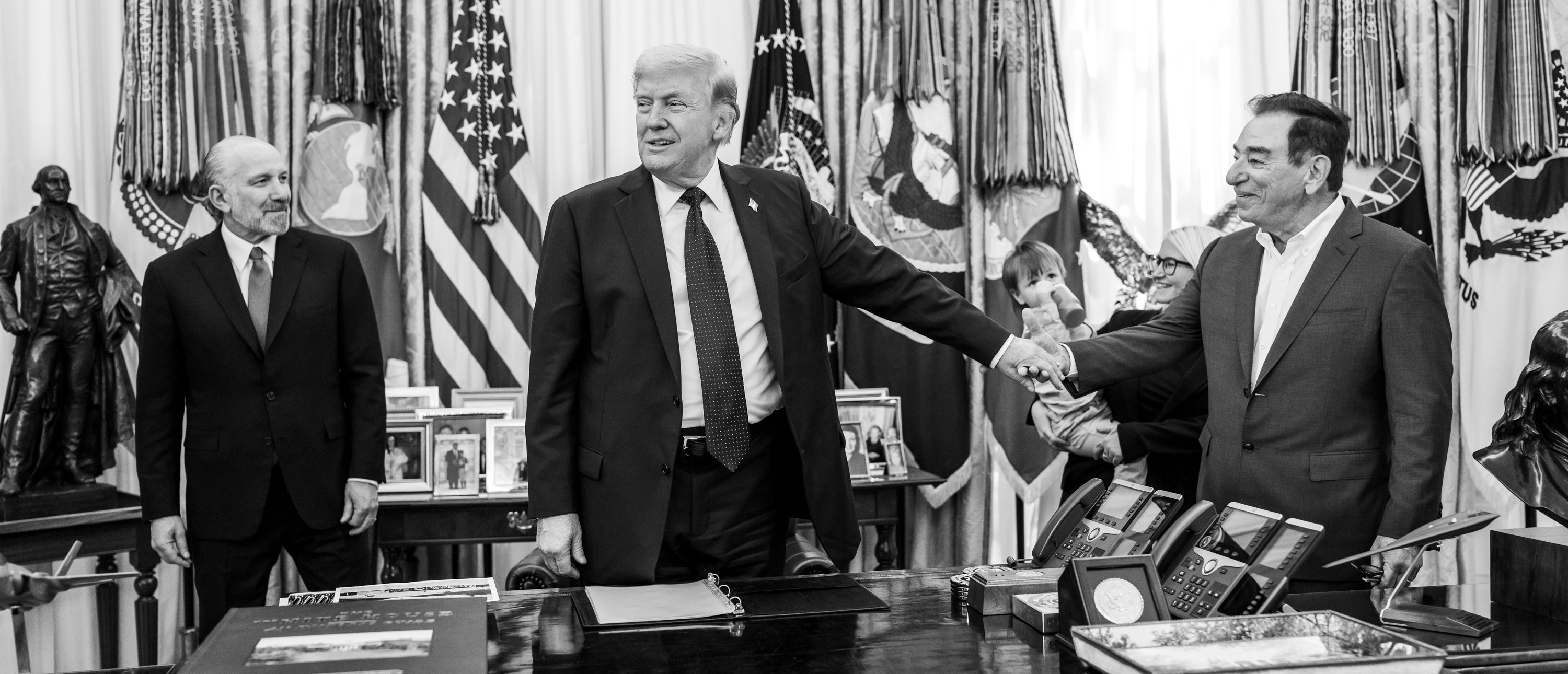
Official White House Photo by Molly Riley
President Donald Trump has stated that he would never use a nuclear weapon in Iran, yet he has repeatedly threatened to strike a facility that may be impervious to conventional weapons.
Most recently, Trump threatened to attack Pickaxe Mountain in Iran during the GOP midterm convention on Wednesday. Pickaxe Mountain, one of the sites that houses Iran’s nuclear materials, is so deep that not even the most powerful conventional weapons in the U.S. military can penetrate its thick granite walls, multiple experts told the Daily Caller News Foundation.
“We noticed there’s a little activity at Pickaxe [Mountain]. I would advise Iran not to get cute,” Trump said during the convention, according to a video posted on X. “Because we will have to hit them very hard, we have no choice.”
“My general sense is that conventional ordnance would be unlikely to decisively destroy such a deeply buried facility,” Philipp C. Bleek, fellow at the James Martin Center for Nonproliferation Studies and the Center on Terrorism, Extremism, and Counterterrorism, told the DCNF. “However, no matter how much a facility is buried, it must come to the surface via access tunnels, air shafts, etc. So even the most deeply buried facility can be entombed if intelligence and precision allow those locations to be effectively attacked.”
The GBU-57 Massive Ordnance Penetrator, commonly known as the MOP, is the most powerful conventional bunker-busting weapon in the U.S. arsenal and is designed to destroy deeply buried, hardened facilities, according to the U.S. Air Force.
The GBU-57 Massive Ordnance Penetrator can reach targets as far as 200 feet underground before detonating, according to the U.S. Air Force.
Pickaxe Mountain’s underground complex is estimated to sit at least 100 meters, or roughly 328 feet, beneath the mountain, according to the Institute for Science and International Security, which says the precise layout and depth of the facility remain uncertain.
“My impression is that the MOP is unlikely to penetrate into the tunnels under Pickaxe Mountain, unless there are vulnerable entry points like ventilation shafts, which the U.S. used to deliver the MOP into Fordow in June 2025. Of course, the MOP could be used to seal entrances and exits of the tunnels,” Gary Samore, a politics professor at the Crown Center for Middle East Studies at Brandeis University, told the DCNF. “I believe that an earth-penetrating nuclear warhead could destroy the underground site at Pickaxe Mountain, but … it is extremely unlikely that Trump will order a nuclear strike on Iran.”
Trump previously threatened to strike Pickaxe Mountain during a July 28 interview on Fox News.
“I know exactly what’s going on at Pickaxe, it’s not a big problem,” Trump said during the interview. “We took out their nuclear sites, and we’ll have to take out Pickaxe if we don’t make a deal. If we don’t make a deal, we’ll take it out very easily.”
“Due to operations security, we do not discuss future or hypothetical movements,” a Department of War official told the DCNF. “The U.S. military continues to provide the President options, and all options remain on the table.”
U.S. Central Command and U.S. Strategic Command referred to the White House, which referred to Trump’s previous comments on the matter.
The renewed focus on Pickaxe Mountain marks a notable shift from the administration’s assessment following the June 2025 strikes on Iran. The White House declared at the time that Iran’s nuclear facilities had been “obliterated,” while Defense Secretary Pete Hegseth said the bombing campaign had “obliterated Iran’s ability to create nuclear weapons,” according to the White House.
Director of National Intelligence Tulsi Gabbard said in March that Operation Midnight Hammer had “obliterated” Iran’s nuclear enrichment program and that Tehran had made no effort to rebuild its enrichment capability since the strikes, according to Office of the Director of National Intelligence archives.
Samore was not alone in his assessment that conventional weapons would not be able to breach the natural fortress that is Pickaxe Mountain.
Even if the U.S. military was able to destroy Pickaxe Mountain, the Iranian regime could always start over and build a new nuclear program.
“The question is what next? Iran would still retain the knowledge of how to build nuclear weapons and could, over time, build a better-protected facility,” John Erath, senior policy director at the Center for Arms Control and Non-Proliferation, told the DCNF. “We could eventually probably hit that as well, but at some point they will likely bury one deep enough/conceal it well enough that we wouldn’t get it. The point is that we need diplomacy, not just force, to get to a real solution.”
Bleek pointed out that while the U.S. would be unlikely to fully destroy the facility, it could adopt the Israeli strategy of “trimming the hedges” or “mowing the lawn” by continuously monitoring the facility and bombing any attempt to repair the entrances or ventilation shafts.
“We should be using the space created by the destruction at Iranian nuclear facilities to reach a better nuclear deal than 2015, but that does not seem to be happening,” Erath told the DCNF. “The U.S. government seems to be going down a path … [that leads to] Iran getting nuclear weapons sooner or later. There may still be a way to prevent such an outcome, but that requires painstaking, detailed diplomacy, not just force.”
The June 17 Islamabad Memorandum of Understanding largely deferred the nuclear issue, maintaining the status quo while Washington and Tehran negotiated a final agreement. Although Iran reiterated that it would not develop nuclear weapons and agreed to address its enriched uranium stockpile under IAEA supervision, restrictions on future enrichment and other elements of its nuclear program were left unresolved.
The war remains ongoing more than six months after the U.S. and Israel launched strikes on Iran on Feb. 28, with Washington maintaining a naval blockade and intermittent military operations as Tehran continues retaliatory attacks on regional shipping and U.S.-aligned interests.
Trump said Wednesday that he expected the war with Iran to end “immediately after the election,” arguing Tehran could not “hold out any longer,” according to a White House video.
“This would break a more-than-eighty-year tradition of not using nuclear weapons that has come to be seen as a taboo against nuclear use,” Jeff Knopf, professor and program chair of the Nonproliferation and Terrorism Studies program at the Middlebury Institute of International Studies, told the DCNF. “Once the taboo is broken, it would set a precedent that would make it easier for other countries to carry out nuclear attacks — with the most likely case being Russia considering a nuclear strike against Ukraine.”
The U.S. military is already doing this, according to a Truth Social post from Trump on Aug. 25.
“Through Space Force, we are watching every square inch of the Strait, as we are, also, with Pickaxe Mountain and the already destroyed three other Nuclear sites,” Trump wrote in the Truth Social post.
Despite all of this, Trump has explicitly stated that he would not use a nuclear weapon in Iran.
“There’s no reason for it,” Trump said to reporters in the Oval Office on Aug. 31. “What a stupid question that is, actually. Here they are, they’re totally defeated militarily. So now I defeat them, and now I should use a nuclear weapon on top of them? What a stupid question.”
Trump cut the press conference short after being asked whether or not he would consider using nuclear weapons in Iran. Staffers immediately proceeded to usher the media out of the Oval Office after Trump gave his answer.
“Such an attack would also further isolate the United States and increase sympathy for Iran,” Knopf told the DCNF. “The United States would be accused of hypocrisy, because the Trump administration has said the main objective of the war is to prevent Iran from getting a nuclear weapon, but then the United States would have turned around and used exactly the kind of weapon it says other countries should not be allowed to have. “
“Breaking the nuclear non-use norm that has persisted since 1945 would be a world-changing event,” Bleek told the DCNF. “At worst, it might usher in an era where others perceived lesser restraints on nuclear weapons use. But it might also have the opposite effect, galvanizing the world to bolster the norm. On balance, I am more pessimistic than optimistic about how this might play out.”
All content created by the Daily Caller News Foundation, an independent and nonpartisan newswire service, is available without charge to any legitimate news publisher that can provide a large audience. All republished articles must include our logo, our reporter’s byline and their DCNF affiliation. For any questions about our guidelines or partnering with us, please contact [email protected].