

Foreign Affairs
Trump-Kim Talks Could Return As South Korean Intelligence Reportedly Spots Signs Of Dialogue
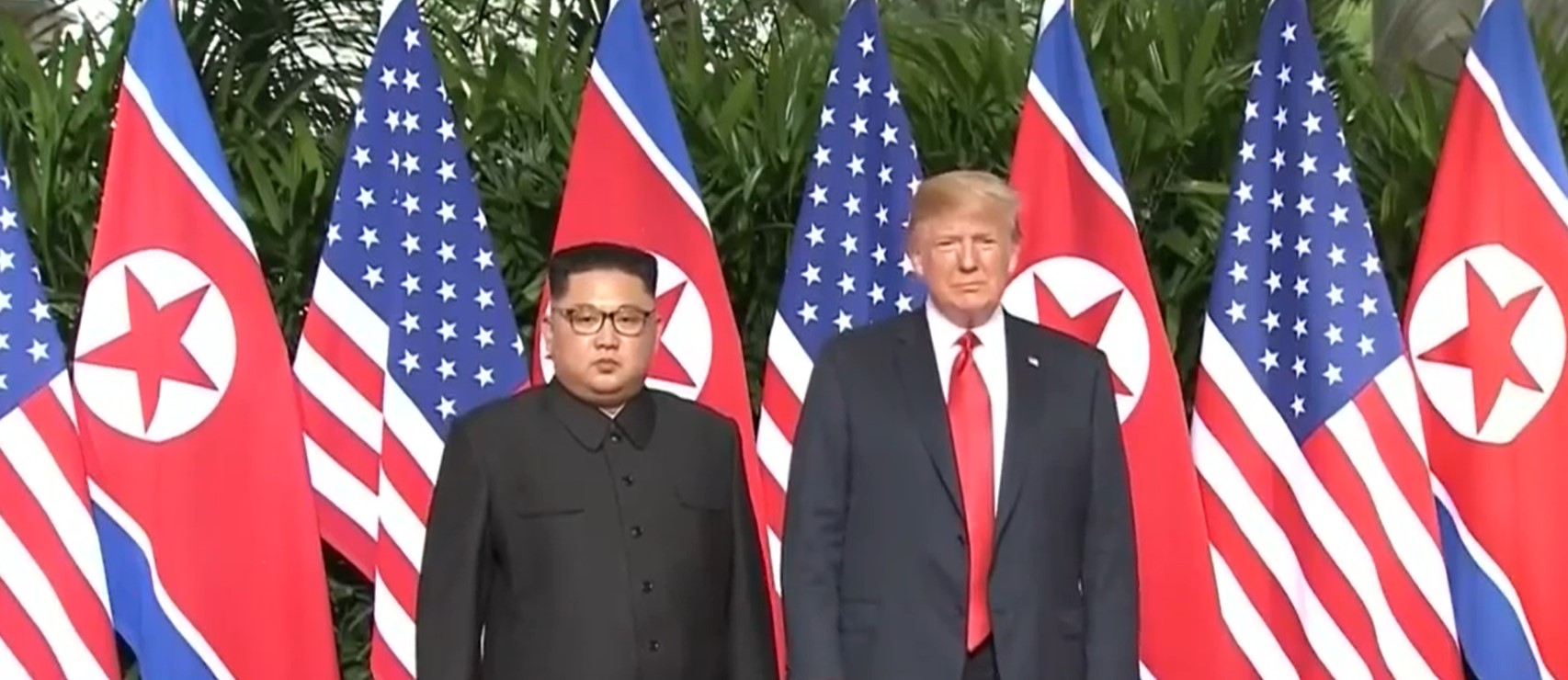
Screen Capture/CSPAN
South Korean intelligence officials believe the U.S. and North Korea are showing signs of moving toward renewed dialogue, raising the possibility of another meeting between President Donald Trump and North Korean leader Kim Jong Un.
South Korea’s National Intelligence Service (NIS) told South Korean lawmakers Tuesday that a U.S.-North Korea summit should be considered possible “at any time,” although the agency has not confirmed concrete talks between Washington and Pyongyang, Yonhap News Agency reported, citing Democratic Party Rep. Youn Kun-young and People Power Party Rep. Yoo Yeong-ha. The assessment arrives after Trump publicly pushed to revive his personal diplomacy with Kim while scaling back U.S. military exercises with South Korea.
“Several indicators make clear that negotiations about a potential meeting are underway,” Alexis Dudden, a professor of history specializing in Korea and Japan at the University of Connecticut, told the Daily Caller News Foundation. “The director of the Pentagon’s Defense POW/ MIA Accounting Agency told reporters the White House reached out about next steps in the event of a summit to help recover the remains of the estimated 5300 US servicemen believed still to be in North Korea since the armistice was reached in 1953. This is exactly what happened in the lead up to the 2018 Trump-Kim meeting in Singapore.”
The South Korean Embassy in Washington, the Pentagon and the White House did not respond to a request for comment.
The State Department told the DCNF that Washington remains committed to North Korea’s complete denuclearization and is open to talks with Pyongyang without preconditions.
“No concrete facts of dialogue between North Korea and the U.S. have been confirmed, but there are signs of dialogue,” South Korea’s NIS said during a closed-door briefing to South Korea’s National Assembly intelligence committee, according to Yonhap News Agency.
Trump has said he wants to meet Kim again and indicated that another meeting could happen later this year, Reuters reported. Trump and Kim met three times during the president’s first term, including summits in Singapore and Hanoi and a 2019 meeting at the Demilitarized Zone, according to Reuters.
“To President Trump, North Korea is still unfinished business,” Greg Scarlatoiu, president and CEO of the Committee for Human Rights in North Korea, told the DCNF. “As recent signals from Washington indicate, he appears willing to re-engage with North Korea, possibly through another summit meeting with Kim Jong-un, prior to the end of his second term. Based on official statements, Pyongyang doesn’t appear as eager to engage, and it is hard to think of possible economic incentives.”
This raises the question: what does Kim want from Trump? Scarlatoiu speculated this could amount to a total disconnection between the U.S. and South Korea.
“Ultimately, Kim Jong-un wants the ‘denuclearization of the entire Korean Peninsula.’ There are no nuclear weapons in South Korea. U.S. tactical nuclear weapons were withdrawn from South Korea in 1991-1992,” Scarlatoiu told the DCNF. “South Korea is under the protection of the alliance with the United States and the U.S. nuclear umbrella. U.S. nuclear capabilities are mobile. What Kim Jong-un really means by ‘denuclearization of the entire Korean peninsula’ is the termination of the U.S.-Korea alliance, the withdrawal of the 28,500 strong U.S. Forces Korea (USFK), and the removal of South Korea from the protection of the alliance and the U.S. nuclear umbrella.”
Trump has increasingly leaned on his personal relationship with Kim while attempting to reopen the diplomatic channel. In response to questions on whether he’d been exchanging written correspondence with Kim, Trump said the two “get along” well, according to a report published by the American Presidency Project.
“Kim Jong Un is seeking what Kim Jong Un always seeks: legitimacy for his dynastic regime,” Dudden told the DCNF. “The 2018 handshake in Singapore in essence declared Kim’s North Korea a legitimate state — which many still wish it were not. Further engagement with the United States potentially opens the way to access global capital, essential to the Kim family’s survival. Obviously, the Trump administration is aware of this and must be wary of being played, yet I firmly believe it is always better to be in open dialogue with an adversary.”
Trump also ordered the Pentagon in August to substantially reduce the annual Ulchi Freedom Shield exercise with South Korea, arguing that large-scale exercises sent an unnecessarily hostile signal to Pyongyang given his relationship with Kim, according to Trump’s Aug. 16 Truth Social post.
The allies subsequently shortened Ulchi Freedom Shield from 11 days to five and reduced associated live-training events, with some events canceled or converted to simulations.
The Pentagon maintained that the changes would preserve the allies’ essential readiness and would not undermine the exercise’s training objectives, Yonhap News Agency reported, citing a Defense Department statement.
“Scaling back the exercises does not diminish America’s preparedness — troops can always practice in Okinawa or Guam — and at the same time such a gesture by the United States to minimize the appearance of waging active war against North Korea demonstrates a willingness to engage through dialogue and not bullets,” Dudden told the DCNF.
South Korean President Lee Jae Myung publicly backed Trump’s decision, saying he respected the U.S. president’s effort to create conditions for renewed dialogue with Pyongyang by reducing the exercises, according to Yonhap News Agency.
Pyongyang, however, has continued to publicly reject Washington’s approach despite the reduction in exercises. North Korea accused the United States on Monday of maintaining a hostile policy toward the country and vowed to continue strengthening its nuclear arsenal while criticizing Washington’s calls for denuclearization, Reuters reported, citing a North Korean Foreign Ministry statement carried by state media.
North Korea has also criticized the upcoming Freedom Edge exercise involving the U.S., South Korea and Japan, which is scheduled for Sept. 7 through Sept. 11, while Seoul says the drills remain scheduled to proceed, Yonhap News Agency reported, citing South Korea’s Joint Chiefs of Staff.
Washington and Seoul formally reiterated their commitment to the complete denuclearization of North Korea and pledged to work toward implementing the agreement reached during Trump and Kim’s 2018 Singapore summit in a November 2025 joint statement, according to the White House.
The NIS briefing also assessed that Kim’s daughter, Ju Ae, appears to be undergoing a process of being positioned as her father’s eventual successor, citing her increasingly prominent appearances in North Korean state media, Yonhap News Agency reported, citing the South Korean lawmakers.
“North Korea has continued developing nuclear weapons and missiles, strengthened its conventional and asymmetric capabilities, and gained combat experience and military benefits from its relationship with Russia. If the threat is increasing while allied readiness is decreasing, the strategic balance is moving in the wrong direction,” David Maxwell, vice president of the Center for Asia Pacific Strategy, told the DCNF. “Diplomacy and deterrence are not competing policies. Effective diplomacy depends upon credible deterrence. We should negotiate from strength, not manufacture weakness to entice Kim to the table. The test should be reciprocity: What concrete military action has Pyongyang taken that justifies reducing allied readiness?”
All content created by the Daily Caller News Foundation, an independent and nonpartisan newswire service, is available without charge to any legitimate news publisher that can provide a large audience. All republished articles must include our logo, our reporter’s byline and their DCNF affiliation. For any questions about our guidelines or partnering with us, please contact [email protected].