

Commentary: Big Tent Ideas
Kevin Warsh’s Bet: A More Humble Federal Reserve
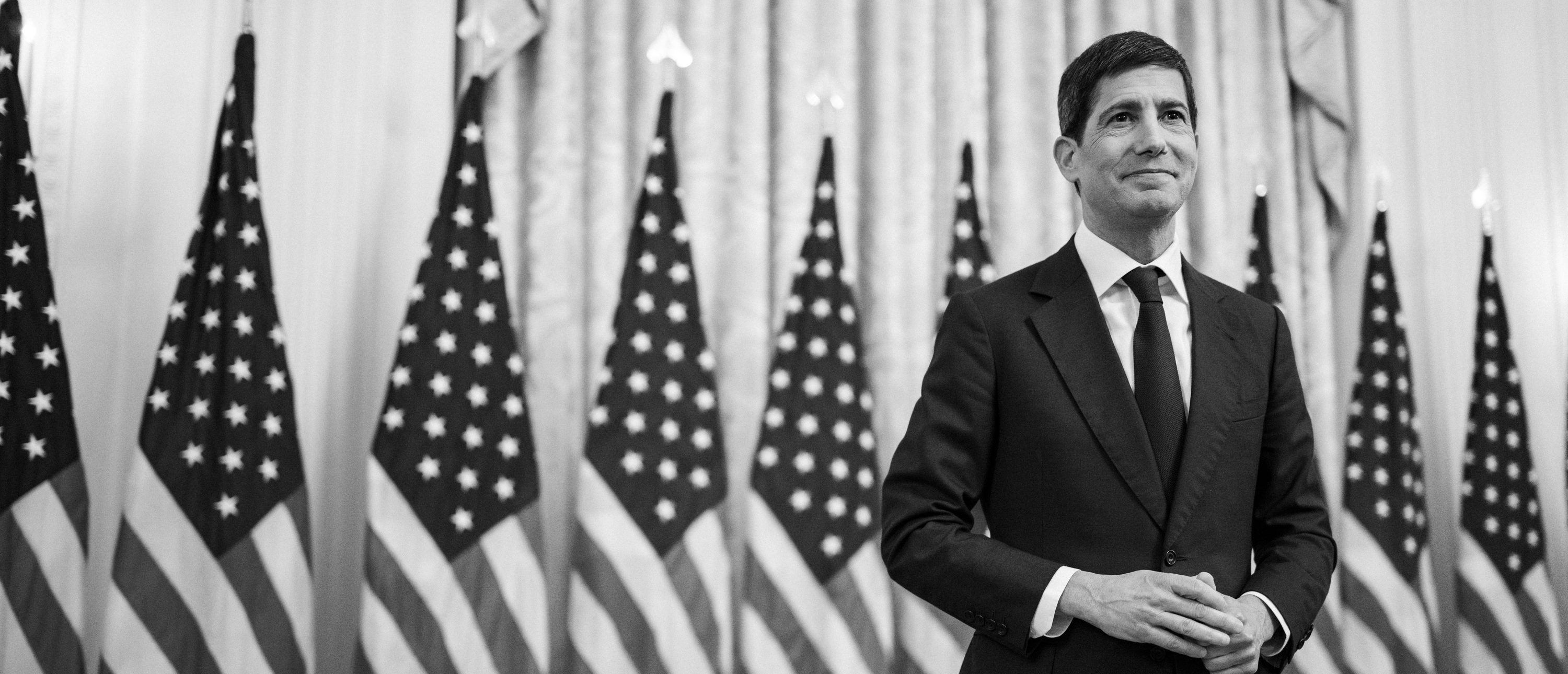
(Official White House Photo by Daniel Torok)
Three months ago, I argued that Kevin Warsh’s confirmation as Fed chair represented something genuine: an intellectual reckoning with what central banks should attempt.
Not a personality. Not a party preference. A doctrine. His first Federal Open Market Committee meeting tested whether that doctrine is real.
I knew Kevin in 2002 when we both worked at the White House. He was skeptical that Washington’s reflexive urge to intervene helped. Six years later, as a member of the Federal Reserve Board during the 2008 financial crisis, he asked harder questions: Was the Fed doing too much? Would it make things worse? His skepticism had deepened.
Which is why his first meeting as chairman mattered less than what he didn’t do.
The Fed shortened its statement and dropped the language signaling an “easing bias” on future rates. That’s not housekeeping. Forward guidance became a market expectation. Investors treat every signal as a promise instead of a guess. Cutting that language is an admission: the Committee knows less about the future than markets want to believe.
Warsh chose honesty over false precision.
He also declined to submit a dot-plot forecast. His predecessors did. It’s an old habit: create an appearance of certainty about where rates will be in eighteen months.
In June 2021, the Committee’s median forecast was 3.0% core PCE by year-end. The actual figure: 4.9%. Warsh looked at that record and decided not to reinforce an illusion of precision.
Here Milton Friedman’s insight becomes essential. Monetary policy operates with long and variable lags between action and effect.
The deeper problem is discretion failure, not mechanical lag. The Fed had warning signs by late 2021: rising wages, surging commodity prices, supply-chain stress. The Committee could have tightened then. Instead, it chose to wait, betting inflation would be “transitory.”
The Fed launched emergency measures in March 2020. By early 2021, M2 money supply had surged nearly 27% year-over-year. Combined with fiscal stimulus, supply constraints, and a recovering economy, the surge contributed to inflationary pressures the Fed initially underestimated. When it finally acted in March 2022, inflation was already at 8 percent.
Warsh warned during the recovery from the 2008 crisis that the Fed was overestimating its ability to fine-tune growth. The post-pandemic inflation surge gave new force to that warning.
Warsh’s third decision at that first meeting: task forces to examine how the Fed should conduct monetary policy. An institutional commitment to building rules and structures before the next crisis hits. That’s restraint — constraining discretion not through exhortation but through design.
Weeks later, Warsh appeared before Congress and made the doctrine explicit. “Humility about what we know—and the courage to revisit our prior views—are also hallmarks of a great institution like ours,” he told lawmakers, outlining five task forces on communications, balance sheet, data, productivity, and inflation frameworks. That’s institutional rebuilding, not window dressing.
Traders have grown accustomed to a Federal Reserve that cushions their losses, and they would prefer to keep it. Less guidance means potentially more volatility — traders weighing actual risk instead of betting on central-bank puts.
But their volatility is not the instability that matters. The instability that matters is the slow erosion when prices stop working. Prices are signals. When money loses its meaning, the signals turn to noise—and everyone, not just Wall Street, makes worse decisions because of it. It falls hardest on the saver, the renter, the family on a fixed income.
Warsh is challenging a broader evolution in central banking: the belief that sophisticated models, communication tools, and balance-sheet policies could allow policymakers to fine-tune outcomes. Balance sheets ballooned from $900 billion to $9 trillion. Asset prices treated as policy targets. Deficit spending subsidized by monetary accommodation.
Warsh appears to be betting the Fed can operate under constraint: that rules, not discretion, produce better outcomes. His ambition is to move the Fed from confident engineer of outcomes to honest steward of constraints.
The strongest criticism of Warsh’s approach is that humility can become paralysis. The Fed’s greatest successes have often come when it acted aggressively under uncertainty — from the 1980s disinflation to the 2008 crisis. The question is not whether discretion is ever needed, but whether an institution can use it without becoming dependent on it.
The answer will come not in calm periods, but in the next moment of genuine uncertainty, when policymakers must decide whether their framework constrains judgment or substitutes for it. One meeting doesn’t change monetary policy. But it can reveal whether an institution understands the limits of its own knowledge.
The challenge now is whether the Fed can turn that humility into a durable framework for making decisions under uncertainty. That is the doctrine Warsh is attempting to put into practice.
James Carter is a Principal and Policy Director with Navigators Global. Previously, he was an Associate Director with the National Economic Council (2001–02) and Deputy Assistant Secretary for Economic Policy at the U.S. Department of the Treasury (2002–06).
The views and opinions expressed in this commentary are those of the author and do not reflect the official position of the Daily Caller News Foundation.
All content created by the Daily Caller News Foundation, an independent and nonpartisan newswire service, is available without charge to any legitimate news publisher that can provide a large audience. All republished articles must include our logo, our reporter’s byline and their DCNF affiliation. For any questions about our guidelines or partnering with us, please contact [email protected].