

National Defense
A Kharg Island Invasion Is A Disaster Waiting To Happen
Flickr/U.S. Department of War
President Donald Trump has restarted the Iran War with a bang.
The U.S. military launched nearly 200 airstrikes against Iran in the last two days, mostly aimed at the southern coastline of the Islamic Republic, hitting targets like Qeshm Island. The Islamic Republic responded by attacking U.S. military targets across the Gulf Arab states.
The longer the war goes on, the greater the chance of escalation, including a possible U.S. Marine landing on the essential Iranian energy production center of Kharg Island. Trump has repeatedly threatened to invade Kharg Island over the course of the more than 100-day war.
Many military experts argue this is an irresponsible move, as the island is well within range of missiles, drones and even conventional artillery, according to U.S. government data on Iranian Weapon systems.
Yet, the president keeps bringing up the prospect of an attack on Kharg Island.
“The United States will be hitting Iran (whose Navy, Air Force, Radar, Anti-Aircraft, and all other forms of Defense, together with most of its offensive capability, are GONE!), VERY HARD TONIGHT,” Trump said in a Truth Social post on Thursday. “At some point in the not too distant future, we will be taking Kharg Island, and other oil infrastructure points, and assume total control of their Oil and Gas Markets.”
Trump had already threatened to “take over” Kharg Island days earlier, Al Jazeera reported on Wednesday.
The Pentagon and the U.S. Marine Corps did not respond to a request for comment.
“If there is no deal soon Mr. President, you are right to put on the table the taking of Kharg Island,” recently deceased Republican South Carolina Sen. Lindsey Graham said in an X post on June 11. “If there is no deal soon, Mr. President, you are right to put on the table the taking of Kharg Island. President Trump’s announcement today that it may be time to take Kharg Island is welcome news and would be the ultimate game changer.”
Trump and the U.S. did have a ceasefire with the Iranians that lasted less than 18 days. That ceasefire broke down last week, when the Iranians attacked civilian ships passing through the contested waters of the Strait of Hormuz.
The Americans do not want Iran to possess any semblance of control over the Strait, which they view as an international waterway. The Iranians want to impose a toll upon ships using the Strait.
Trump has indicated that he is done negotiating with the Iranians. He intends to “finish the job,” a theme that Trump and his supporters have repeated on social media over the last week.
It’s A Trap!
The U.S. military believes it has degraded the Iranian military’s ability to both exercise control over the Strait while setting the conditions for an attempted landing on Kharg Island.
Kharg Island is responsible for 94% of Iran’s oil exports, according to KPLER, and is also home to a crude oil storage facility holding roughly 31 million barrels of oil.
If the Trump administration seizes the island, the thinking is that it can effectively collapse whatever remains of Iran’s economy while conducting sea control from the island to reopen the Strait, Axios reported, citing four sources with knowledge of the matter.
The island is well protected by Iran’s extensive heavy artillery, missile, and drone arsenals. Iran had placed anti-personnel and anti-armor mines around Kharg Island and was moving troops, air defenses and missile systems to defend the island ahead of a possible U.S. ground operation, CNN reported on March 25.
Any landing would be under constant threat from these nearby Iranian weapons and the layers of traps that the Iranian military has set on the island.
The Iranian military will avoid attacking any potential U.S. force that makes it onto Kharg Island out of fear that their attacks might damage or destroy their critical energy infrastructure, an individual with knowledge of the Trump administration’s thinking told the DCNF. The person was granted anonymity to discuss sensitive Pentagon policy matters.
One expert told the DCNF that he believes such an operation would be beneficial to the region.
“Unceasing military and economic pressure from the U.S. has forced the Iranian regime to face the stark reality that it must choose between its nuclear ambitions or its own survival, and soon,” Jacob Olidort, chief research officer at the America First Policy Institute, said. “Kharg Island is critical to this calculus, particularly as 90% of Iran’s oil exports depend on it … Current U.S. action will go a long way in eradicating one of the longest-standing threats to the American people while also introducing a new era of long-term stability for the region.”
Some experts are skeptical that an invasion would even happen.
“A U.S. amphibious invasion of Kharg Island would likely prove to be a suicide mission,” retired United States Army officer and former Missile Defense Agency (MDA) senior executive, David Pyne, told the DCNF.
Pyne highlighted that even U.S. Navy warships required to pass through the contested Strait of Hormuz on their way to Kharg Island lack adequate defenses against potential Iranian hypersonic missiles, or swarms of supersonic anti-ship ballistic missiles (ASBMs) and drones launched from the mainland. Pyne, who writes The Real War substack, likens it to running “a gauntlet.”
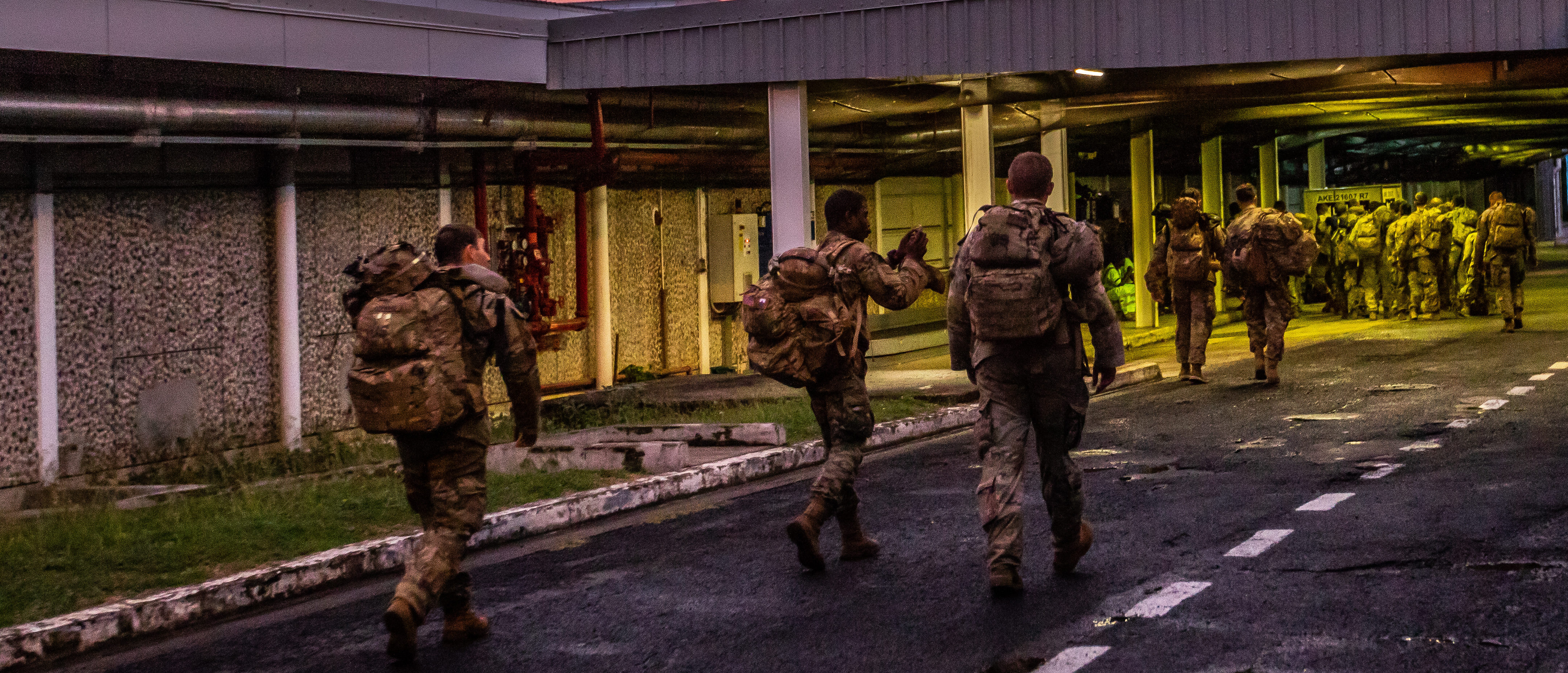
Pyne acknowledged that Trump may eschew an amphibious landing on the fortified island in favor of an attack by U.S. Army Airborne troops “using troop transport aircraft and helicopters from Kuwait.” The 82nd Airborne is on standby in the region for just this contingency.
Pyne, like many other military experts, stresses that even an Airborne assault on the island would be fraught with dangers not worth the trouble.
“A U.S. takeover of Kharg Island would prove a pyrrhic victory for the U.S. because while the U.S. could likely succeed in taking the island, we would likely suffer dozens of U.S. military casualties every day,” Pyne told the DCNF.
He offers a more frightening prospect, too: “Iran might actually allow [U.S. troops] to land on the island before sinking our naval vessels trapped in the Persian Gulf to entrap them.”
This scenario would essentially give the Iranians thousands of hostages on that island, which they could then leverage to get a better deal with the Americans.
What Are The Iranians Packing?
Kharg Island is located 16 miles from the Iranian mainland. Within this range, Iran can use an arsenal that is more diverse and expansive than in previous long-range strikes on U.S. targets across the Middle East.
The Fajr-5 is an Iranian multiple launch rocket system (MLRS) that has the range to hit Kharg Island with 385 lb fragmentation high explosive warheads, according to the U.S. Army OE Data Integration Network (ODIN). Munitions of this size have a fragmentation radius of more than 1,600 feet.
While rockets are nothing new to this conflict, short-range unguided MLRS are new to the Iran War, as they can be fired more rapidly and at higher volumes. Even more numerous is artillery; no conventional artillery has been used in this conflict, as it has a relatively short range compared to rocket-powered systems.
Artillery differs from other munitions used so far in the conflict because it can be used continuously and at low cost. Explosive shells are fired from an artillery gun, which can be repeatedly reloaded and fired over and over, as long as a supply of shells remains.
The Iranians have access to the Raad-2 155-millimeter self-propelled howitzer, which can fire at a maximum rate of 4 rounds per minute, according to ODIN. This gun can reach Kharg Island with 155-millimeter high-explosive shells, which are not as powerful as drones or missiles but can be fired repeatedly for extended periods.
These are only the new aspects of what Kharg Island could bring to the U.S. Marines landing on the island. The Marines would still have to contend with the drones that we have already seen in the Iran War, such as the Shahed-136, which has a payload of up to 100 pounds of high explosive filler, according to the U.S. Defense Intelligence Agency.
Moreover, the Iranians have access to hypersonic weapon systems. Hypersonic missiles have not yet been used in a naval capacity; they could pose a serious threat to U.S. naval assets in the region, which have been keeping their distance to avoid it.
All content created by the Daily Caller News Foundation, an independent and nonpartisan newswire service, is available without charge to any legitimate news publisher that can provide a large audience. All republished articles must include our logo, our reporter’s byline and their DCNF affiliation. For any questions about our guidelines or partnering with us, please contact [email protected].