

Commentary: Big Tent Ideas
ANDREA PICCIOTTI-BAYER: The Nuns Fighting New York To Serve Dying Cancer Patients
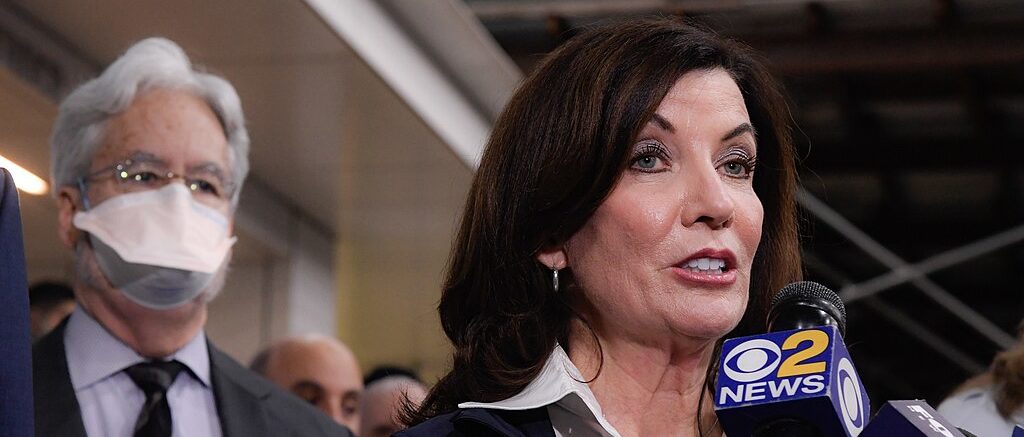
Gov. Kathy Hochul (Marc A. Hermann / MTA)
A small group of Catholic nuns is taking on one of the most powerful governors in the country. The Dominican Sisters of Hawthorne are in a striking David-and-Goliath clash with Democratic Gov. Kathy Hochul and the full weight of New York state. What’s at stake is not just religious liberty, but also whether the kind of quiet charity the Sisters exercise is still welcome in American public life.
Earlier this month, the Sisters filed suit against Hochul in U.S. District Court, challenging a 2024 New York law that requires long-term care facilities to use a patient’s preferred pronouns and to assign rooms and regulate restroom access according to gender identity rather than biological sex. The Sisters can’t comply without violating their Catholic faith. They formally asked the state for a religious exemption in March, but the state did not respond. Penalties for defiance include fines, license revocation, and jail time.
What makes this hard to dismiss as a culture war skirmish is what the Sisters actually do, and for whom. To get into Rosary Hill Home, their 42-bed facility in Westchester County, you need two things: a terminal cancer diagnosis and your word that there is no one else to care for you. No insurance. No government reimbursement. No payment of any kind. In 125 years of operation, the state of New York has recorded exactly zero complaints against them. The law they are now fighting passed the State Assembly 144-2 and the Senate 55-7, with no public hearing. Religious liberty never came up in debate.
The congregation was founded by Rose Hawthorne Lathrop, daughter of Nathaniel Hawthorne, author of “The Scarlet Letter.” She converted to Catholicism, took a nursing course, and in 1896 rented a cold-water flat on the Lower East Side to care for cancer patients who had nowhere else to go. Her successors are still at it on the same terms. And they are younger than you might expect: the congregation’s members range in age from 19 to 40. These are not elderly sisters outlasting a fading mission. They are women who chose a life of poverty, obedience, and night watches at the bedsides of the dying and are now in federal court to keep doing it.
The lawsuit puts the stakes plainly: “The implications are so much greater than whether to utter the words ‘he’ or ‘she.’ To demand that a Catholic deny another’s sex is to require him or her to affirm another religious worldview.”
“We cannot implement New York’s mandate without violating our Catholic faith,” said Mother Marie Edward, the congregation’s general superior. “Without our Catholic identity, there’s no purpose for us to do what we’re doing.”
They are not the first women religious to end up in court over exactly this kind of conflict. The Little Sisters of the Poor, who care for the destitute elderly across the country, have spent more than a decade fighting the contraceptive mandate in the Affordable Care Act, which would have required them to provide insurance coverage for drugs and devices their faith considers impermissible. They successfully argued their case before the Supreme Court twice.
Two different religious communities. The same answer when the government came knocking.
Many observers tend to divide religious Americans into two camps: the doctrinally serious ones who argue about theology and the merciful ones who actually help people. The Hawthorne Dominicans show that to be a false dichotomy. They are serious about both, and they see no contradiction, because for them there isn’t one. That’s not a recent phenomenon. It’s a disposition the Church has been forming in people for a very long time and is forming still.
A lot of attention has recently been paid to the Catholic religious revival in America. Gen Z is filling parishes, reading theology, and taking faith more seriously than the generations that came before them. Hopefully, these conversions will join the steady work of the Sisters of Hawthorne as examples of the Church at its best: faithful who refuse to treat belief and action as separate considerations.
The word “coherent” describes people who won’t separate what they believe from what they do and won’t stop doing it when it gets difficult. It doesn’t get used much anymore, but it truly describes the Dominican Sisters of Hawthorne. The Sisters nurse cancer patients because of what they believe about human dignity, the body, and death. Take their coherency with Catholicism away, and their work doesn’t make sense anymore.
New York wants them to bend. They went to court instead.
Andrea Picciotti-Bayer is director of the Conscience Project and recipient of the Religious Freedom Institute’s 2025 Religious Freedom Impact Award.
The views and opinions expressed in this commentary are those of the author and do not reflect the official position of the Daily Caller News Foundation.
(Featured Image Media Credit: Marc A. Hermann / MTA)
All content created by the Daily Caller News Foundation, an independent and nonpartisan newswire service, is available without charge to any legitimate news publisher that can provide a large audience. All republished articles must include our logo, our reporter’s byline and their DCNF affiliation. For any questions about our guidelines or partnering with us, please contact [email protected].