

National Defense
Rubio Defends Iran War As Republicans Reel From Crushing Election Losses
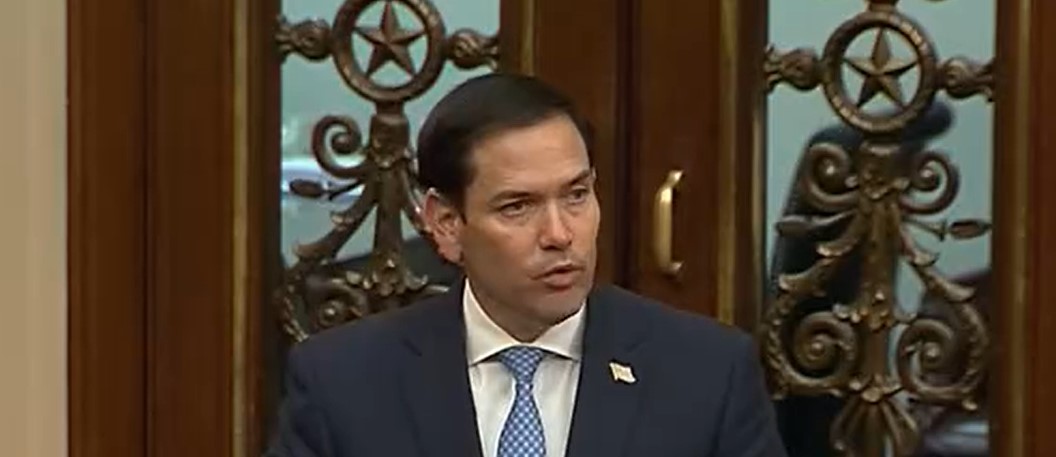
Screen Capture/CSPAN
Secretary of State Marco Rubio acknowledged Sunday that President Donald Trump’s increasingly unpopular war against Iran was politically costly but insisted the conflict was necessary to prevent Tehran from obtaining nuclear weapons.
The remarks followed devastating Republican losses in Tuesday’s midterm elections, which handed Democrats control of Congress after more than eight months of fighting in Iran. Rubio’s defense also contrasted with Vice President JD Vance’s assessment that the conflict was responsible for the Republican defeat.
The president confronted a longstanding threat to American national security despite the political consequences because “doing it isn’t necessarily popular but necessary,” Rubio told reporters Sunday before departing for a Group of Seven foreign ministers meeting in Paris, according to the State Department.
However, the administration previously claimed it had already eliminated Iran’s nuclear threat, with Trump declaring the country’s key nuclear enrichment facilities “completely and totally obliterated” following American strikes in June 2025, according to his presidential address.
Rubio himself endorsed that assessment, describing the destruction of Iran’s nuclear infrastructure as “complete and total obliteration” following the strikes on Fordow, Natanz and Isfahan, according to a June 2025 White House statement.
American intelligence officials had also concluded that Iran was not actively constructing a nuclear weapon before those attacks. The intelligence community assessed that Iran was “not building a nuclear weapon” and that its supreme leader had not authorized the resumption of a weapons program suspended in 2003, Director of National Intelligence Tulsi Gabbard told the Senate in March 2025, according to the ODNI.
Even after the latest war began, Gabbard maintained in prepared March 2026 testimony that the 2025 strikes had obliterated Iran’s enrichment program and that Tehran had made no effort to rebuild that capability, according to the ODNI.
Rubio declined to directly discuss the Republican electoral losses, arguing that his position as America’s top diplomat required him to avoid domestic political disputes, according to the State Department.
The war has contributed to rising gasoline prices and broader economic dissatisfaction, particularly as disruptions in the Strait of Hormuz have threatened global energy supplies, the Associated Press reported.
The conflict was the principal reason Republicans lost Congress, Vance argued in a lengthy X post Wednesday.
“Another pollster—one of the smartest people I know in politics, told me yesterday we’d lose the generic ballot by 13 points,” Vance said in the X post. “I felt negative going into Tuesday, but even I was shocked by this. In his polling, he saw that a lot of Trump 2024 voters were angry and planning to vote for Democrats.”
The vice president identified four major grievances among voters who previously supported Trump: ending the Iran war, addressing inflation, prioritizing American interests and changing Washington’s relationship with Israel, according to his X post.
Vance’s remarks have raised questions about the Republican Party’s direction ahead of the 2028 presidential election, in which both Vance and Rubio are considered potential contenders, the Associated Press reported.
Trump acknowledged that the war and higher gasoline prices contributed to Republican losses but maintained that his decision to attack Iran was justified, according to his Sunday interview with CBS News.
The president said he wished Vance had also explained whether he believed launching the war was justified, according to the interview transcript.
“My answer is an emphatic yes because you can’t let Iran have a nuclear weapon,” Trump told CBS.
The war began Feb. 28 and has continued far beyond the four-to-five-week timeline Trump initially presented, according to CBS News.
At least 23 American service members have died during operations related to the war, including 11 from hostile action and 12 from nonhostile causes, according to the Department of War. Another 865 American troops had been wounded as of late October, according to the military’s casualty records.
The conflict has also killed thousands across the Middle East, with more than 8,000 reported deaths in Iran and Lebanon alone, according to separate casualty tallies from the Human Rights Activists News Agency and Lebanon’s Health Ministry.
At least 3,636 people were killed in Iran by April 7, including 1,701 civilians, 1,221 military personnel and 714 people whose status could not be determined, according to the Human Rights Activists News Agency.
In Lebanon, Israeli military operations have killed at least 4,390 people and wounded another 12,429 since March 2, according to the country’s Ministry of Public Health. The figures, updated Nov. 5, do not distinguish between civilian and combatant fatalities.
American military operations have also cost taxpayers approximately $47.1 billion through Oct. 16, the Associated Press reported, citing a U.S. Central Command estimate provided to Congress. Approximately $29 billion went toward replacing expended munitions, $11.9 billion covered operational expenses and another $6.1 billion accounted for equipment losses, with the estimate excluding damage to American military bases.
Iran possesses approximately 440.9 kilograms of uranium enriched to 60% purity, below the approximately 90% level generally considered weapons-grade, according to the International Atomic Energy Agency.
Iran maintains that its nuclear program is peaceful, although Trump administration officials have repeatedly cited Tehran’s enriched uranium stockpile as justification for their warnings about a potential nuclear weapons threat, the Associated Press reported.
Trump was scheduled to meet Qatari Prime Minister Sheikh Mohammed bin Abdulrahman Al Thani at the White House Monday to discuss a potential ceasefire and renewed nuclear negotiations with Iran, according to the White House schedule and Axios.
Qatari mediators have proposed a two-day plan that would involve lifting the American naval blockade, releasing some frozen Iranian funds, reopening the Strait of Hormuz and resuming nuclear negotiations, Axios reported, citing regional sources. However, senior American and Gulf officials remain skeptical that a breakthrough is imminent, Reuters reported.
Iran has demanded the removal of the American naval blockade, sanctions relief, the release of frozen assets, compensation for wartime damage and an end to regional hostilities, including Israeli operations in Lebanon, the Associated Press reported, citing officials familiar with the negotiations.
The administration remains open to diplomatic negotiations, although Tehran’s demands are “outrageous and ridiculous and really not realistic,” Rubio said, according to the State Department.
Trump separately indicated that renewed American strikes would be unlikely if Iran demonstrated meaningful progress toward an agreement, according to a Sunday CNN interview.
However, the president warned that American forces had identified potential infrastructure targets, including 38 Iranian bridges, that could be destroyed if fighting intensified, according to CNN.
American forces have continued limited military operations against Iranian targets while enforcing the naval blockade, including disabling a commercial vessel on Saturday that allegedly attempted to breach the restrictions, the Associated Press reported.
All content created by the Daily Caller News Foundation, an independent and nonpartisan newswire service, is available without charge to any legitimate news publisher that can provide a large audience. All republished articles must include our logo, our reporter’s byline and their DCNF affiliation. For any questions about our guidelines or partnering with us, please contact [email protected].