

Commentary: Big Tent Ideas
Corporate America’s LGBTQ Ally Has A 99% Democratic Endorsement Record
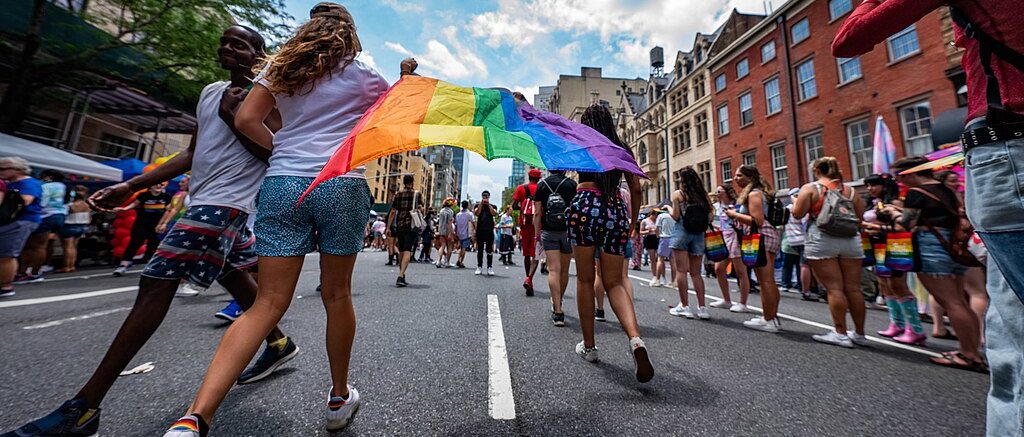
New York City Pride Parade, 2021 (Anthony Quintano from Mount Laurel, United States / Wikimedia Commons)
As Americans prepare to vote in November’s midterm elections, one of the Democratic Party’s most reliable political allies is mobilizing millions of voters and spending millions of dollars to influence the results.
That organization is the Human Rights Campaign (HRC), which also happens to maintain close ties with some of America’s largest corporations, many of which publicly affiliate with and sponsor the organization.
HRC bills itself as the nation’s largest advocacy organization dedicated to advancing LGBTQ equality. But a new analysis by 1792 Exchange reveals just how overwhelmingly partisan its political activities have become.
After examining HRC’s online archive of press releases, 1792 Exchange documented 1,408 political endorsements covering 970 unique candidates between 2010 and October 2026.
Of those 970 candidates, 964 were Democrats, two were Republicans, three were nonpartisan candidates and one was an independent.
In other words, more than 99% of the unique candidates identified in HRC’s archived endorsements were Democrats.
This record raises questions for companies that financially support HRC or affiliate with its infamous Corporate Equality Index under the banner of supporting nondiscrimination policies, particularly when they do not extend comparable affiliation with or support of conservative organizations.
And HRC’s political operation is not slowing down anytime soon.
In April, HRC announced a $15 million electoral program, dubbed “Let’s Get Free,” designed to reach 74 million so-called “Equality Voters” ahead of the midterms. The organization, which reports approximately four million members and supporters, is targeting competitive congressional races and mobilizing voters through advertisements, events and grassroots organizing.
On October 20, HRC’s PAC endorsed more than 20 transgender and nonbinary candidates for state legislatures.
HRC is entitled to advocate for candidates and policies it supports. But corporations should understand the political character of the organizations they associate with, which extends beyond mere partisan affiliation.
HRC promotes controversial positions on transgender medical interventions for minors, biological males participating in women’s sports and access to sex-separated bathrooms and locker rooms based on gender identity.
Its affiliated HRC Foundation has also exercised considerable influence over corporate policies through its Corporate Equality Index (CEI), which scores companies on their adoption of preferred LGBTQ policies.
In fact, HRC was instrumental in expanding corporate transgender healthcare benefits. After announcing stricter CEI requirements concerning transgender medical coverage, the number of companies offering comprehensive coverage increased dramatically.
The result demonstrates how an outside advocacy organization can shape corporate policies far beyond its stated interest in nondiscrimination protections.
Meanwhile, many corporations that support HRC offer no equivalent partnership to conservative organizations. As I recently explained in The Washington Post, some even use charitable-giving platforms like Benevity that incorporate the Southern Poverty Law Center’s controversial “Hate Map.” This screening tool excludes mainstream conservative organizations like Turning Point USA and Moms for Liberty from corporate gift-matching programs altogether.
Fortunately, corporate America’s relationship with the HRC is slowly changing.
In 2026, Fortune 500 participation in HRC’s Corporate Equality Index (CEI) plummeted 65%. The National Center for Public Policy Research reported a 38% decline in HRC corporate sponsorships between 2024 and 2025. Meanwhile, 1792 Exchange found that HRC’s prestigious Platinum Corporate Partners have fallen approximately 48% from their 2022 peak, while sponsorships for its annual National Dinner dropped 54.5% between 2024 and 2025.
Nevertheless, major companies continue their affiliations.
In July 2025, the telecommunications giant T-Mobile assured the Federal Communications Commission that it was ending its DEI policies and that its relationships with organizations would be “driven by its desire to advance its core business objectives.” Yet the company subsequently appeared again among HRC’s Gold Corporate Partners, raising questions about how the partnership aligns with its public commitments.
Dell Technologies, a major federal contractor receiving over $3 billion a year in federal contracts, has likewise maintained its HRC Corporate Sponsorship and received a Verified 100 on the 2026 CEI.
These corporate affiliations deserve greater scrutiny, particularly given the contrast between the companies’ ostensible commitments to political neutrality and HRC’s overwhelmingly partisan and controversial nature.
With HRC spending millions to influence the upcoming midterm elections, corporations should consider whether their continued affiliations align with their stated commitments to political neutrality. Supporting equal treatment for employees does not require associating with an organization that overwhelmingly endorses one political party and advocates controversial policies.
In fact, such affiliations run counter to what customers, shareholders and employees expect.
Dustin DeVito is Director of Research at the 1792 Exchange, where he oversees the organization’s Corporate Bias Ratings, Proxy Voting database and corporate engagement efforts. His research focuses on corporate governance, ESG, DEI and viewpoint neutrality. He holds an M.A. in Christian Apologetics from Biola University and a B.A. in Political Science from the University of Florida. He is also a Cotton Mather Fellow and a Young Voices Contributor, writing primarily on corporate governance and the Southern Baptist Convention.
The views and opinions expressed in this commentary are those of the author and do not reflect the official position of the Daily Caller News Foundation.
All content created by the Daily Caller News Foundation, an independent and nonpartisan newswire service, is available without charge to any legitimate news publisher that can provide a large audience. All republished articles must include our logo, our reporter’s byline and their DCNF affiliation. For any questions about our guidelines or partnering with us, please contact [email protected].