

National Defense
American And Chinese Aircraft Carriers Could Cross Paths As Tensions Rise Near Taiwan
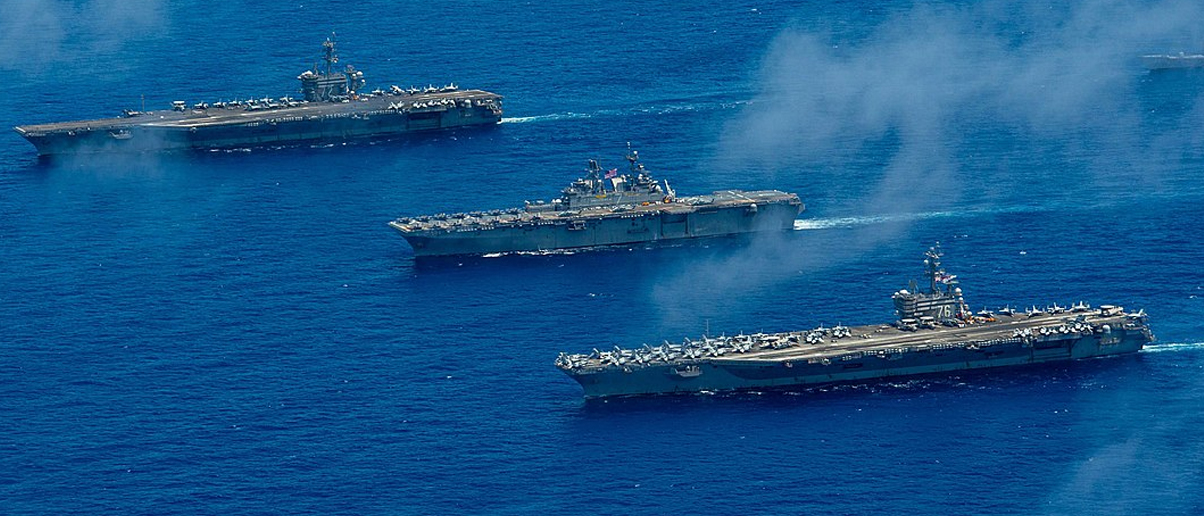
U.S. Navy photo by Mass Communication Specialist 3rd Class Gray Gibson
China’s Liaoning aircraft carrier strike group is heading toward waters where an American supercarrier is conducting massive military exercises alongside allied warships.
The Chinese carrier and its accompanying destroyers sailed beyond the first island chain, a strategic maritime boundary stretching from Japan through Taiwan to the Philippines, the South China Morning Post (SCMP) reported Sunday. The deployment could bring Chinese warships into the Philippine Sea, where the USS Theodore Roosevelt is participating in multinational military exercises involving tens of thousands of American and Japanese troops.
“The deployment of China’s Liaoning aircraft carrier strike group to the Philippine Sea would be largely military theater and showmanship,” Steve Hanke, a professor of applied economics at Johns Hopkins University and former senior economist on President Ronald Reagan’s Council of Economic Advisers, previously told the Daily Caller News Foundation. “However, it is important because it is intended to send a signal. The Chinese are signaling to the U.S. not to mess around in China’s sphere of influence, or the U.S. will get its clock cleaned.”
“The Chinese for decades have been bold in challenging the U.S. Navy in China’s peripheral waters, so the People’s Liberation Army Navy sending one of its carriers, the Liaoning, close to the USS Theodore Roosevelt Carrier Strike Group is, in that sense, not particularly new,” China policy analyst Gordon Chang told the DCNF. “Of course, the presence of opposing carrier strike groups in close proximity is a cause for concern, but in wartime the Chinese would not send their carriers close to ours. This maneuver, therefore, looks like a propaganda exercise, an intimidation move.”
The Chinese formation reached approximately 25 nautical miles southeast of the Philippines’ Balut Island before turning northeast Friday, Philippine news outlet Bilyonaryo News Channel (BNC) reported, citing Philippine Navy monitoring reports.
Philippine naval vessels monitored the Chinese formation as it navigated the Basilan Strait near the southern Philippines. The warships reportedly traveled with their Automatic Identification Systems disabled, complicating efforts to track their movements through civilian maritime monitoring systems, BNC reported, citing a source familiar with the tracking operation.
The Chinese deployment coincides with Keen Sword 27, a massive U.S.-Japan military exercise running from Oct. 19-29 across Japan and its surrounding waters, according to the U.S. Pacific Fleet.
Approximately 45,000 Japanese personnel and 11,000 American troops are participating alongside forces from additional allied nations. The exercise involves roughly 260 aircraft and 40 warships, including the USS Theodore Roosevelt Carrier Strike Group, according to the U.S. Pacific Fleet.
American naval forces are operating alongside warships from Japan, Australia, Canada and France in the Philippine Sea, according to U.S. Navy imagery released Oct. 22.
American Marines are also deploying advanced anti-ship missile systems and air-defense equipment across Japan’s southwestern islands, positioning weapons near strategically important maritime passages.
The deployments include the Navy-Marine Expeditionary Ship Interdiction System (NMESIS), a mobile missile launcher designed to attack enemy warships, and the Marine Air Defense Integrated System (MADIS), designed to counter aerial threats, according to the U.S. Pacific Fleet.
Some exercises are taking place on Yonaguni Island, approximately 70 miles from Taiwan, where American and Japanese troops are practicing operations involving missile systems, air defenses and island security, USNI News reported, citing Japanese Defense Ministry documents.
“Today, October 26, 2026, is the 20th anniversary of a Chinese Song-class submarine surfacing within five nautical miles of the USS Kitty Hawk,” Chang told the DCNF. “The U.S. Navy aircraft carrier was operating east of Okinawa at the time. The event shocked a complacent Navy: The event highlighted the vulnerability of America’s most important naval ships. Yet since then, no one has been able to hit an American carrier, although Iran has tried this year. These vessels are, despite their size, exceedingly hard to target. This means, despite Chinese propaganda, they will be in the Taiwan fight, especially as they gain the ability to launch long-range drones.”
Chinese military aircraft have also operated near Japanese territory during the exercises, according to Japan’s Defense Ministry.
Japanese Defense Minister Shinjiro Koizumi reported that Chinese reconnaissance drones and a Y-9 intelligence aircraft flew through strategically sensitive waterways near Okinawa and Taiwan on Oct. 19. Koizumi cautioned against assuming the flights were intended to monitor the American-Japanese exercises, according to the ministry.
Beijing has maintained that the Liaoning deployment is part of its regularly scheduled military training rather than an attempt to threaten another country.
“Those claiming that Carriers are a thing of the past are deluded,” Steven Bucci, a Heritage Foundation visiting fellow and former Pentagon official, told the DCNF. “There are more challenges to defending them than before; they are still the preeminent platform for power projection. Carriers are the only way we could have a conflict with China in their region; otherwise they would have to provide both sides of the war. The emerging technologies are significant, but not yet true game changers.”
The Chinese navy announced on Oct. 14 that the carrier group was conducting exercises intended to improve combat readiness and operational capabilities, emphasizing that the deployment was not directed against any particular nation, according to China’s Ministry of National Defense.
The Liaoning’s movements nevertheless raise the possibility of American and Chinese carrier strike groups operating in the same strategic waters during one of the region’s largest military exercises.
“As far as escalation is concerned, it is extremely unlikely because the U.S. realizes it would get its clock cleaned,” Hanke told the DCNF. “The mainland United States is roughly 7,000 miles from the Philippine Sea. If a naval conflict were to arise, the decisive factor would be geography.”
All content created by the Daily Caller News Foundation, an independent and nonpartisan newswire service, is available without charge to any legitimate news publisher that can provide a large audience. All republished articles must include our logo, our reporter’s byline and their DCNF affiliation. For any questions about our guidelines or partnering with us, please contact [email protected].