

Commentary: Big Tent Ideas
Pride Has Borders After All
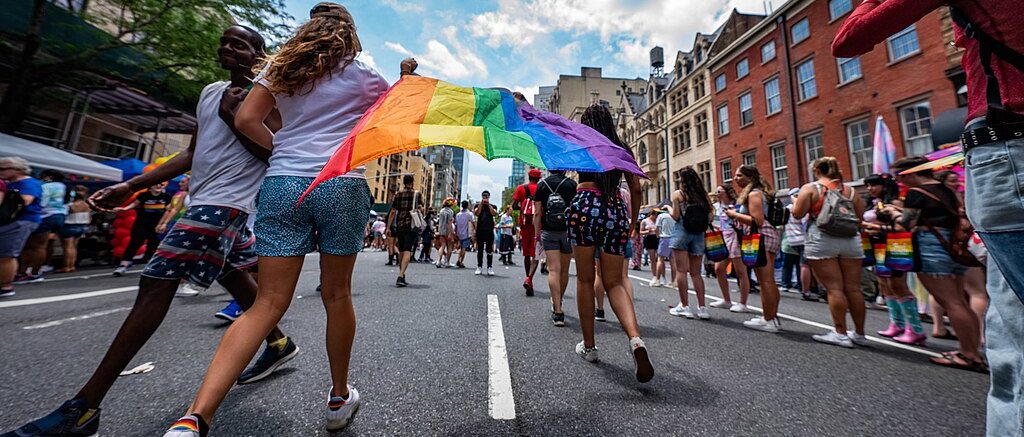
New York City Pride Parade, 2021 (Anthony Quintano from Mount Laurel, United States / Wikimedia Commons)
“Pride has no borders.”
That was the slogan. Then the map showed up.
In June 2022, Amazon told American consumers it was going to “Pride Out Loud.” The same month, Amazon.ae hid more than 150 search terms in the United Arab Emirates (UAE) — among them “LGBTQ,” “Pride,” and “transgender flag.” Even so, the company said it remained committed to the cause.
The usual defense writes itself: different markets, different audiences, different campaigns. That is what the marketing department says when it wants credit for a conviction it can’t carry through customs.
Ordinary localization changes a menu, clothing colors, or a commercial. The difference is that these companies are changing the moral script they demand that American employees, customers and shareholders treat as non-negotiable. In the U.S. the script is a cause. In the Gulf, it is a liability. A cause you will not own anywhere on the map is not a cause. It is a costume.
The pattern is not subtle. And Amazon is not a one-off.
Google spent that same June rolling out an “LGBTQ+ owned” label for U.S. Search and Maps and donating no small sum as a platinum partner of the Human Rights Campaign (HRC). Across the globe, it was promoting a Middle East North Africa startup program. Microsoft launched a global campaign titled “Pride has no borders.” Days later it published UAE copy about jobs, data centers and growth. Apple unveiled its Pride Edition Watch bands and a Pride “Shot on iPhone” campaign in the U.S. and U.K. No mention of the Pride announcements from the Saudi division. It was busy posting Worldwide Developments Conference (WWDC) coverage.
Mastercard told U.S. consumers that “Your True Self Is Priceless.” Days later, the regional newsroom was talking fintech, APIs and the UAE payments market. Nike released a “Be True” collection and named the activist groups behind it, while Converse (owned by Nike) built shoes specifically around the Pride, bisexual, pansexual, lesbian, non-binary and transgender flags. In Dubai, Nike in-store work focused on Nike’s 50th anniversary celebrations. And in neighboring Saudi Arabia, the company produced national-team kits in the Kingdom’s colors.
Coca-Cola wrapped rainbow bottles for Times Square and advertised support for the HRC. In Saudi Arabia, its “pride” was “Pride in Our Nature.” PepsiCo’s U.S. brands went for “#DragForAllFlavors” and steered corporate matching gifts to approved LGBTQ+ charities. In Saudi Arabia, the brand celebrated Saudi pride instead.
The list goes on. Starbucks. McDonald’s. IBM. UPS. Honeywell. Boeing. Pfizer. Merck. Estee Lauder. Same ticker. Two businesses. Which is the company’s “true self”
If this were only advertising, the “different audiences” line might hold. It is not only advertising. These companies write the same commitments into U.S. employment rules supplier expectations, charitable giving and activist partnerships. They tell American shareholders the position is a value. Then they run a second company, same name, same bottom line, that will not say the words where the contract is large and the politics are not cheap.
That hypocrisy cuts in two directions. First, they are not honest with the people who already own, staff and buy from it in the U.S.A. “value” that can be switched off for a sovereign client was never a value. It was a bet that one audience would reward the performance and another would never see it. Second, they are proving these campaigns are optional. Their products all travel. The politics travel only as far as they are cheap. If a company must hide a stance to keep a market, the stance cannot be essential to the product. And in that case, it should not be in business anywhere.
The case at home is no better. These unnecessary campaigns divide American customers and employees. They invite boycotts, lawsuits and years of costly brand repair. They consume management time that should be dedicated to price, quality and service. A company that requires a second script to survive contact with another market is telling on itself. The first script was never core.
Shareholders are not buying two companies. They are buying one ticker and yet being handed two stories. Employees are told the corporate line is sacred in one office, yet unmentionable on another. Customers are sold authenticity by a business that has no problem parking that authenticity at the border. Boards that accept that arrangement are not managing reputation. They are manufacturing a credibility problem.
Sunlight is the best disinfectant. That is why 1792 Exchange is putting translated Corporate Bias Ratings in front of Arabic-speaking investors, journalists and officials for more than 300 Fortune 500 companies operating in both the U.S. and Arabic-speaking markets. The point is not to impose one country’s social code on another. It is to take away the luxury of two siloed files.
Corporate directors do not need a translator to see the problem. They can view for themselves the U.S. campaigns side by side with what’s being promoted around the globe. If the company will not own the first document in the foreign market, it should never have published the first at all.
That is not principle. Principle holds no matter your time zone. A pitch you strain to defend at home and wouldn’t dare post abroad is not a strategy. It is a costume. And while costumes may be fun for kids, for a company, they only mask a business’s “true self.”
Greg Scott is the Executive Vice President of 1792 Exchange, a nonprofit that helps companies get back to business through data, research and confidential engagement with boards and executives.
The views and opinions expressed in this commentary are those of the authors and do not reflect the official position of the Daily Caller News Foundation.
All content created by the Daily Caller News Foundation, an independent and nonpartisan newswire service, is available without charge to any legitimate news publisher that can provide a large audience. All republished articles must include our logo, our reporter’s byline and their DCNF affiliation. For any questions about our guidelines or partnering with us, please contact [email protected].