

National Defense
South Korea Wants To Take Wartime Military Command Away From American General
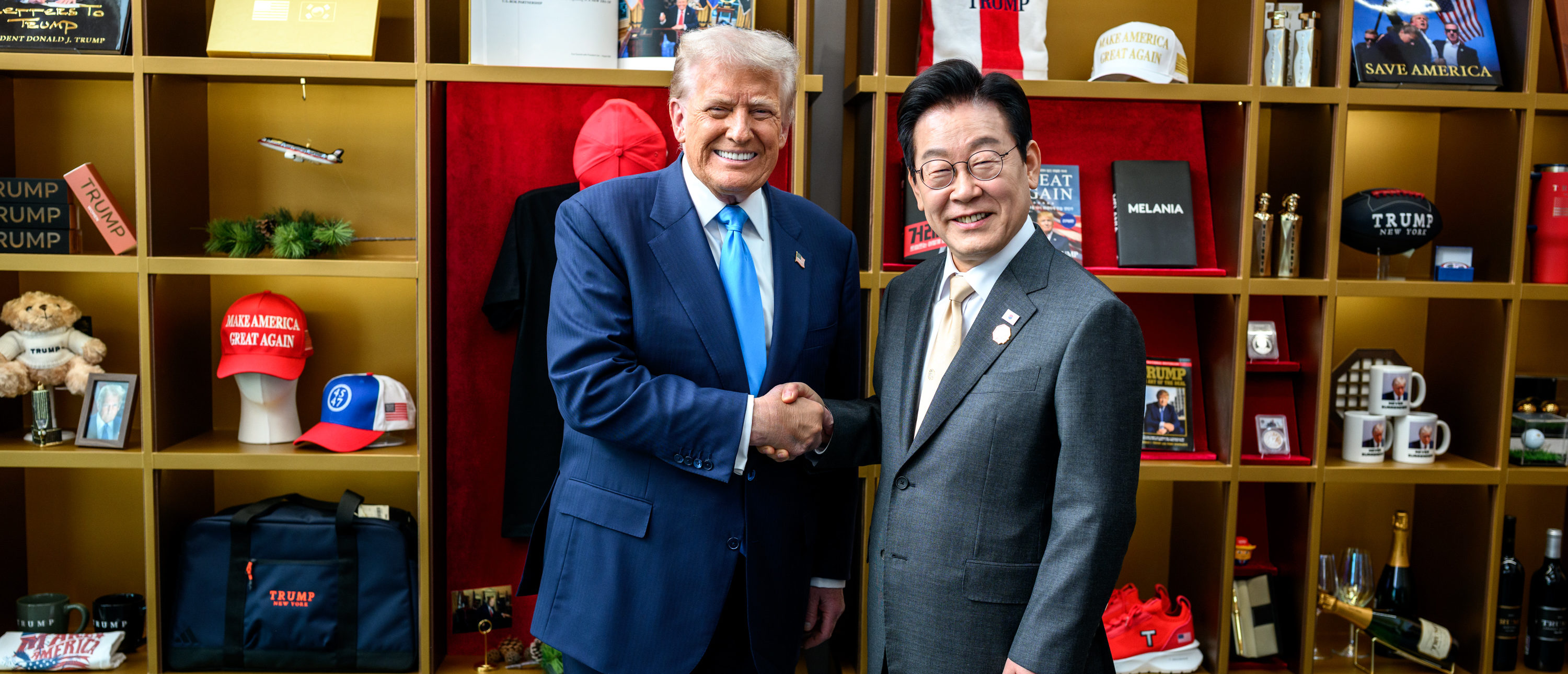
President Donald Trump and President Lee Jae Myung, Official White House Photo by Daniel Torok
South Korean President Lee Jae Myung wants his country’s military to assume wartime command of South Korean forces, potentially ending decades of U.S. military leadership on the Korean Peninsula.
Lee declared Monday that South Korea is capable of assuming wartime operational control (OPCON) of the Korean military, a responsibility currently held by an American general, Yonhap News reported. The proposed transfer would place a South Korean commander in charge of combined allied military operations during a conflict with North Korea.
“To put it plainly, we should take back wartime operation control at an early time,” Lee told reporters Monday at the Blue House presidential compound, according to Reuters.
President Donald Trump and Lee have previously discussed the transfer of command, a senior administration official told the Daily Caller News Foundation.
“The United States policy on wartime operational control has been consistent for decades,” a White House official told the DCNF. “The United States intends to transfer wartime operational control to South Korea when the agreed conditions have been met, which will ensure the safety and security of the people of South Korea and U.S. forces stationed there.”
U.S. Forces Korea and the South Korean Embassy in Washington did not respond to a request for comment.
“The transition of wartime operational control (OPCON) remains a conditions-based process mutually agreed upon by the United States and the Republic of Korea,” a Department of War official told the DCNF. “Both nations remain committed to ensuring that the necessary conditions are met before any transition occurs. We will not prejudge decisions or outcomes of this bilateral process.”
“The reality is that if there is an outbreak of war on the Korean peninsula, South Korean troops are going to form the bulk of forces defending the country,” Matthew Wallin, chief executive officer of the American Security Project, told the DCNF. “In comparison, the U.S. troop presence is relatively small. Given that the South Korean military is well trained, technologically advanced, and likely effective, it makes sense for their leadership to be in command on their own territory. I have no doubt that South Korea could effectively defend itself against a North Korean attack even without U.S. forces involved.”
“Transferring OPCON would allow South Korea to take greater responsibility for leading the combined defense against North Korea while preserving the US–ROK alliance and the US contribution to deterrence on the Korean Peninsula,” James Park, research associate in the East Asia Program at the Quincy Institute for Responsible Statecraft, told the DCNF. “It would not end US involvement in a conflict or place American forces entirely under South Korean national command.”
Not all experts contacted by the DCNF agreed on who should be in charge of the armed forces in South Korea.
“I am categorically against it because, as the nuclear-armed superpower, the United States remains the backstop to the alliance, despite South Korea’s very impressive military,” Michael O’Hanlon, senior fellow and director of research in foreign policy at Brookings, told the DCNF.
“South Korea has made clear progress and is in the process of modernizing and enhancing its capabilities,” Bruce E. Bechtol Jr., professor of political science in the Department of Security Studies at Angelo State University, told the DCNF. “But the ROK military has not yet made several of the necessary advances to meet the threshold for military readiness, coordination, and command and control.”
The United States maintains approximately 28,500 troops in South Korea to help defend against North Korean aggression, according to U.S. Forces Korea. North Korea continues expanding its nuclear weapons program and developing advanced ballistic missiles, Pentagon officials said in April 2025.
“The U.S. has even opted to purchase South Korean mobile artillery to replace its towed M777 howitzers,” Wallin told the DCNF. “I do not think the transition poses any specific significant risk. I am personally more concerned about the Trump administration’s willingness to hold America’s relationships with its allies hostage for the purpose of appeasing adversaries like Putin or Kim, instead of continuing to build the strong connections and training that will allow our forces to operate as seamlessly as possible should a conflict break out.”
The American-led Combined Forces Command (CFC) is responsible for coordinating the allied military response to a potential North Korean invasion. The organization is currently led by an American four-star general, with a South Korean four-star general serving as deputy commander, according to U.S. Forces Korea.
Under the proposed arrangement, those leadership positions would be reversed, placing a South Korean general in command and an American general in the deputy position. Both countries previously endorsed that structure in a 2018 joint defense agreement.
“The transfer is supposed to be a capabilities-based event. Unfortunately, the South Korean government wants to apply a very narrow timeline – and this means it is likely the transfer will be made before ROK forces have actually met the guidelines for OPCON transfer,” Bechtol Jr. told the DCNF. “This has the potential to hurt the readiness of Combined Forces Command.”
However, the transfer would not eliminate the American military’s independent chain of command. U.S. Forces Korea operates separately from the binational Combined Forces Command, with American military authorities retaining national command responsibilities, according to U.S. Forces Korea.
“A drop in readiness for Combined Forces Command has the potential to change perspectives in both China and North Korea,” Bechtol Jr. told the DCNF. “Thus, the prudent move for the alliance would be to keep this a capabilities-based transfer, not a transfer based on a strict timeline which may or may not be simply based on internal politics.”
South Korea originally entrusted operational control of its military to the American-led United Nations Command during the 1950-1953 Korean War. That responsibility subsequently passed to the Combined Forces Command in 1978, while Seoul regained peacetime operational control in 1994, according to ROK-U.S. Combined Forces Command.
Washington and Seoul agreed in 2007 to eventually transfer wartime operational control to South Korea, initially targeting 2012, according to the State Department. The transition was subsequently postponed until 2015 before the allies agreed to delay it again over concerns about North Korea’s growing military capabilities, according to the Pentagon.
The two governments subsequently adopted a conditions-based approach requiring South Korea to demonstrate sufficient military capabilities before assuming wartime command, according to U.S. Forces Korea.
Those requirements include critical South Korean military capabilities, adequate allied defenses against North Korean nuclear and missile threats, and security conditions suitable for a stable transition, according to a 2022 congressional statement by former U.S. Forces Korea commander Gen. Paul LaCamera.
Lee wants the wartime operational control transfer completed before his presidential term ends in 2030, according to the South Korean government. Gen. Xavier Brunson testified in April that the U.S. military had submitted a roadmap aimed at satisfying the transfer requirements by early 2029, according to his congressional testimony.
“It could also allow Washington to focus on more immediate strategic priorities in the Middle East and elsewhere in Asia. Rather than signaling declining US influence, a successful transition would demonstrate that US alliances can adapt to changing strategic circumstances without sacrificing deterrence or regional stability,” Park told the DCNF.
Brunson, commander of U.S. Forces Korea, warned that South Korea must demonstrate the necessary military capabilities before assuming wartime operational control, according to his congressional testimony. South Korean Defense Ministry spokesperson Chung Bin-na subsequently warned, speaking in a personal capacity, that continually changing the requirements could make the transfer impossible, according to an official South Korean government transcript.
“South Korea has a capable, technologically advanced military and decades of experience conducting combined operations with US forces,” Park told the DCNF. “OPCON transfer could create some gaps in capabilities and command coordination, but South Korea is capable of filling them, especially with continued US support. “
“In fact, delaying OPCON transfer indefinitely could undermine South Korea’s ability to develop the capabilities and experience needed to lead the combined defense,” Park said. “Although the US did not intend to delay the process indefinitely, the so-called ‘conditions-based’ transfer has created a pretext for indefinite delay. A timeline-based transfer therefore seems the right approach.”
The South Korean president has argued that his country’s growing military strength makes continued dependence on American wartime command unnecessary. Lee also characterized regaining operational control as an important component of national sovereignty, according to Yonhap News Agency.
The two countries never reached a formal peace treaty following the Korean War, leaving the peninsula technically in a state of war under a 1953 armistice, according to the United Nations Command.
“It would modernize the alliance to reflect South Korea’s growing military capabilities and strengthen its ownership of its own defense,” Park told the DCNF. “Overall, that is the right direction for the alliance. The US cannot permanently ‘lead’ all of its global defense commitments. Given the growing fiscal and strategic constraints the US faces, this kind of burden-shifting in alliances is inevitable and necessary.”
All content created by the Daily Caller News Foundation, an independent and nonpartisan newswire service, is available without charge to any legitimate news publisher that can provide a large audience. All republished articles must include our logo, our reporter’s byline and their DCNF affiliation. For any questions about our guidelines or partnering with us, please contact [email protected].