

Healthcare
Was NIH’s Trans Kids Research The Last Straw For Trump’s Budget Bulldog?
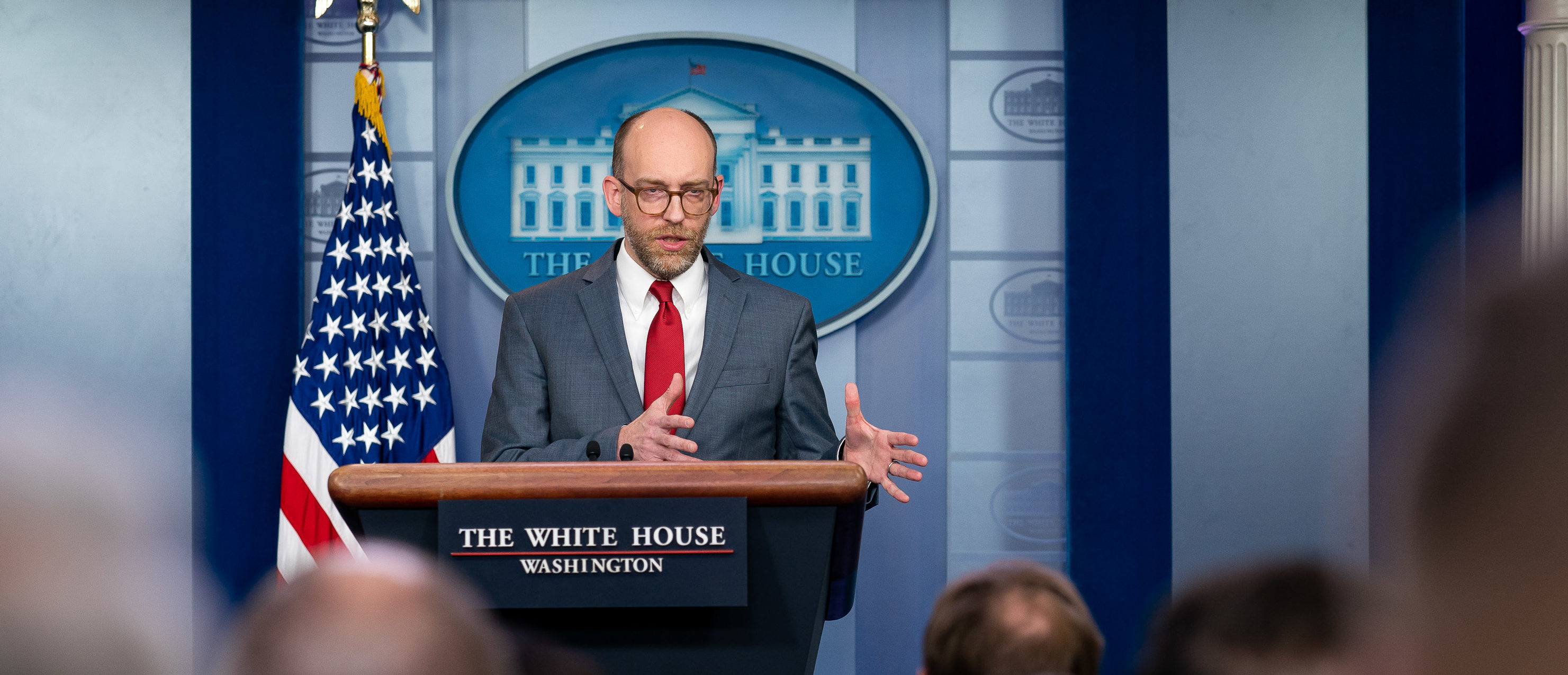
(White House Photo by Tia Dufour/Flickr)
About a month before the White House considered an executive order giving it greater control over the National Institutes of Health, outside experts close to the administration learned of an NIH-backed project advocating sex-change procedures in children, according to a former administration official.
Reversing the tide of transgender surgeries in minors, including securing the closure of five top gender clinics this summer, has otherwise been among the Trump administration’s biggest triumphs with conservatives.
But NIH Director Jay Bhattacharya continues to underwrite an epidemiologist who conducts controversial scholarship on “discriminatory LGBT bills,” which she defines as including bans on transgender surgeries in kids. The epidemiologist, Harvard T. Chan School of Public Health Prof. Brittany Charlton, has been cited in the press hundreds of times to argue against the Trump administration’s policies.
The project began in August 2024 and ends in September 2029.
The continued grant may have contributed to the frayed relationship between Bhattacharya and the president’s budget bulldog, Office of Management and Budget (OMB) Director Russ Vought, the official said.
“The grant in question was terminated in 2025 but reinstated by a court order. It is the subject of active litigation; NIH does not comment on litigation,” an HHS spokesperson said in a statement to the Daily Caller News Foundation. “HHS continues to work diligently to ensure that the only research receiving NIH funding is scientifically rigorous and supportive of NIH’s mission of conducting research to improve the health of the American public.”
An email seeking the name of the lawsuit did not receive a reply.
“NIH has confirmed that Dr. Charlton’s grant is currently the subject of active litigation. We cannot comment further on the matter,” the HHS spokesperson said.
Charlton did not respond to requests for comment.
Beginning in mid-August, organizations close to the White House were briefed on continued NIH funding for far-left priorities, the former official said.
The White House reportedly drafted an executive order creating a new committee to cull NIH waste in September, but delayed it because of opposition from Senate Appropriations Chair Susan Collins, according to news reports. But the White House did move forward with nearly $1 billion in rescissions across the Department of Health and Human Services on Sept. 25, once again prompting opposition from Collins.
Should NIH partner with OMB, Bhattacharya would receive fresh resources, some experts say. Weeding out the political grants from a massive $48 billion institution requires a fine-toothed comb and a lot of manpower to wrestle with an overwhelmingly liberal bureaucracy.
“The first reason it’s a good idea is that simply having more of a headcount of people who are truly on your side can help you play the Whack-a-Mole game to distinguish which civil servants are promoting their own agenda and which are there to follow the law,” said Richard Stern, a budget expert at Advancing American Freedom, a conservative advocacy and policy group. “The second reason is that OMB people know appropriations law like the back of their hand. They can tell whether a grant approval is coloring inside the lines … or whether a civil servant knew what they could get away with.”
But it is still unclear to many experts whether Bhattacharya wants the help.
“If I’m the head of the NIH and you bring in a bunch of help from OMB I would embrace it. I would love to have help to scope out this enormous problem. If it’s not fully embraced, that seems weird to me and brings into question whether you actually want to solve the problem,” one expert granted anonymity to speak candidly about a Trump appointee said.
“If we remove your obstacles and you don’t do the thing, that’s helpful to know,” another outside expert granted anonymity for the same reason said.
“You have the stomach and the conviction to say ‘this is what’s right’ or you don’t,” the second expert added. “At a certain point you can do the job or not, and whether we like you personally ceases to be as important.”
“If I ask you to build a new building and after two years you haven’t even broken ground — if I give you the necessary materials, the necessary labor, the money and the permits, and you still haven’t broken ground — I’m going to begin asking whether or not you’re ever going to build my building,” he said.
Bhattacharya has been a mentee of Harvard President Alan M. Garber for three decades and maintains close communications with several professors there who oppose the Trump administration, according to the Harvard Crimson.
One Charlton project really got the experts’ attention, according to the former administration official.
In 2024 she coauthored an influential two-page research letter in the Journal of American Medical Association (JAMA) Network Open arguing that electronic medical records show that so-called “man boob” surgeries outnumber breast-reduction surgeries in children who identify as transgender.
“These findings suggest that concerns around high rates of gender-affirming surgery use, specifically among transgender or gender non-conforming minors, may be unwarranted,” the authors argue. It cites one of Charlton’s NIH grants as the funder. (That five-year grant was originally set to end in 2026, but appears to have received a no-cost extension until 2027.)
In the study, Charlton did not count double mastectomies, a much more common surgery in people who identify as transgender. She used medical records, but the Trump administration uncovered that hospitals often conceal transgender procedures in minors by classifying them as another procedure — a discovery that complicates the letter’s entire premise.
Yet the corporate press has continued to cite it. It has appeared in 331 news stories, according to Altmetric.
“Credible data indicates that gender-affirming surgeries are rarely performed on minors, and most minors who receive them are not actually trans, but cisgender boys getting chest reductions,” reads a Snopes “fact check.”
Appropriations law is complex and “each grant has its own unique geometry,” Stern said. But “in the last few months of the Biden administration, rogue bureaucrats were jumping all over themselves to obligate grants as strongly as possible as far into the future as possible.”
Charlton was a plaintiff in a 2025 lawsuit against NIH to combat cuts under the Department of Government Efficiency (DOGE). The Supreme Court handed down a two-pronged ruling: The government’s initial anti-DEI guidance was arbitrary and capricious, but the terminations could proceed. Grantees could appeal in the Court of Federal Claims.
A search of the PACER database of court records from the Court of Federal Claims did not turn up Charlton’s name. An appeal in the case is ongoing, but court documents suggest it was brought by the government to challenge its loss on the first issue.
It’s not immediately clear why that appeal would impact the second issue of grant terminations. Harvard has also sued the Trump administration over terminated funding, and that suit remains ongoing. The Department of Justice declined to comment.
NIH grant policy specifies that grant funding each year is “contingent on satisfactory progress, the availability of funds, and the continued best interests of the Federal government.” Charlton has continued to receive funding in fiscal year 2026.
Several experts who want deeper reforms to NIH said that they would like to see Bhattacharya use his bully pulpit.
“HHS does not seem to be making a great effort here or being particularly honest,” Stern said. “If I were them and if the truth is this money is obligated and there’s nothing I can do, you’d be the first person I’d go to. I would go to the media … to highlight this as a prime example of how appropriations default to the whims of bureaucracy and the liberal establishment that runs through Deep State.”
NIH determines the direction of American science, supporting research at 2,500 universities, medical schools and research institutes.
How much money has been diverted from science to DEI since it caught fire in 2020? Nobody has studied the question.
At one time, descriptions of new NIH grants had on average one diversity-related word (words like “implicit bias,” “anti-racism,” and “chestfeeding”) for every 90 words, or about once every paragraph, but that plummeted immediately in the weeks after Trump’s election in 2024 to one diversity-related word for every 185 words, suggesting that words reflecting diversity language were deleted from grant abstracts.
For example, one epidemiologist who continues to receive NIH funding changed the title of her grant from “The Effects of Medicaid Policy Interventions on Racial Equity in Severe Maternal Morbidity” to simply “The Effects of Medicaid Policy Interventions on Severe Maternal Morbidity.”
The Washington Post first reported the conflict between Vought and Bhattacharya. The paper included in its story the claim that “polls have shown that bipartisan majorities of voters generally oppose health care research cuts.”
The source of its cited poll? The Harvard T.H. Chan School of Public Health.
All content created by the Daily Caller News Foundation, an independent and nonpartisan newswire service, is available without charge to any legitimate news publisher that can provide a large audience. All republished articles must include our logo, our reporter’s byline and their DCNF affiliation. For any questions about our guidelines or partnering with us, please contact [email protected].