

Legal/Law/Criminal Justice and Reform
Supreme Court Split On Making Oil Companies Pay For Climate Change, Oral Arguments Suggest
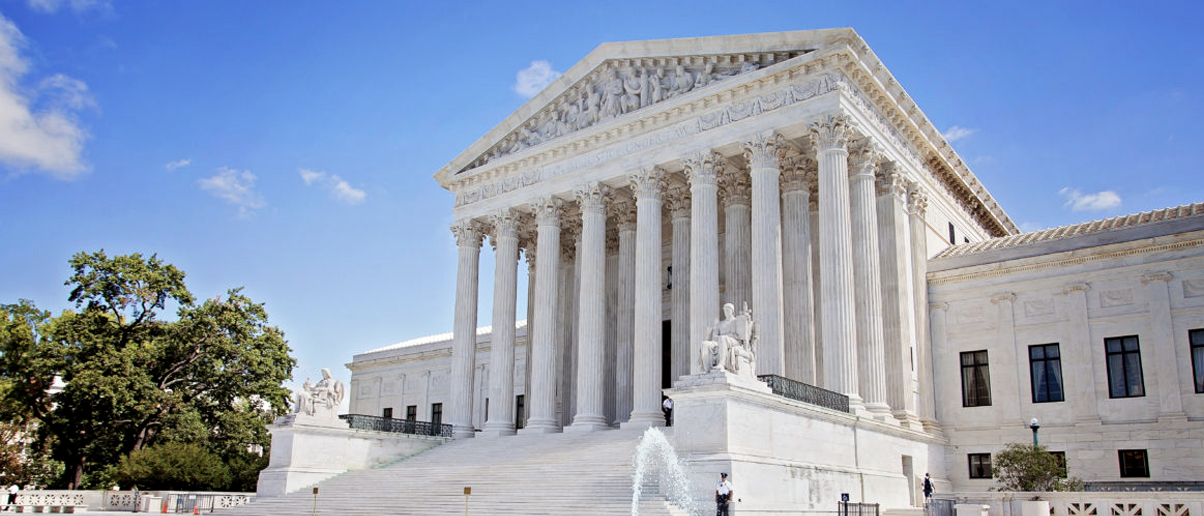
Sunira Moses/Creative Commons/Flickr
Supreme Court justices appeared divided Monday over whether a Colorado county can make oil companies pay for climate change damages under state law.
With Justice Samuel Alito recused, Justice Amy Coney Barrett, a potential deciding vote, questioned a central part of the oil companies’ argument, while Justice Brett Kavanaugh said decades of the court’s precedents treat interstate pollution as a federal matter.
In the case, Suncor Energy v. County Commissioners of Boulder County, ExxonMobil and Suncor told the justices that nearly 60 state and local governments have filed similar suits, according to a Bloomberg report.
Kannon Shanmugam, arguing for Suncor and ExxonMobil, told the justices the case “involves an unprecedented effort to use state law to regulate global conduct.”
“If Boulder’s claims are allowed to go forward, some 90,000 municipalities across the country will have the ability to make national and international energy policy by asking juries to impose catastrophic damages on selected fossil fuel producers,” Shanmugam said during the oral arguments.
Justice Elena Kagan compared Boulder’s suit to the lawsuits state and local governments brought against tobacco companies in the 1990s and the more recent opioid litigation, which she said accused companies of misrepresentations that led people to overuse their products.
“This is Chapter Three. So, if this is Chapter Three, were Chapters One and Two also preempted?” Kagan asked.
Kagan also questioned the companies’ argument that states gave up the power to regulate interstate pollution when they joined the Union unless Congress says otherwise.
“Where is the text for that? Where’s the support for that? Where’s the precedent for that? Where’s the anything for that?” she asked.
Kavanaugh offered a different answer to Kagan’s tobacco comparison, saying the court has “consistently said that air and water pollution are different.”
“There’s a lot of constitutional theory being tossed around, but we have four precedents on point,” Kavanaugh said, citing two cases involving Milwaukee, International Paper Co. v. Ouellette and American Electric Power Co. v. Connecticut, which he said “make crystal clear that interstate air and water pollution are matters for federal law unless Congress specifically preserves state law.”
Barrett pushed back on Shanmugam’s argument that the Clean Air Act’s saving clause authorizes only narrow state lawsuits.
“Well, I mean, it doesn’t say authorize; it says preserve, and a saving clause suggests that you’re saving something that already exists,” Barrett told him.
Barrett later called one of Shanmugam’s answers “a little slippery,” saying that when pressed on federal common law, he was “reverting to the constitutional structure equal sovereignty point.”
“You don’t win unless you get us to say that federal law preempts state law in this area,” Justice Sonia Sotomayor told Shanmugam, who agreed. She noted that the court has allowed state-law nuisance suits under the Clean Water Act and said she did not see why it would not do the same under the Clean Air Act.
Sotomayor also questioned whether the court has jurisdiction to hear the case now. “Shouldn’t we be certifying this question to the Colorado court instead of us deciding it? We have to be sure of our jurisdiction before we take it,” she said.
Justice Ketanji Brown Jackson said the discussion made her think “we’re really early in this case” and that it may be premature for the court to step in.
The Trump administration also argued in support of the companies after the court granted the solicitor general’s request to take part, according to the court’s docket. The administration contends that federal law precludes Boulder’s claims, Bloomberg reported.
Principal U.S. Deputy Solicitor General Sarah Harris, arguing for the administration, told the justices the suit “egregiously exceeds constitutional limits on state authority.”
Justice Neil Gorsuch said the EPA has disclaimed the power to regulate greenhouse gases from motor vehicles and “more recently from stationary sources too,” and asked whether that means that “because of the Clean Air Act and Congress not addressing this issue, nobody can sue at all.”
“Again, I think that’s correct,” Harris said, pointing to the Clean Air Act’s renewable fuel program as an example of Congress addressing greenhouse gas emissions.
Jackson later told Harris it “feels to me like the defendants in this case are coming in after attempting to remove this to federal court” and are now “coming up with theories that are bringing it back to federal court before the state courts have really had a chance to sort out” the facts.
Kevin Russell argued for Boulder County and the city of Boulder, according to the city’s website.
“Since the founding, states have had the power to provide tort remedies for injuries occurring within their borders, even when the conduct causing those injuries occurred elsewhere,” Russell told the justices during the Monday arguments.
Asked whether there was any limiting principle on whom Boulder could sue if it prevails, Russell pointed to constitutional limits on choice of law, the dormant commerce clause and personal jurisdiction. Pressed on whether the same theory would allow suits against large retailers of fossil fuels, Russell said, “Nothing in our theory prevents that.”
Kavanaugh told Russell the court has “a wall of precedent that says state tort law does not apply” to interstate pollution, apart from suits under the law of the state where the pollution originates.
If the court now required Congress to act to block suits like Boulder’s, Kavanaugh said, “this court would be rightly accused of misleading Congress for decades on what the state of the law was.”
Russell responded that “this case is not about emissions; it’s about deception and producers.”
Asked what would happen if municipalities in every state copied Boulder’s suit, Russell pointed to asbestos and other product liability cases that courts have managed, adding that Boulder would still have to prove proximate cause, “which they say we cannot prove.”
Pressed on whether the suit is an attempt to get around the court’s rulings on emissions, Russell said, “No, it is not an effort to reduce emissions.”
Under Boulder’s deception theory, he said, the companies “can continue to produce as much fossil fuels as they like” as long as consumers are properly informed.
Barrett asked Russell whether anything would stop Colorado from passing a law “purporting to cap emissions in the other 49 states.”
Russell said such a law would not be allowed, but that a tort suit “requires them to internalize a portion of the costs of their activities” rather than prohibiting the conduct.
Kavanaugh read from the court’s AEP decision, which said federal judges lack the resources of an expert agency to regulate greenhouse gas emissions, and asked whether the same reasoning applied to a “six-person state jury in Boulder and other juries throughout the country.”
“Those are all good policy arguments about why state law should not apply here. But that’s not the question presented here,” Russell replied.
In rebuttal, Shanmugam called the breadth of Boulder’s theory “astonishing,” saying it would let Boulder “tag me with personal jurisdiction when I am in Colorado in two weeks and sue me on a nuisance claim for refilling my car and thereby contributing to global climate change.”
Noting that “90 percent of greenhouse gas emissions occur outside the United States,” Shanmugam said the issue “is a matter for the political branches on the federal level in the first instance.”
“Climate change is certainly one of the most pressing issues of the day, but we would submit that this is exactly the wrong way to go about resolving it,” Shanmugam said in closing.
ExxonMobil, Suncor and the city of Boulder did not immediately respond to the Daily Caller News Foundation’s requests for comment. Boulder County said in an email to the DCNF that it would issue a statement after the arguments.
Republican North Dakota Sen. Kevin Cramer told the DCNF in a Sept. 30 interview that suits like Boulder’s are “anti-federalism.”
“At the end of the day, you simply can’t have a patchwork of laws determining what other states do in their own states, much less a community or a city,” Cramer said.
Boulder County and the city of Boulder sued the companies in 2018, accusing them of misleading the public about how fossil fuels affect the climate while continuing to sell them, Bloomberg reported.
The Colorado Supreme Court let the case move forward in a 5-2 ruling in May 2025, Colorado Public Radio reported.
Alito recused himself from the case Sept. 28, leaving eight justices to decide it, the Associated Press reported.
Alabama and 25 other states filed a brief backing the companies, according to the court’s docket.
Nineteen attorneys general, including Massachusetts Attorney General Andrea Campbell, joined an August brief backing Boulder, contending that its state-law claims are not preempted by federal law.
A decision is expected before July 2027, according to the environmental law firm Beveridge & Diamond.
All content created by the Daily Caller News Foundation, an independent and nonpartisan newswire service, is available without charge to any legitimate news publisher that can provide a large audience. All republished articles must include our logo, our reporter’s byline and their DCNF affiliation. For any questions about our guidelines or partnering with us, please contact [email protected].