

Legal/Law/Criminal Justice and Reform
Legal Experts React To Supreme Court Showdown Over Climate Lawsuits
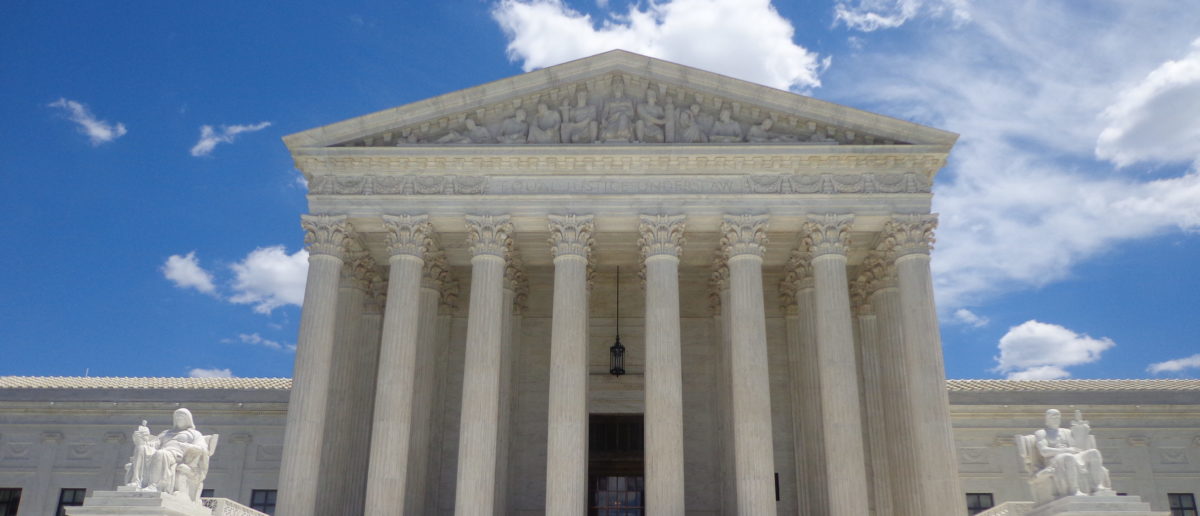
Yellow/3467/Creative Commons/Flickr
Supreme Court justices grappled Monday with whether a blue city can make oil companies pay for climate damages — and legal experts are weighing in.
Monday oral arguments for Suncor Energy v. Board of County Commissioners of Boulder County concluded with the Court’s nine justices appearing to be split on the question. In the case, multiple Colorado governments including the City of Boulder argue the companies should pay for alleged local climate harms, while energy companies Suncor and ExxonMobil contend federal law preempts claims involving interstate and global greenhouse gas emissions.
Republican Utah Attorney General Derek Brown told reporters outside the Supreme Court he left the arguments “optimistic,” saying the dispute ultimately comes down to “who gets to decide the policy.”
“It’s an energy tax dressed up in a fraud lawsuit,” Brown said of Boulder’s claims. “That’s ultimately what this is, because the reality is, they’re trying to regulate action that takes place, not just in their own state, but anywhere across the country.”
Republican Alabama Attorney General Steve Marshall likewise said he felt more confident after hearing the justices’ questions, pointing particularly to Justice Brett Kavanaugh.
“We were confident coming in. I feel better having heard, particularly if you listen to Justice Kavanaugh on his line of questioning,” Marshall told the Daily Caller News Foundation. “It makes it abundantly clear that this is not a question for local officials in Boulder, Colorado, to somehow adopt energy policy for our country. But instead, that’s an issue of federal law, and particularly an issue of Congress.”
Marshall cautioned, however, against interpreting individual questions as indications of how a justice might ultimately vote. Asked about Justice Amy Coney Barrett’s pushback on aspects of the companies’ arguments, Marshall said she was “just doing her job as somebody on the court, trying to fully understand specifically what the advocates are advancing.”
“It’s always foolish to try and predict a Supreme Court outcome solely from oral argument, but it seems like several members of the Court appear primed to defer to the state-court action,” Zac Morgan, senior litigation counsel for Washington Legal Foundation, told the DCNF. “That said, Boulder never offered a satisfying answer to the objection raised by both Justices Barrett and Kavanaugh: why is regulating greenhouse gases outside Boulder, Colorado via a state-court action substantively different from doing so via a municipal or state statute, which all agree would conflict with the Constitution.”
“The arguments today confirmed what we’ve said all along: federal law forecloses these suits several times over,” Michael R. Williams, Solicitor General of West Virginia told the DCNF. “Whichever path the Court takes, we’re confident they all lead to the same conclusion — Boulder can’t proceed.”
“As Justice Kavanaugh suggested, we think it’s ‘crystal clear’ that interstate issues like these must be governed by federal law, not by varying state law in dozens of state courts,” Williams added.
The Supreme Court agreed in February to hear the case and directed the parties to address whether the justices have statutory and constitutional jurisdiction to decide the dispute.
The case has drawn roughly 20 amicus briefs, with environmental organizations and Democratic-led governments backing Boulder while industry and free-speech groups have raised concerns about allowing states to impose liability over global emissions.
“The Justices were very engaged and asked tough questions of both sides. Justice Kavanaugh, in particular, asked incisive questions about the Court’s precedents concerning interstate air and water pollution. He reads those cases as leaving no doubt that interstate air pollution is a matter for federal law unless Congress specifically preserves state law,” Cody L. Reaves, partner at Torridon Law PLLC, told the DCNF.
Chief Justice John Roberts’ “questions, especially of Boulder’s counsel, really zeroed in on the practical consequences here. He seemed particularly troubled by the fact that, if Boulder’s suit is not preempted, every single city and county across the country could copy Boulder’s complaint and bring suit in state courts across the country, subjecting these defendants (and others) to ruinous liability,” he added.
Just one week before oral arguments, Justice Samuel Alito recused himself, leaving eight justices to consider the dispute. The justice’s absence — which came following scrutiny into his and his wife’s energy investments — raises the possibility of a 4-4 split. An evenly divided Court would leave intact the Colorado Supreme Court’s decision allowing Boulder’s lawsuit to proceed without creating a controlling nationwide precedent.
“Justice Alito’s absence was palpable. He is a penetrating questioner who really brings the tough issues in a case into focus. Last term in Hencely [v. Fluor Corporation], he penned a powerful dissent that explained the importance of preemption based on constitutional structure, especially when state law intrudes on the federal government’s exclusive authority to conduct relations with other nations,” Reaves told the DCNF. “That doctrine — foreign affairs preemption — featured prominently in the Suncor briefing but came up on only a couple occasions at argument. Had Justice Alito participated in the case, there is good reason to think that foreign affairs preemption would have played a bigger role at oral argument.”
The dispute has also spilled into Colorado’s statewide elections. Democratic gubernatorial nominee and current Colorado Attorney General Phil Weiser co-led a coalition of Democratic attorneys general urging the Supreme Court to allow Colorado courts to consider Boulder’s claims.
Additionally, Colorado Secretary of State Jena Griswold, the Democratic nominee seeking to succeed Weiser as attorney general, has also backed Boulder’s lawsuit and pledged to pursue climate-related litigation if elected.
The election could therefore shape Colorado’s climate litigation strategy regardless of how the Supreme Court resolves Suncor.
All content created by the Daily Caller News Foundation, an independent and nonpartisan newswire service, is available without charge to any legitimate news publisher that can provide a large audience. All republished articles must include our logo, our reporter’s byline and their DCNF affiliation. For any questions about our guidelines or partnering with us, please contact [email protected].