

Politics
Republicans Pull The Plug On 2 Swing States As GOP’s Midterm Prospects Become Increasingly Grim
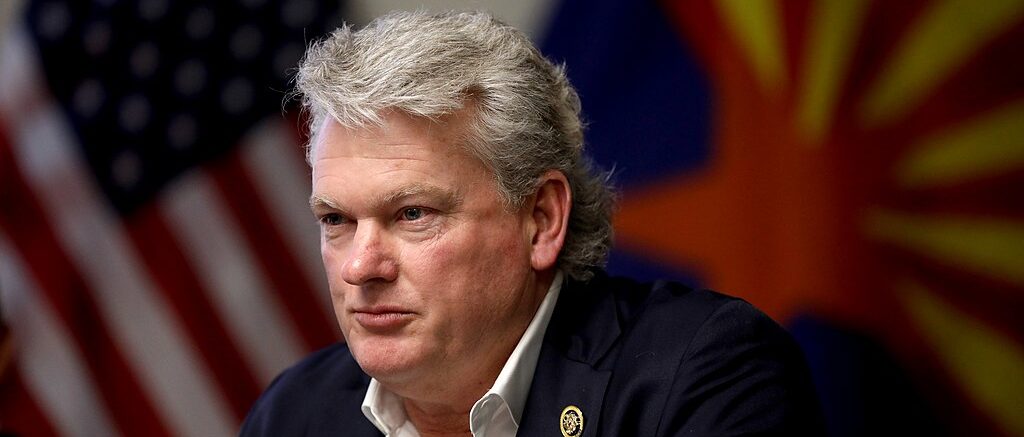
Wikimedia Commons/Public/Gage Skidmore from Surprise, AZ, United States of America, CC BY 2.0, <https://creativecommons.org/licenses/by-sa/2.0>]
Republican political action committees (PACs) and the Senate Leadership Fund (SLF) scaled back their time and resources in North Carolina and Georgia while pouring large sums of money into keeping red seats just weeks before the midterm elections.
Republican committees and PACs spent unprecedented amounts of money in red states and districts while polling results shifted against Republican candidates. These PACs pulled support away from North Carolina and Georgia, where Republican Georgia Rep. Mike Collins and Republican North Carolina Senate nominee Michael Whatley face tight races, according to Punchbowl News.
Democratic Georgia Sen. Jon Ossoff led Collins by an average of eight points, and former Democratic North Carolina Gov. Roy Cooper led by nine points, according to RealClearPolling.
The Senate Leadership Fund (SLF), the main GOP super PAC, paused its ad spending in North Carolina Friday after spending $30 million on the Senate race, Semafor first reported. The super PAC was launching a seven-figure ad campaign in Kansas, a traditionally red state where Republican Kansas Sen. Roger Marshall faces tough competition against Democratic Kansas Senate nominee Adam Hamilton.
Kansas has not had a Democratic senator since 1939. Marshall became embroiled in controversy after he sued 700 patients for debts, leading to 81 arrests, according to The New York Times.
“SLF’s job is to maintain the majority and this move reflects the most effective and efficient use of resources to do exactly that,” a spokesperson said.
A spokesperson for Whatley’s campaign remained confident the campaign had the resources to defeat Cooper. The campaign did not clarify if any other group or PAC would pick up the slack to help Whatley win.
“Roy Cooper recently said about federal elections in North Carolina, ‘Democrats are often ahead until they are not,'” spokesperson DJ Griffin told the Daily Caller News Foundation. “Undecided Voters who break late decide the election in North Carolina and the majority of those Late-Breakers typically go Republican. We feel confident we have the resources to highlight Career Politician Roy Cooper’s 40 Years of Failures and win in November.”
Republican North Carolina Sen. Thom Tillis announced he would not seek reelection in June 2025 after President Donald Trump threatened to back a primary challenger over the senator’s vote against the One Big Beautiful Bill. Trump endorsed Whatley early in the cycle after he chaired the Republican National Committee alongside his daughter-in-law, former co-chair Lara Trump, during Trump’s winning 2024 presidential campaign.
Senate Minority Leader Chuck Schumer appeared optimistic about the SLF’s pause.
“The fact that the biggest Republican Senate Super PAC took its money out of North Carolina today and put it into Kansas says all you need to know about which direction the Senate Majority is headed,” Schumer said.
Collins’ campaigns did not respond to the DCNF’s requests for comment.
It was unclear if any other groups intend to increase spending in these races.
Polling for Republicans dropped since the midterm convention in mid-September, with RealClearPolitics’ Generic Congressional Vote showing Democrats at 50.6% and Republicans at 42.3%. More than half of registered voters, 53%, said they would vote for Democrats if the election were currently held, while 41% preferred Republicans, according to a PBS News/NPR/Marist poll from Sept. 23.
Independent voters preferred Democrats by a 25-point margin, according to the poll.
The National Republican Senatorial Committee (NRSC) ran several television advertisements with Republican Senate campaigns in Alaska, Iowa, Ohio and New Hampshire. The campaign arm is not airing any television ads to support Whatley or Collins.
The NRSC reported in its August campaign finance filing that it spent $3.6 million in Georgia and nearly $8 million in North Carolina on direct mail, according to Punchbowl News.
No Going Back PAC, a super PAC aligned with President Donald Trump, has no planned ads for the week of Oct. 5 in North Carolina and is prepared to spend under $90,000 in Georgia, according to Punchbowl News. The super PAC, along with MAGA Inc. and the Safety and Affordability PAC, spent more than $163 million on advertising and air time since Sept. 1, according to KARK, an NBC News affiliate.
Old North Action, a pro-Whatley super PAC, cut $6.5 million last week from its buy for the month of October, Semafor reported.
These cuts could threaten Republican candidates’ chances, given that Ossoff booked more than $46 million in ads from August until Election Day. Collins booked $1.6 million, according to Punchbowl.
Former Democratic North Carolina Gov. Roy Cooper booked $25 million. Republican spending in the state dropped from $9.3 million in mid-September to $4.3 million.
Trump-aligned super PACs spent 40% of their money in states and districts where Trump won by double digits in the 2024 election. In Texas, Republicans expected to spend between $150 million and $200 million to save Republican Attorney General Ken Paxton from losing to Democratic Texas Senate nominee James Talarico, who led Paxton by 2.4 points as of Friday, according to RealClearPolling.
Republicans poured money into Iowa and Alaska to boost the chances of Republican Iowa Rep. Ashley Hinson and Republican Alaska Sen. Dan Sullivan in their Senate bids.
In Iowa, Republicans booked about $73 million in ads to bolster Republican candidates, including Republican Iowa Rep. Ashley Hinson in her race against Democratic nominee Josh Turek. The Democrat held a 0.4 point lead as of Friday, according to RealClearPolling.
Sullivan faces a competitive matchup against former Democratic Alaska Rep. Mary Peltola. He will face off with another candidate with the same name on a ranked choice ballot, whom Republicans alleged purposefully entered the race to confuse voters and help Peltola win.
Republican and Trump-aligned groups booked around $36.4 million in Senate ads versus the $21.6 million reserved by Democrats in Alaska to help Sullivan.
All content created by the Daily Caller News Foundation, an independent and nonpartisan newswire service, is available without charge to any legitimate news publisher that can provide a large audience. All republished articles must include our logo, our reporter’s byline and their DCNF affiliation. For any questions about our guidelines or partnering with us, please contact [email protected].