

Legal/Law/Criminal Justice and Reform
Could Alito’s Recusal Change The Outcome Of Landmark Climate Case?
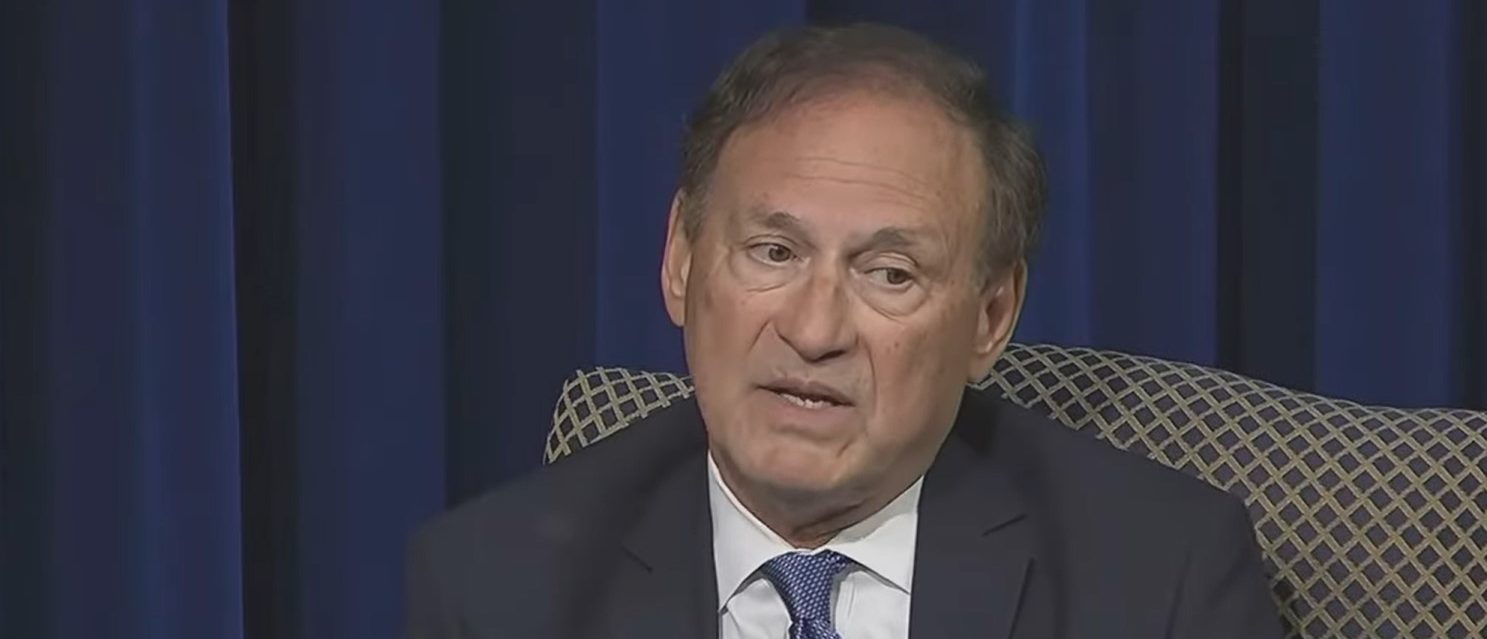
Supreme Court Justice Samuel Alito (Screen Capture/CSPAN)
Justice Samuel Alito’s last-minute recusal has shaken up a blockbuster Supreme Court battle that stands to alter the future of climate litigation across the country.
The Supreme Court is scheduled to hear oral arguments Oct. 5 in Suncor Energy v. County Commissioners of Boulder County, a dispute over whether Colorado localities can use state tort law to seek damages from energy companies for alleged harms tied to global greenhouse gas emissions, according to the court’s docket. Alito recused himself Sept. 28, leaving eight justices to consider the dispute.
“The recusal raises the possibility that the Colorado Supreme Court decision might be affirmed without decision by an equally divided 4-4 U.S. Supreme Court,” Harold Hongju Koh, Sterling Professor of International Law at Yale Law School, told the DCNF. “But that still leaves open an important question for Monday’s oral argument: which Justice might provide a fourth vote for affirmance?”
That even split would leave the 2025 Colorado Supreme Court ruling standing.
“The timing is something of a surprise, but the underlying decision less so because Alito has recused from cases involving energy companies in the past due to his stock holdings,” Jonathan H. Adler, Tazewell Taylor professor of Law at William & Mary Law School told the DCNF.
Alito recused himself from the case Monday without publicly explaining why. The justice does not own stock in Suncor or ExxonMobil, the companies directly involved in the case, but his 2025 financial disclosure shows holdings in other energy companies, including ConocoPhillips and Phillips 66, both of which face similar climate lawsuits around the country. Alito’s disclosure valued his ConocoPhillips investment at up to $15,000 and his Phillips 66 holdings between $15,001 and $50,000.
“Most observers have assumed that Alito was among those most likely to support the petitioners arguments as he has been more likely to vote in favor of federal preemption than most of the other justices,” Adler continued.
Boulder County and the City of Boulder sued Suncor and ExxonMobil in 2018, alleging their fossil fuel activities contributed to climate-related local harms. The Colorado Supreme Court allowed the case to proceed in 2025, with the companies arguing that claims involving interstate and international emissions are governed by federal law, while climate litigation advocates have laid out strategies for pursuing fossil fuel companies through state laws as the High Court showdown approaches.
Similar state-law climate cases are proceeding around the country. California and several local governments have sued major oil companies, alleging they misled consumers about the climate effects of fossil fuels and seeking damages and other relief under state law. A California court stayed the coordinated cases in April, concluding the Supreme Court’s decision in Boulder could resolve “in whole or in substantial part” issues raised in the litigation.
Hawaii has likewise sued BP, Chevron, ExxonMobil, Shell, ConocoPhillips and other defendants, alleging a decades-long campaign of deception about fossil fuels’ climate effects and seeking damages and other relief under state law. Unlike California, a Hawaii court declined to pause the case for Boulder, reasoning in part that the Supreme Court’s eventual ruling might not resolve Hawaii’s deception-based claims.
Minnesota’s case against ExxonMobil, Koch Industries and the American Petroleum Institute similarly alleges the defendants misled consumers about fossil fuels and climate change. A state trial court allowed most of Minnesota’s claims to proceed in 2025, and the Minnesota Supreme Court declined in April 2026 to review an appellate decision allowing the litigation to continue.
New Jersey’s case against ExxonMobil, Chevron, BP, Shell, ConocoPhillips, Phillips 66 and the American Petroleum Institute was dismissed in 2025 after a state judge concluded federal law preempted the state’s climate claims. New Jersey appealed, but the appellate court put that appeal on hold in March pending the Supreme Court’s decision in Boulder.
The outcome, however, may not come down solely to whether the justices agree with Suncor and ExxonMobil on preemption.
When the Supreme Court agreed in February to hear the case, it directed the parties to address an additional question: whether the court has statutory and constitutional jurisdiction to hear it at all.
“It’s always hard to predict how a Justice will vote before the oral argument in a case. It is possible that the Court will split 4-4, which would mean affirming the Colorado Supreme Court’s decision in favor of Boulder County,” Robert Glicksman, J.B. & Maurice C. Shapiro professor of Environmental Law and faculty director of the Environmental and Energy Law Program at George Washington University Law School, told the DCNF.
The case also presents a separate jurisdictional question that could prevent the justices from ever reaching the central dispute over whether federal law preempts Boulder’s claims.
“What makes prediction even more difficult is the presence of a jurisdictional issue,” Glicksman said. “Does the fact that the Colorado Supreme Court affirmed the trial court’s denial of a motion to dismiss deprive the Supreme Court of jurisdiction because [it] is not reviewing a final order? That might preclude the Court from reaching the merits of the preemption issue.”
The case may not split the justices along typical ideological lines because it centers on the balance of state and federal power.
“The case involves federalism issues, on which the Court does not always break down into the usual conservative and progressive split,” Glicksman said.
“Having said all that, Justice Alito has voted to narrow the scope of the Clean Air Act, the Clean Water Act, and the National Environmental Policy Act in recent years. And the Clean Air Act case involved regulations aimed at mitigating climate change,” Glicksman continued. “So he is not known to be a strong advocate of environmental protection. His stance in those cases might be an indication that he would have voted in favor of Suncor. But that’s really speculation.”
Alito’s recusal has drawn mixed responses from legal experts.
“Justice Alito absolutely did the right thing. Given his extensive oil and gas holdings, he had a clear actual conflict of interest — far beyond the ‘could his impartiality be questioned’ standard in the Supreme Court Code of Ethics. The rationale for recusal is far stronger in this case than it was in Plaquemines Parish — in which Alito also recused himself,” Rebecca Bratspies, Oliver Houck professor of Environmental Law at Tulane Law School, told the DCNF.
“As to the outcome, I am optimistic that his recusal will not make any difference because Boulder’s lawsuit is so clearly not pre-empted by the Clean Air Act or by any of the tenuous foreign policy claims,” Bratspies continued. “Not only does the Clean Air Act explicitly not pre-empt the field, there is also no conflict between holding the industry liable in tort for harms caused within the state of Colorado and the industry’s ability to comply with its obligations under federal law. I think all the Justices will recognize that. Indeed, I was surprised that the Supreme Court granted certiorari in the first place.”
“I like to think that had he not properly recused himself, even Justice Alito would have rejected Suncor’s attempt to restrict the availability of Colorado state tort law remedies for harms suffered within the state of Colorado,” she added.
“Justice Alito has stepped aside because of financial interests in energy companies that are not even parties to this case,” Jason Isaac, CEO of the American Energy Institute, told the DCNF.
“Justice Kagan remains on a case involving so-called climate science after putting her name and credibility behind the Reference Manual on Scientific Evidence, a judicial reference manual whose climate chapter became so compromised by conflict-of-interest concerns that the Federal Judicial Center removed it and the National Academy of Sciences launched an independent review,” Isaac said.
Kagan wrote the foreword to the fourth edition of the manual, which is intended to help federal judges evaluate complex scientific evidence. The Judicial Crisis Network called on Kagan in July to recuse herself from the Suncor case, arguing her association with the manual raised questions about her impartiality. Kagan did not write the climate chapter itself. The chapter later came under scrutiny over the involvement of Columbia Law professor Michael Burger, who is also counsel at Sher Edling, a law firm representing governments suing energy companies in climate cases. Burger and other Sher Edling attorneys filed an amicus brief supporting local governments in the Suncor case before the Supreme Court.
The Federal Judicial Center removed the climate chapter, while the National Academies of Sciences launched an independent review of the process used to develop it. NAS President Neil Shubin later acknowledged that the chapter’s authors were more closely associated with climate plaintiffs than defendants and that the chapter did not undergo the organization’s usual conflict-of-interest review.
All content created by the Daily Caller News Foundation, an independent and nonpartisan newswire service, is available without charge to any legitimate news publisher that can provide a large audience. All republished articles must include our logo, our reporter’s byline and their DCNF affiliation. For any questions about our guidelines or partnering with us, please contact [email protected].