

National Defense
China’s Wreaking Havoc On America’s Jet Engine Supply Chain
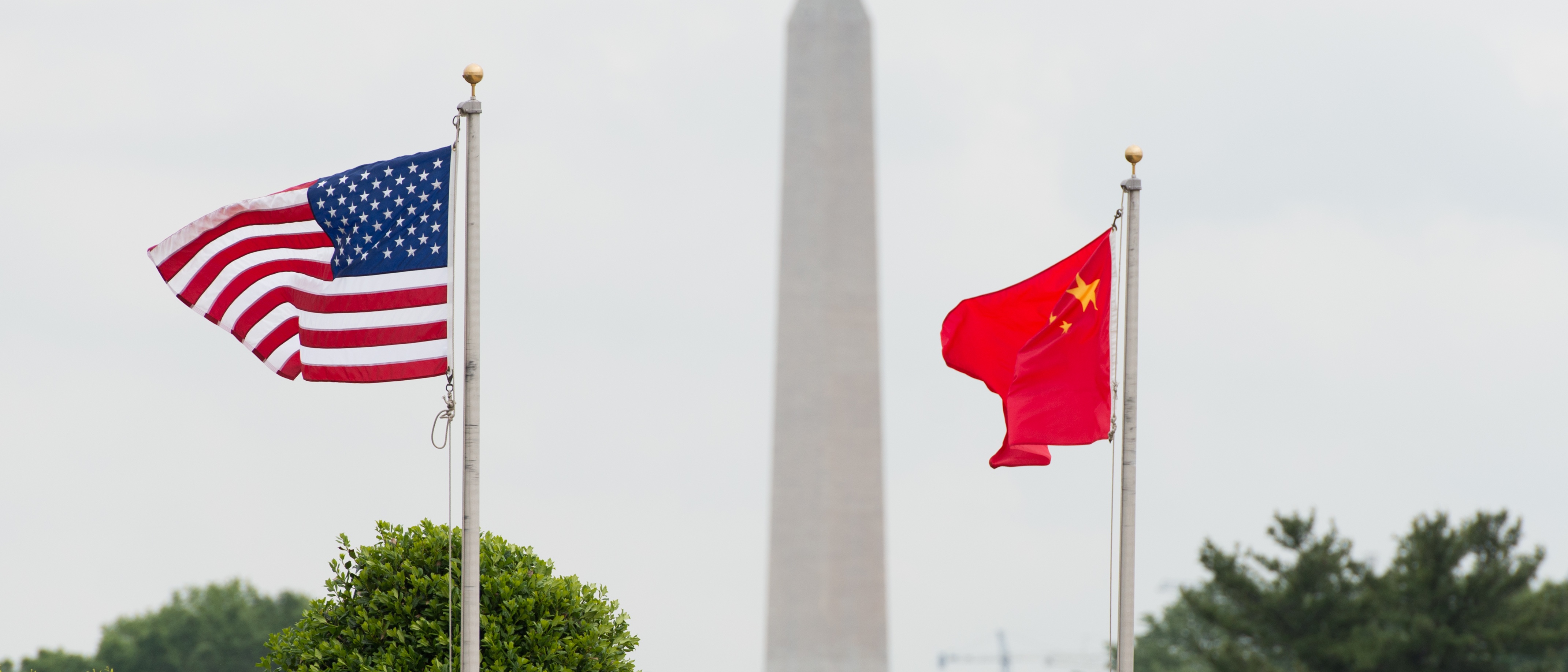
The U.S. and Chinese flags wave in the wind before a full-honor welcome ceremony for Chinese Gen. Fang Fenghui, chief of the General Staff of the People’s Liberation Army, at the Pentagon, May 15, 2014. Gen. Martin E. Dempsey, chairman of the Joint Chiefs of Staff, hosted the ceremony, the first time, since 2012, a full-honors ceremony was conducted. (Flickr/Chairman of the Joint Chiefs of Staff)
America’s aerospace industry is dusting off decades-old technology to protect critical components in jet engines.
The industry is scrambling to replace yttrium, a rare earth metal used in heat-resistant coatings that protect turbine blades, vanes and other jet-engine components from extreme temperatures, Reuters reported. China’s stranglehold on the metal has accelerated that search, with Beijing directly supplying about 70% of U.S. yttrium imports between 2021 and 2024, according to the U.S. Geological Survey (USGS).
“There’s a huge shortage of yttrium, which is used for making turbine coating inside every jet engine,” REAlloys Inc. Chief Growth Officer Anupam Ghildyal told the Daily Caller News Foundation. “Without that, they can’t build jet engines.
The shortage is forcing aerospace suppliers to reconsider technologies dating to the 1970s and 1980s. Suppliers are testing zirconium-dioxide coatings stabilized with magnesium or calcium instead of yttrium, while some companies are also attempting to recycle coating material, according to Reuters.
Chinese yttrium shipments to the United States plunged after Beijing imposed export controls, while prices rose and some coating suppliers rationed material or temporarily halted production, Reuters reported in February. GE Aerospace, Pratt & Whitney and Honeywell declined to comment to Reuters at the time, though aerospace supply-chain specialist Kevin Michaels said low inventories had not yet reduced engine production.
Oerlikon Surface Solutions, a major supplier of aerospace and turbine coatings, uses yttrium in thermal-barrier coatings designed to protect engine components from extreme heat.
China’s restrictions have pushed Oerlikon to seek alternative supplies. Dattatraya Kamatkar, global head of sourcing at Oerlikon Surface Solutions, told Manufacturing Dive in April that the company had to “get creative” securing yttrium oxide, including recycling material from its manufacturing process and working with U.S. suppliers and the federal government to secure additional supplies.
The pressure extends beyond aircraft engines. GE Vernova, one of the world’s largest gas-turbine manufacturers, began working with the U.S. government to increase its yttrium stocks after China’s restrictions disrupted supplies, Reuters reported in December. CEO Scott Strazik said the company had enough inventory to carry it into 2026 and that managing yttrium availability had become a daily focus. GE Vernova is also investing in alternative materials to reduce its dependence on the rare earth.
Honeywell, a major supplier of thermal-barrier coatings for aircraft and industrial gas-turbine engines, uses yttrium-containing materials to protect critical engine components from extreme heat. The company says its predominant aerospace coating is 6% to 8% yttria-stabilized zirconia, a ceramic material containing yttrium.
Those coatings are not confined to Honeywell’s own engines. Honeywell’s current catalog lists coating services for components used in several major GE Aerospace and CFM engine families, including the GE90, GEnx, LEAP and CF34, as well as the military F110. Honeywell describes itself as a developer, supplier and repair and overhaul center whose thermal-barrier coatings are used by aircraft and industrial turbine-engine producers and operators.
“A permanent magnet and rare earth supply chain is only as strong as its weakest link, and nearly every stage today sits in the hands of a strategic adversary,” Abigail Hunter, executive director of SAFE’s Center for Critical Minerals Strategy, told DCNF.
Oerlikon, Honeywell, GE Vernova, GE Aerospace and Pratt & Whitney did not respond to the DCNF’s requests for comment.
China’s Stranglehold
America’s rare-earth vulnerability did not begin with a shortage of rocks in the ground. It developed as the capacity to turn those rocks into usable industrial materials became concentrated overseas.
The distinction, Ghildyal said, is between possessing rare-earth-bearing material and being able to process it. North America has mineral resources, but the United States allowed much of the infrastructure needed to separate, refine and convert those materials into usable products to develop elsewhere. Rare-earth processing is particularly difficult because producers must separate elements with similar chemical properties and, depending on the deposit, manage radioactive materials associated with the ore.
“China has a monopoly of rare earth minerals,” Ghildyal told the DCNF.
Over time, China came to dominate both ends of that supply chain. China accounted for more than 70% of global rare-earth extraction and 87% of processing, according to the U.S. Geological Survey (USGS). It also accounted for all reported production of dysprosium and terbium, two heavy rare earths tracked by the agency.
The United States was consequently left dependent not merely on foreign mines, but on foreign processing capacity. USGS found that the U.S. remained 67% net-import reliant for rare-earth compounds and metals in 2025. The agency also cautions that conventional trade statistics can obscure that dependence because minerals can pass through intermediary countries after being processed elsewhere before ultimately reaching American manufacturers.
Yttrium became a particularly stark example of that imbalance. The United States produced no commercial-scale primary yttrium in 2025 and remained 100% net-import reliant, according to USGS. China directly supplied 70% of U.S. yttrium imports between 2021 and 2024, followed by Germany at 11%, Austria at 8% and South Korea at 4%.
The restrictions turned America’s longstanding processing weakness into an immediate bottleneck for manufacturers that needed those materials. Suppliers serving U.S. aerospace and semiconductor companies were turning away some customers as shortages worsened earlier this year, Reuters reported. Yttrium prices climbed while some North American coating manufacturers rationed supplies or temporarily halted production.
Beijing maintains that the controls are intended to safeguard China’s national security and interests and fulfill international obligations, including nonproliferation. China’s Ministry of Commerce requires exporters of covered rare-earth products to obtain licenses before shipping them abroad, and the U.S. Geological Survey reported that China had begun issuing general export licenses to selected exporters by the end of 2025.
The episode underscored the underlying problem Ghildyal described: finding more rare earths does not by itself break America’s dependence on foreign processing. The United States also needs infrastructure capable of separating and refining those minerals at commercial scale. USGS reported that federal funding flowed to new U.S. heavy-rare-earth separation and recycling projects in 2025, including a $150 million loan for a heavy-rare-earth separation facility at Mountain Pass, California, as Washington sought to expand domestic processing capacity.
“We have a near-total dependence on China for these vital industrial inputs, and China still holds all the cards,” Hunter told the DCNF.
All content created by the Daily Caller News Foundation, an independent and nonpartisan newswire service, is available without charge to any legitimate news publisher that can provide a large audience. All republished articles must include our logo, our reporter’s byline and their DCNF affiliation. For any questions about our guidelines or partnering with us, please contact [email protected].