

National Defense
Trump Pushes Energy Truce As Russian Refineries Burn
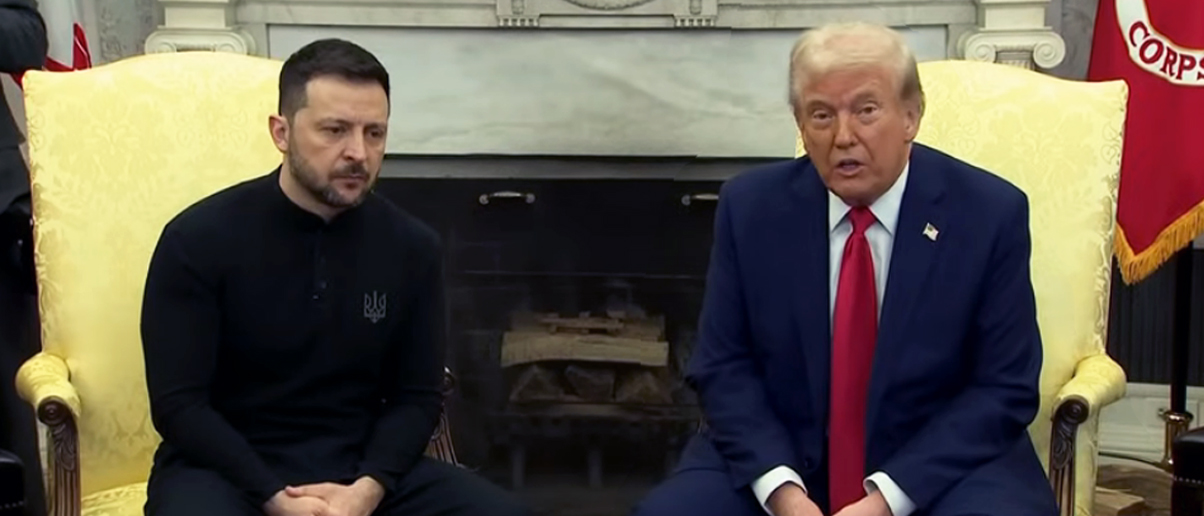
Screenshot/White House/C-SPAN
President Donald Trump and Ukrainian President Volodymyr Zelenskyy are set to discuss an energy ceasefire Tuesday as Ukrainian strikes knock Russian refining capacity offline, deepening pressure on an already strained global fuel supply.
Zelenskyy is expected to meet Trump on the sidelines of the United Nations General Assembly in New York City, where a mutual halt to Russian and Ukrainian attacks on energy infrastructure will be among the issues under discussion, Reuters reported. The talks carry consequences well beyond the battlefield, as Ukraine’s campaign against Russian refineries has taken a growing share of Moscow’s refining capacity offline and experts warn that even relatively small losses in global oil supply can produce outsized price shocks.
“Russia is the world’s third-largest refiner. The sustained Ukrainian drone campaign has cut Russia’s production by 30% over the past year, to its lowest level in more than two decades,” Steve Hanke, a professor of applied economics at Johns Hopkins University, told the DCNF. “Ukraine has now hit all but four of Russia’s 32 largest refineries.”
The disruption to oil flows from Russian exports to the rest of the world is having a devastating effect on global oil markets because even small supply disruptions can lead to large price changes, one expert told the Daily Caller News Foundation.
“The price elasticity for crude oil is approximately minus 0.47, meaning that for a 1% drop in supply to the market, the price will go up roughly 25%,” Ed Hirs, an energy fellow at the University of Houston, told the DCNF. “Logically, this makes sense. If you’re one gallon short of getting home to mom for Thanksgiving, you’d pay $25 a gallon for that, wouldn’t you?”
Trump has separately pressed Zelenskyy to stop Ukrainian attacks on Russian oil refineries as part of a broader effort to de-escalate the war, Reuters reported, citing an anonymous source familiar with the discussions. Kyiv is reluctant to give up those attacks without concessions from Moscow because Ukrainian officials view damage to Russia’s oil industry as a major source of leverage.
“Ukraine’s strategy of targeting Russian refining has been highly effective, with current estimates that about 43% of Russia’s total refining is now offline,” David Blackmon, a Texas-based energy writer and consultant who spent 40 years in the oil and gas industry, told the DCNF. “Formerly the world’s biggest exporter of diesel and other refined products, Russia now finds itself forced to import diesel fuel from India.”
“Consistent reporting suggests the impacts [on Russian energy infrastructure] are substantial — and growing,” J.D. Foster, a former senior fellow on the economics of fiscal policy at The Heritage Foundation, told the DCNF. “Ukraine’s capacity to strike deep and strike hard is growing, Russia’s ability to defend is declining as is Russia’s ability to repair struck facilities. The true evidence lies in the many stories about rising gas prices and long lines at service stations. Putin does not want the effects of the war washing over the general population.”
The State Department, the Pentagon and the Ukrainian and Russian embassies in Washington did not respond to requests for comment.
“The President wants this war settled so the senseless killing ends,” a White House official told the DCNF. “The President and his team remain committed to continuing to play a constructive role in ending the war between Russia and Ukraine, and he remains optimistic that we’ll ultimately get a peace deal done.”
Although the U.S., along with allies throughout the world, agreed to release over 400 million barrels from strategic petroleum reserves in an effort to drive down global prices, Hirs said that this has likely come to an end and cannot be pushed any further.
“There’s really not much more we can take out of the Strategic Petroleum Reserve,” Hirs told the DCNF. “The guys I know who work in that area, Mont Belvieu, Bayou Choctaw and all those areas, say, ‘Guys, we’re at the bottom. Anything that’s counted as oil is sludge on the bottom. We can’t get it out.’ It’s stored in salt caverns.”
Bayou Choctaw is one of four Strategic Petroleum Reserve sites, where the federal government stores emergency crude oil in underground salt caverns, according to the Department of Energy. Mont Belvieu, Texas, is a separate commercial energy hub built around extensive underground salt-cavern storage for natural gas liquids, according to the Department of Energy.
“Almost 100% of our SPR releases and more went overseas to keep the world price down,” Hirs told the DCNF. “You know, at one point the U.S. was exporting more than seven and a half million barrels a day. So that’s not only from our strategic reserve, but that’s from our commercial reserves, and we pretty well run that down.”
Ukrainian officials have also been preparing additional defenses for critical infrastructure, including electronic warfare and air defense measures, according to the Ukrainian presidency.
Although an agreement between Russia and Ukraine to stop targeting oil refineries and other energy production would eventually aid recovery of the world’s energy supply, experts told the DCNF that these boons would not be felt for years as the Russian refineries would take considerable time and resources to repair.
“Repairs to fully restore Russia’s refining capability will take months – likely years – and billions of dollars in capital.” Blackmon told the DCNF.
“Refineries are very complex processing machines,” Hirs told the DCNF. “They use an awful lot of energy to essentially boil the crude oil to to pull off the different products they can through the the towers, the cracking towers, depending upon where these these facilities were attacked, the fabrication of towers, the fabrication of heat exchangers, the fabrication of pumps and manifolds can take months, if not years.”
Zelenskyy said earlier in September that Ukraine was prepared to support an American proposal for a mutual halt to attacks on critical infrastructure if Washington could ensure Russia would genuinely participate, according to the Ukrainian presidency.
“Ukraine will take its own de-escalatory steps,” Zelenskyy said, according to the Ukrainian presidency.
Trump and Zelenskyy also spoke by phone Sunday and agreed to meet in New York, with Zelenskyy saying afterward that there was “diplomatic momentum” and that the talks covered potential de-escalation measures involving energy and food security, according to the Ukrainian presidency.
“The United States continues to play a constructive role in speaking to both sides in working towards bringing the war to an end,” a White House official told the DCNF. “We are the only country in the world that can play that role.”
An earlier attempt to curb energy attacks quickly unraveled. Trump announced last week that the two countries had agreed not to strike energy targets, but Russia attacked petrol stations in Kyiv the following day and Ukraine subsequently struck a Russian refinery, Reuters reported.
Trump said Monday that Russia had “lost control” of its diesel industry after Ukrainian strikes knocked numerous refineries offline, arguing that the continuing war was inflicting costs beyond the two combatants, according to a Truth Social post.
“This ridiculous and never ending War with Ukraine must be ended,” Trump said in the Truth Social post. “The whole World suffers as 25,000 people, mostly soldiers, are being killed each month. What a shame!”
It should be noted that Trump claimed multiple times during his candidacy that he would have the Russo-Ukrainian War ended within a day of taking office.
“Shortly after we all together win the Presidency, we will have the horrible war between Russia and Ukraine settled,” Trump said at a campaign rally in Erie, Pennsylvania, on July 29, 2023, according to the American Presidency Project. “It will be settled. The war is going to be settled. I’ll get them both. I know Zelinsky, I know Putin. It’ll be done within 24 hours.”
“If I’m president, I will have that war settled in one day, 24 hours,” Trump said during a CNN town hall in New Hampshire on May 10, 2023, according to the CNN transcript.
The energy question has also attracted support from European officials. French President Emmanuel Macron discussed a moratorium on Russian and Ukrainian attacks against energy infrastructure with Trump in New York Monday, Le Monde reported.
Russia, however, has not publicly signaled that it is prepared to suspend its broader aerial campaign, Reuters reported. Moscow retains greater missile firepower, while Ukraine has increasingly relied on long-range drones to impose costs on Russian energy infrastructure, the outlet reported.
“Ukraine has far more to gain, because Ukraine is the one being destroyed,” Hanke told the DCNF. “The Ukrainian economy is in dire straits and is now largely dependent on shrinking foreign aid. Ukraine faces a $27 billion shortfall in defense funding. The human toll is far worse than the fiscal one. Deaths are running at roughly four times births, and Ukraine has lost more than half of its population in the 35 years since independence.”
Zelenskyy is also expected to discuss acquiring additional American-made Patriot air defense missiles if Moscow refuses to de-escalate, Reuters reported, citing a source familiar with the matter.
“Since this summer, when Ukraine accelerated its provocations, the Russian counterattacks have been massive,” Hanke told the DCNF. “Russia has hit more than 90% of Ukraine’s warehouses and is effectively destroying the country. It is obvious that Ukraine’s military strategy is totally counterproductive and that a ceasefire is worth far more to Kyiv than to Moscow.”
However, the pool of Patriot interceptors available to send Ukraine is already severely constrained. The United States entered the Iran war with an estimated 2,330 modern PAC-3 CRI and MSE interceptors and had only about 800 remaining by the end of July, a roughly 66% decline, according to the Center for Strategic and International Studies.
Multiple experts said that even if Russia and Ukraine commit to ending attacks on energy infrastructure, the global energy markets would remain tumultuous.
“At this point, a mutual halt between Ukraine and Russia would have minimal impact on global oil, refined-product, or natural-gas prices,” Hanke added.
“A mutual halt to attacks on energy infrastructure would reduce market uncertainty, but it is unlikely to dramatically move global oil or gas prices,” Paul McCarthy, a senior research fellow for European affairs at The Heritage Foundation’s Margaret Thatcher Center for Freedom, told the DCNF. “Energy markets have largely adapted to the Russia-Ukraine war. So, the biggest effect would be greater stability, not a major drop in prices.”
The diplomatic push will continue after the Trump-Zelenskyy meeting. Russian Foreign Minister Sergei Lavrov is expected to meet Secretary of State Marco Rubio in New York Wednesday, Reuters reported.
“Ukraine would gain relief from attacks on its power grid and civilian infrastructure, but it would also lose one of its most effective tools for imposing costs on Russia,” McCarthy told the DCNF. “Whether the deal benefits Kyiv depends entirely on whether Moscow actually honors it. A ceasefire only works for Ukraine if it’s mutual. A one-sided restraint would benefit Russia far more than Ukraine.”
All content created by the Daily Caller News Foundation, an independent and nonpartisan newswire service, is available without charge to any legitimate news publisher that can provide a large audience. All republished articles must include our logo, our reporter’s byline and their DCNF affiliation. For any questions about our guidelines or partnering with us, please contact [email protected].