

Commentary: Big Tent Ideas
Qatar’s LNG Loss Is America’s Gain
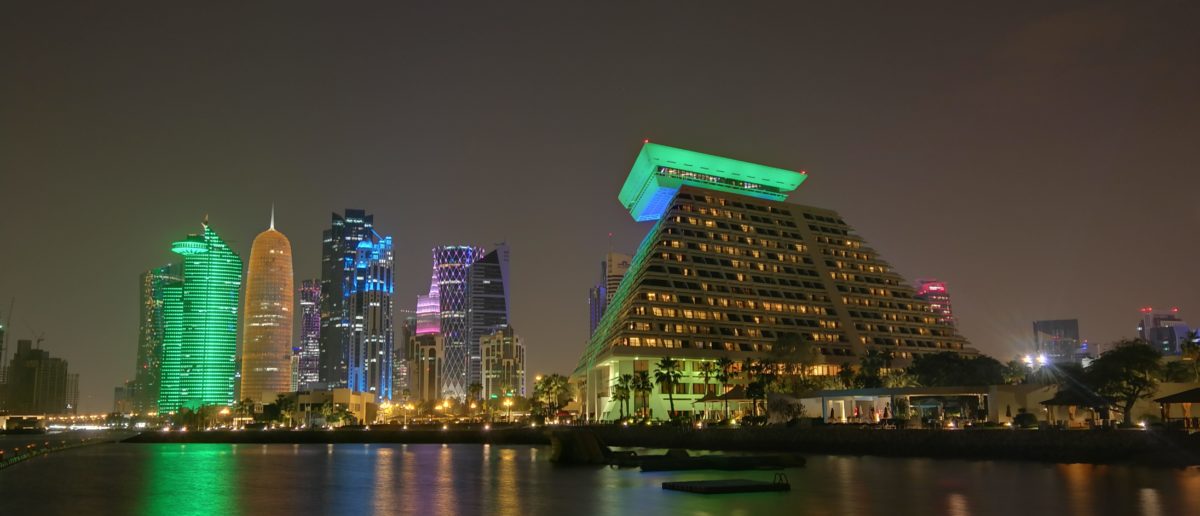
Nikolovskii/Wikimedia Commons
Cheniere Energy completed Stage 3 of its massive Corpus Christi LNG facility on August 28, 2026, marking the latest major expansion of America’s rapidly growing LNG export industry. The company’s announcement comes amid skyrocketing international demand for U.S. liquefied natural gas spurred by the loss of most of Qatar’s exports via the Strait of Hormuz due to a successful missile attack by the Islamic Revolutionary Guard Corps (IRGC) in March.
Located in San Patricio County just outside Corpus Christi, Texas, the Energy Information Administration (EIA) says Cheniere’s latest addition is capable of producing 3.1 billion cubic feet per day (Bcf/d). The added capacity now ranks Corpus Christi LNG as the nation’s second largest LNG facility behind Cheniere’s Sabine Pass LNG in Louisiana, which has a nominal capacity of 3.6 Bcf/d. Altogether, the Federal Energy Regulatory Commission (FERC) reports U.S. online export capacity totals to 15.23 Bcf/d, ranking it as far and away the biggest exporter on earth.
That’s impressive, but is it enough to fill the gap for the lost exports from Qatar? The answer is clearly no, and that has importing countries across Europe and Asia scrambling to fill their own domestic needs with winter fast approaching.
But help is on the way. The Federal Energy Regulatory Commission (FERC) reports a massive total additional capacity of 25.33 Bcf/d is permitted and under construction by companies like Cheniere, ExxonMobil, Venture Global, Woodside, NextDecade, and Sempra. Those facilities are scheduled to come online over the coming four years, and would more than fill the supply hole left by Qatar. Qatar probably won’t be offline forever, so these developers are betting on the LNG market to keep growing over time.
Even more, those companies are betting on the need to grow capacity that can’t be held hostage at the Strait of Hormuz or other choke points in hot spots around the globe. That pressing need was a major topic of discussion at this year’s Gastech Conference, held September 14-17 in Bangkok.
Like it or not, Qatar’s options to establish alternative routes to Hormuz for its LNG to reach global customers are extremely costly and limited. Crude oil produced in Persian Gulf nations can bypass the Strait of Hormuz via the building of new pipelines to ports on the Red Sea or Mediterranean Sea and loaded onto tankers for export. It can even be transported via hundreds of tanker trucks to those ports.
But moving LNG out of the region involves fewer, more costly options. Theoretically, Qatar could move its raw natural gas production via pipeline to a port in another country, where it would then need to either contract with a major liquefaction facility which currently does not exist or reach an agreement with the local government to invest tens of billions of dollars building a new facility of its own. It can be done, but there are returns on investment to be considered and whether attractive returns could be gained while remaining price competitive in a U.S.-dominated export market.
Then there is the possibility – hopefully remote – that traffic flows via Hormuz will never return to their prior status. Sellers and buyers on the global market can’t afford to wait to see what ultimately comes about, which helps to explain the current frenzy of new building in the United States.
America is uniquely situated today to fill the global LNG thirst. The U.S. is home to the the world’s most massive supply of natural gas which can easily fill the needs of the rapidly expanding export sector without causing shortages at home or a blowout in domestic prices. Where prices of crude oil, gasoline, and diesel have exploded since the start of the Iran Conflict, the Henry Hub price for domestic natural gas has remained depressed due to oversupply, currently sitting at right around $3.00 per MMBtu, where it has traditionally resided for the past 17 years or so.
U.S. gas producers have been able to not just maintain national gas production levels but keep them rising despite deploying only slightly more than 100 active gas drilling rigs for the past several years. That number of rigs can be quickly and easily expanded to meet rising demand when needed.
Thus, where natural gas and LNG exports are concerned, Qatar’s loss is America’s gain thanks to its innovative and nimble natural gas industry.
David Blackmon is an energy writer and consultant based in Texas. He spent 40 years in the oil and gas business, where he specialized in public policy and communications.
The views and opinions expressed in this commentary are those of the author and do not reflect the official position of the Daily Caller News Foundation.
All content created by the Daily Caller News Foundation, an independent and nonpartisan newswire service, is available without charge to any legitimate news publisher that can provide a large audience. All republished articles must include our logo, our reporter’s byline and their DCNF affiliation. For any questions about our guidelines or partnering with us, please contact [email protected].