

National Defense
Trump Admin Quietly Opens Direct Talks With Iran-Backed Houthis As Yemen War Heats Up
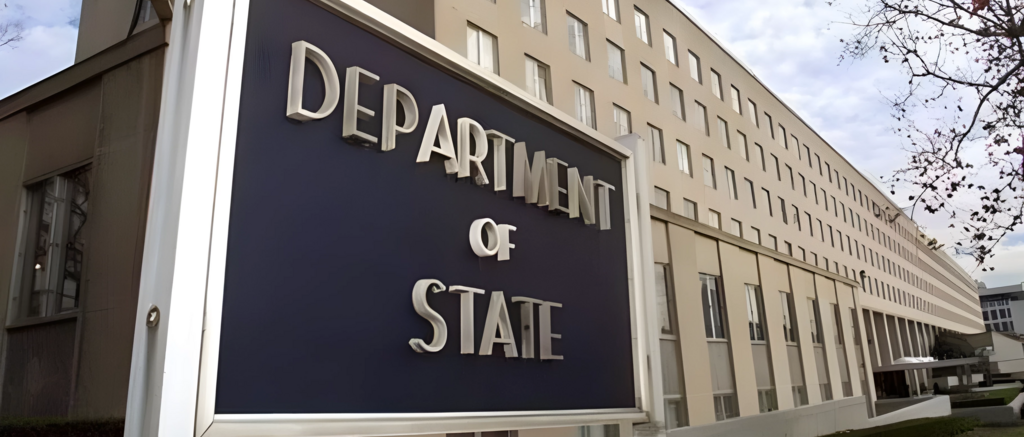
State Department building (State Department / Wikimedia Commons)
U.S. officials reportedly held undisclosed talks with Iran-backed Houthi representatives in Oman over the weekend as the rebels make major battlefield gains against Saudi-backed forces in Yemen.
The alleged meeting took place at the U.S. Embassy in Muscat and was facilitated in part by the Omani government, Reuters reported Wednesday, citing five sources familiar with the matter. The talks indicate Washington is communicating directly with the Houthis even as the Trump administration continues to formally designate the group as a foreign terrorist organization, according to the Federal Register.
“The significance of the timing of U.S. direct talks with the Houthis has to do with what it says about the Iranian regime’s calculus and the successes of the U.S. efforts to eliminate threats from it to the American people,” Jacob Olidort, the director of American Security at the America First Policy Institute (AFPI), told the Daily Caller News Foundation. “The Iranian regime regards the Houthis as a lower-risk option to escalate attacks against U.S. personnel and partners in the region (as opposed to directly doing so or relying on more prominent proxies like Hezbollah).”
“The Houthis likely seek to extract some semblance of international legitimacy by proving they can responsibly guard the Bab-el-Mandeb,” Alex Welz, senior research associate for the Middle East and North Africa at the Heritage Foundation’s Allison Center for National Security, told the DCNF. “However, they remain a U.S.-designated terrorist organization, firm Iranian proxies, and sworn enemies of the West, so their commitments should be taken lightly.”
“We have no comment on this specific reported meeting,” a State Department spokesperson told the DCNF. “However, we remain in regular communication with our regional allies and partners regarding Yemen and are focused on our shared counterterrorism goals against the Houthis and other terrorist groups that sow chaos throughout the region.”
The Houthis allegedly told American officials that they had no intention of attacking U.S. vessels and remained committed to a ceasefire reached with Washington in 2025, Reuters reported, citing two sources familiar with the discussions. A Yemeni source also said the Houthis pledged not to attack Israeli or other commercial vessels, except for Saudi ships, according to Reuters.
“The United States reserves the right to protect its national and international interests,” a State Department spokesperson told the DCNF. “Our commitment to Israel is ironclad. Israel has the right to defend itself, and the United States supports Israel taking necessary action to defend its country, consistent with international law.”
Senior Houthi official Mohammad Abdulsalam, who is under U.S. sanctions, attended the talks alongside Abdelmalik al-Ajiri, while embassy personnel represented the American side, Reuters reported. The State Department did not confirm that the meeting occurred but said protecting freedom of navigation in the Red Sea and preventing the export of terrorism from the Middle East remain core U.S. interests, Reuters reported, citing a department spokesperson.
“As a proxy of the Iranian regime, the Houthis receive training, funding and direction from the regime,” Olidort told the DCNF. “In that light, if the Houthis are offering these assurances could be interpreted and addressed as part of the regime’s response. Most immediately, these assurances indicate that the regime is concerned that any weakening of the Houthis amid a conflict with Saudi Arabia would mean the regime loses a regional proxy and source for regional instability amid this period of diplomatic and economic isolation.”
The State Department raised the issue of arms sales in response to questions about reported U.S.-Houthi negotiations, despite the DCNF inquiry making no mention of any proposed weapons sale or transfer, raising questions regarding a potential future arms sale with the Yemeni government or the Kingdom of Saudi Arabia.
“As a general matter of policy, the Department does not confirm or comment on proposed arms sales until they have been formally notified to Congress,” a State Department spokesperson told the DCNF. “All proposed defense sales and transfers are assessed on their individual merits in accordance with the Arms Export Control Act, the U.S. Conventional Arms Transfer Policy and other related law and policy guidance which accounts for a broad range of political and economic considerations including human rights.”
The Trump administration formally designated Ansar Allah — the Houthis’ official name — as a foreign terrorist organization in March 2025 after President Donald Trump ordered the State Department to begin the process shortly after taking office, according to the Federal Register.
Trump’s January 2025 order accused the Iranian Islamic Revolutionary Guard Corps-Quds Force of supporting the Houthis and said the group had fired on U.S. Navy warships dozens of times since 2023 and attacked commercial vessels transiting the Bab el-Mandeb more than 100 times, per the Federal Register.
Washington nevertheless negotiated with the Houthis later that year, reaching a ceasefire in May 2025 following roughly two months of U.S. strikes intended to halt attacks on Red Sea shipping.
“This development reflects fractures within the anti-Houthi camp in Yemen as well as the increasing urgency the United States views defusing Red Sea maritime security threats with,” Welz told the DCNF. “Direct engagement with the Houthis may also be aimed at establishing a separate negotiating channel decoupling the Houthi campaign from that of Iran’s wider regional strategy.”
The U.S. Maritime Administration warned that the Houthis continued to pose a threat to U.S.-associated commercial vessels in the Red Sea, Bab el-Mandeb and Gulf of Aden despite an extended pause in attacks on commercial shipping, according to a 2026 U.S. Maritime Advisory System statement.
“The United States’ core interests in the Middle East include ensuring freedom of navigation in the Red Sea and the region, as well as preventing the export of terrorism,” a State Department spokesperson told the DCNF. “The Trump Administration has clearly demonstrated its commitment to defending these interests against aggression from Iran and its proxies.”
The latest negotiations come after Houthi forces seized effective control of Yemen’s entire Red Sea coastline, including the historic port of Mocha and Perim Island in the strategically important Bab el-Mandeb Strait.
Saudi Crown Prince Mohammed bin Salman sought U.S. military assistance from Trump as the Houthi advance accelerated, but Washington told Riyadh it did not intend to enter the fighting directly, Reuters reported.
“The meeting indicates the Trump administration’s effort to deescalate and prevent the outbreak of a new major front in the conflict with Iran,” Will Todman, senior fellow in the Middle East Program at the Center for Strategic and International Studies (CSIS), told the DCNF. “The Houthis want to articulate that their campaign has specific and narrow goals. They are aiming to end Saudi intervention in Yemen, rather than trying to increase pressure on the global economy in support of Iran by targeting all shipping going through Bab al-Mandeb. They are also trying to deter President Trump from joining Saudi operations against the Houthis.”
Trump said Saturday that the Houthis had contacted his administration and asked the United States to stay out of the renewed Yemen fighting, Reuters reported, citing the president. Vice President JD Vance said Monday that Washington had held direct talks with the Houthis and remained in close communication with Saudi Arabia about developments in Yemen, according to Al Jazeera.
Secretary of State Marco Rubio also spoke Tuesday with Omani Foreign Minister Sayyid Badr al-Busaidi and recognized Oman’s role in regional de-escalation while reiterating U.S. support for freedom of navigation, according to a State Department readout.
“In the past, the U.S. supported the Kingdom of Saudi Arabia and the corrupt government in Sanaa in their war against the Houthis,” Steve Hanke, a professor of applied economics at Johns Hopkins University, told the DCNF. “The U.S. supplied everything but boots on the ground. That support turned out to be a clear-cut disaster. Now, it looks like the Trump administration is trying to cut its losses and disengage from the long-running regional conflict between Saudi Arabia and the Houthis. As long as that remains the case, talks between the Houthis and the U.S. will probably be, as they say, constructive.”
All content created by the Daily Caller News Foundation, an independent and nonpartisan newswire service, is available without charge to any legitimate news publisher that can provide a large audience. All republished articles must include our logo, our reporter’s byline and their DCNF affiliation. For any questions about our guidelines or partnering with us, please contact [email protected].