

Politics
Major Crypto Bill Crumbles In Senate
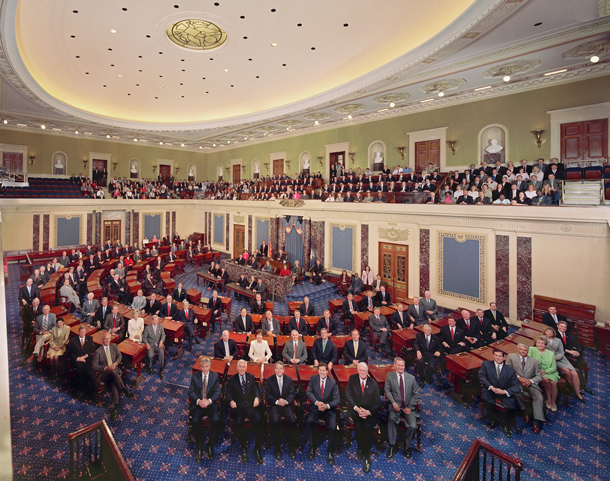
US_Senate | Circa January 2008 | See page for author [Public domain], via Wikimedia Commons | Pmax7
The Senate failed Tuesday to pass a major cryptocurrency bill in a procedural vote after the industry advocated for its passage.
The Digital Asset Market Clarity Act fell short of the 60-vote threshold in a 49 to 50 vote after Democrats and Republicans could not agree on an ethics provision. The crypto industry lobbied for the legislation, which would provide a regulatory framework for cryptocurrency and digital assets, while the banking industry opposed the bill.
Republican Sens. Tim Scott of South Carolina, Cynthia Lummis of Wyoming and John Boozman of Arkansas brought the legislation to the chamber after it passed the House. Some senators, including Republican Sens. Josh Hawley of Missouri and John Curtis of Utah, expressed concern over the legislation’s impact on banks, particularly while the banking industry opposed the bill.
Hawley vowed he would vote with his constituents who were “very worried” about the bill’s effect on community banks.
“I’m going to vote with my state on this,” Hawley said. “I can tell you that my state right now — agriculture folks, local community people — are very, very worried about the effect on community banks. They are blowing me up over it.”
The legislation would establish the nation’s first comprehensive regulatory framework for the cryptocurrency sector by splitting oversight of the industry between the Securities and Exchange Commission (SEC) and the Commodity Futures Trading Commission (CFTC). It includes consumer protections to prevent platforms from collapsing without consequence and sets rules on how crypto could be used for traditional consumer assets like mortgages and loans.
President Donald Trump and most congressional Republicans supported the Clarity Act. No House Republican voted against the bill when it passed the House on July 17, 2025, in a 294 to 134 vote.
Democrats demanded an ethics provision be included to crack down on Trump’s ability to profit off of his family’s crypto businesses. Republicans said they made 126 changes Democrats asked for, including the ethics provision to prevent the president, vice president, members of Congress and federal judges from issuing and sponsoring digital assets.
Democrats sent a counterproposal Monday, arguing the changes were not enough, according to CoinDesk. They argued the updated language would block state attorneys general from directly bringing lawsuits against the U.S. president and that the Office of Government Ethics could issue a notice allowing senior government officials to continue their crypto business ties.
The legislation advanced out of the Senate Banking Committee on May 14 after Democratic Sens. Ruben Gallego of Arizona and Angela Alsobrooks of Maryland voted with Republicans to advance it. Both Democrats said their vote did not guarantee they would vote for it on the floor.
Gallego received support from the crypto industry during his 2024 candidacy. The industry gave money to the super PAC Fairshake and its affiliate, Protect Progress, which spent more than $10 million supporting Gallego, according to the Washington Examiner.
Defend American Jobs, an affiliate of Fairshake, gave $40 million to support Republican Ohio Sen. Bernie Moreno during his 2024 campaign against former Democratic Ohio Sen. Sherrod Brown.
Democratic New York Sen. Kirsten Gillibrand privately urged her colleagues Monday to advance the legislation, according to Politico.
Several banking organizations, including JP Morgan Chase and the American Banking Association lobbied against the bill. JP Morgan Chase CEO Jamie Dimon opposed the bill, arguing against its treatment of stablecoin yields and its lack of legal protections.
“It allows cryptocurrency firms to effectively pay interest on deposits — stablecoins or something like that — without the protection that they should have,” Dimon said. “It has almost no legal protections,” Dimon said on Fox Business in May.
The crypto industry poured nearly $200 million throughout the 2026 election cycle supporting candidates who backed the Clarity Act. Coinbase and Ripple Labs primarily donated to outside groups, including pro-crypto super PACs Fairshake and Protect Progress, which then spent on independent expenditures to support or oppose candidates in the 2026 cycle.
Ripple Labs contributed approximately $49 million in the 2026 election cycle, while Crypto.com spent $38.6 million and Coinbase spent $35.2 million, with the majority of that money going to Fairshake, according to a Public Citizen reported published on June 30. Coinbase lobbying hit $1.07 million in the first quarter of 2026, which included provisions of the Clarity Act.
All content created by the Daily Caller News Foundation, an independent and nonpartisan newswire service, is available without charge to any legitimate news publisher that can provide a large audience. All republished articles must include our logo, our reporter’s byline and their DCNF affiliation. For any questions about our guidelines or partnering with us, please contact [email protected].