

National Defense
Russia’s Undersea War Games Expose Nightmare Scenario For Global Internet
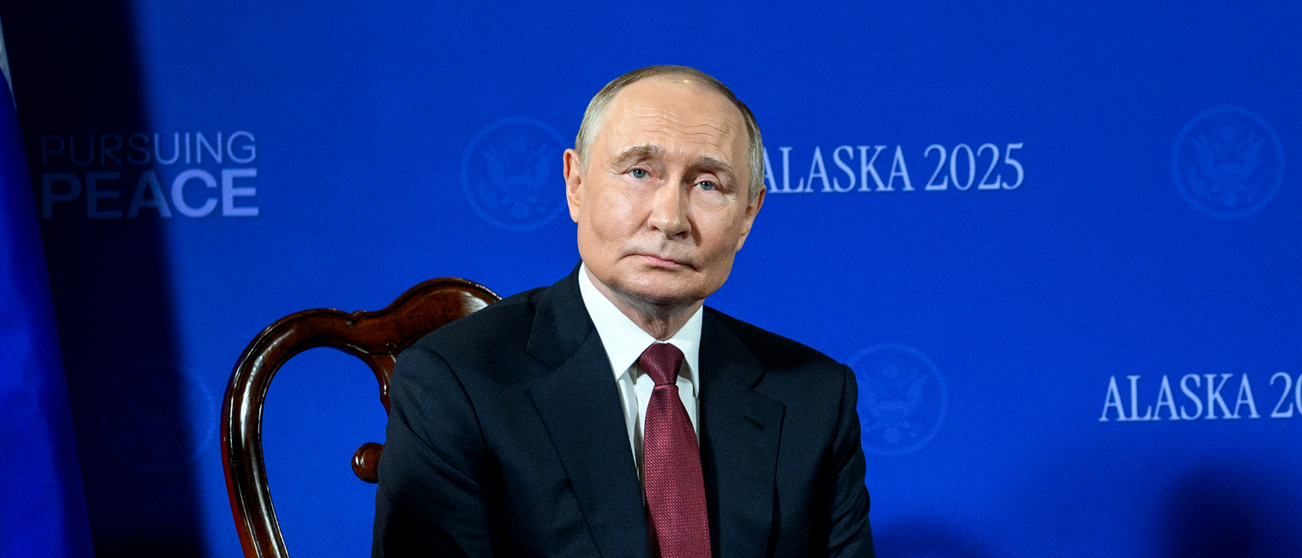
Vladimir Putin (Image via The White House)
Russian submarines allegedly rehearsed deploying technology designed to disable critical undersea communications cables in the Arctic this spring, raising questions about how much of modern civilization would keep functioning if a global war turned the internet’s physical backbone into a battlefield.
British, Norwegian and American forces tracked and confronted the Russian vessels near Norway’s Svalbard archipelago and prevented them from completing the exercise, Reuters reported Thursday, citing two anonymous Western officials. The alleged operation involved Russia’s Main Directorate for Deep Sea Research, known as GUGI, a secretive military organization specializing in deep-sea operations.
The alleged Russian operation adds to growing concern over how vulnerable critical infrastructure on the ocean floor could be during a wider conflict, following the destruction of the Nord Stream pipelines in the Baltic Sea in 2022. The pipeline explosions demonstrated the potential for underwater infrastructure to be severely damaged by sabotage, though the incident has not been attributed to Russia and investigations have increasingly focused on individuals linked to Ukraine, Reuters reported, citing German prosecutors.
An internet infrastructure expert whose research focuses on internet routing told the DCNF that the Domain Name System, or DNS, the system that translates website names into the numerical IP addresses computers use to locate one another online, is the glue holding the global information infrastructure together.
“The DNS, the name system, is dependent on the network, and while caching features heavily in the DNS, as the caches age out a connectivity cut would mean that expired data would not be refreshed and the DNS would slowly dim out and turn dark,” Geoff Huston, chief scientist at the Asia Pacific Network Information Centre, or APNIC, told the Daily Caller News Foundation.
“Once the DNS stops working then we have a massive problem with the infrastructure that supports applications,” Huston told the DCNF. “From mobile phone networks to traffic lights. From electricity grids to water circulation. The failure of flight control systems would totally disrupt aviation, and perhaps more of a concern the failure of the network would precent any attempts to organise a response.”
A global war involving deliberate attacks on those cables could produce consequences considerably more severe than ordinary internet outages, former U.S. Army officer and military communications expert Terry Kelly told the DCNF.
“Not only would undersea cables be cut, but it is likely that there would be at least some if not very significant degradation to satellite comms as well,” Kelly told the DCNF. “However, if WWIII happened, we would see a massive disruption of modern society in any case, whether comms were cut or not.”
No cables were damaged during the alleged operation, which involved Russian deep-sea submersibles simulating deployment of technology intended to disable subsea infrastructure, Reuters reported, citing the Western officials.
The Russian Ministry of Defense did not respond to a request for comment.
Norway had already publicly accused the Russian military organization of developing the ability to threaten Western infrastructure months before Reuters disclosed the details of the alleged exercise. GUGI’s activity demonstrated Russia was continuing to develop its ability to map and potentially sabotage Western critical infrastructure at great depths, Norwegian Defense Minister Tore Sandvik said in April, according to the Norwegian Ministry of Defence.
Norwegian forces deployed a P-8 maritime patrol aircraft and a frigate during the operation, Sandvik said. Norway had also warned Russian authorities that attempts to strike its critical undersea infrastructure would be detected and carry consequences, according to the Norwegian Ministry of Defence.
The stakes for undersea internet cables extend far beyond whether civilians could load websites or send emails.
“The impact would be equally felt by everyone – it would not be isolated to particular countries,” Paul Barford, chair of the University of Wisconsin-Madison Department of Computer Sciences and director of the Wisconsin Advanced Internet Laboratory, told the DCNF. “There is no way to know what the impact would be on military or government systems – but all commercial services would be impacted. It would not be possible to reroute all of the traffic that would be disrupted over ‘other infrastructure’.”
More than 99% of international data traffic travels through submarine telecommunications cables, which support financial transactions, cloud computing, government communications and other critical services, according to the International Telecommunication Union. Disruptions can also affect government and industry operations as well as access to banking, healthcare and education, according to the ITU.
A global conflict resulting in the targeting of information infrastructure would also likely see the destruction of satellites responsible for relaying information by anti-satellite missiles fired from high-flying fighter aircraft.
Russia demonstrated that capability in November 2021 when it used a direct-ascent anti-satellite missile to destroy one of its own satellites, generating more than 1,500 pieces of trackable orbital debris, according to the State Department.
Huston explained that not even satellite systems such as Starlink are immune to disruptions on the ground.
“Starlink relies on an earth network – command and control and earth stations,” Huston told the DCNF. “It’s not immune from failure in terrestrial networks. Yes, you can build rings, and 1+1 redundancy in systems and overprovisioning our systems to ensure that there are no single points of critical reliance. Yes, we know how to do this, and if consumers weren’t such cheap bastards, we could even get consumers to pay for it. But they are cheapskates. And we don’t build what consumers won’t pay for.”
The world has already seen undersea demolition operations unfold. The destruction of the Nord Stream pipeline saw tactics and technology that could easily be repurposed for undersea internet cables.
Explosions ruptured three of the four Nord Stream natural gas pipelines beneath the Baltic Sea in September 2022, severely damaging the system that had carried Russian gas to Germany.
German prosecutors have since indicted a Ukrainian man who was serving as a special forces officer at the time of the attack, while Ukraine has denied involvement in the sabotage, Reuters reported, citing German prosecutors.
Some have alleged that the United States was responsible for the Nord Stream explosions, though the claim remains unproven and Washington has repeatedly denied any involvement.
U.S. Navy divers planted explosives on the pipelines with assistance from Norway, investigative journalist Seymour Hersh alleged, citing a single anonymous source with direct knowledge of the planning, in a February 2023 report.
How individual countries weathered the disruption would depend heavily on the way their economic, technological, social and military systems were structured, Kelly said. Countries better able to rely on domestic communications infrastructure could initially fare better than states heavily dependent upon international connectivity, according to Kelly.
“I do not have a hard list of what would be most disrupted, but since almost all international data transfer happens over these cables, everything that depends on these cables would be disrupted,” Kelly told the DCNF. “The effect would be larger for countries that are unable to respond using internal, domestic communications cables.”
International finance could prove particularly vulnerable, though the consequences would not necessarily fall equally across countries, Kelly said. Nations dependent on access to the U.S.-dominated financial system could face greater difficulties if communications with American institutions were severed, according to Kelly.
The scale of the financial dependence is enormous. NATO said in January 2025 that roughly 1.3 million kilometers of undersea cables supported an estimated $10 trillion in financial transactions each day, according to the NATO.
Military communications would also suffer from widespread cable destruction, though the U.S. military possesses alternative means of communicating at lower bandwidth, Kelly told the DCNF.
“Redundant cable routes might help, though even then they would be relatively few in number and identifiable, and so targetable,” Kelly told the DCNF. “It does not take terribly sophisticated abilities to cut cables, as recent examples of vessels dragging anchors to rip them out show.”
Even widespread cable destruction, however, would represent only one part of the economic catastrophe accompanying a world war, Kelly cautioned. The loss or capture of merchant vessels, collapse of trade between belligerents and disruption of military and intelligence communications could ultimately prove even more consequential than the disappearance of individual internet routes.
“Submarine infrastructure is almost entirely owned and operated by private companies – not nation-states,” Barford told the DCNF. “If there were large disruptions to submarine infrastructure, it would have a dramatic negative impact on virtually all services since a gigantic proportion of Internet traffic flows over submarine cables.”
“In our race to a cheaper, faster, bigger Internet we’ve built a horrendously fragile system that has little more than a superficial veneer of resilience and underneath is all a complex web of interdependence and a worrisome collection of single-points of failure,” Huston told the DCNF. “What would it take to push it over? A sea floor plough and a shallow ocean are good starting points. Our only defence is that there are no nation-states that are completely self-reliant, so any consequent disruption and chaos would be as much a form of self-inflicted damage as it would be to inflict damage on others.”
All content created by the Daily Caller News Foundation, an independent and nonpartisan newswire service, is available without charge to any legitimate news publisher that can provide a large audience. All republished articles must include our logo, our reporter’s byline and their DCNF affiliation. For any questions about our guidelines or partnering with us, please contact [email protected].