

Legal/Law/Criminal Justice and Reform
Supreme Court Justices Get Swamped By Flood Of Briefs As Semi-Auto Showdown Looms
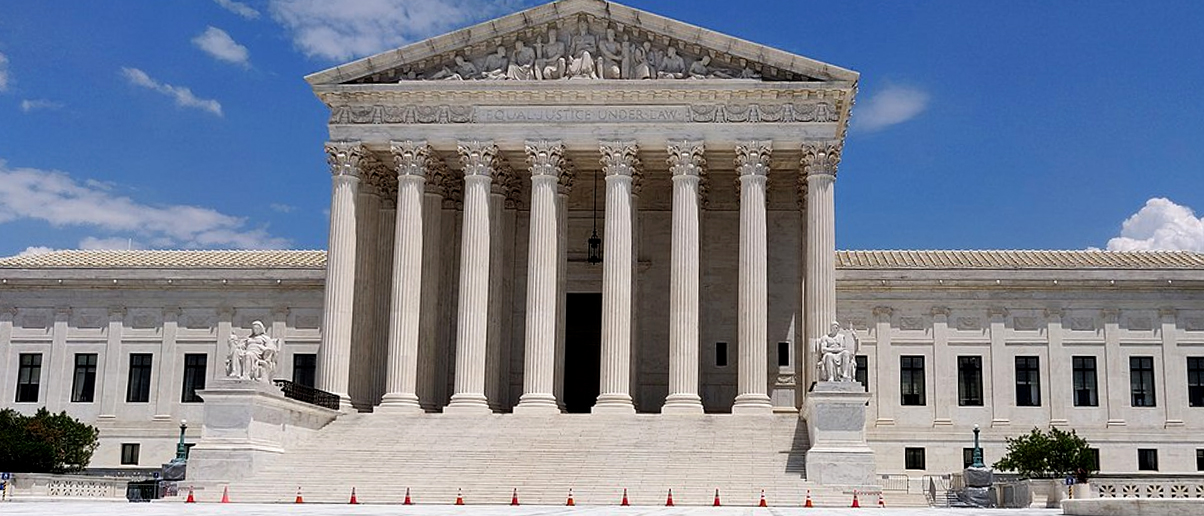
Wikimedia Commons
The Supreme Court received 40 briefs on a significant Second Amendment Case involving semiautomatic firearms as of Friday.
The justices agreed on June 30 to hear Viramontes v. Cook County, a Second Amendment challenge to the Illinois locality’s ban on modern semiautomatic firearms. According to the Supreme Court’s website, “amicus” briefs, also known as “friend of the court” briefs, were submitted by members of the House of Representatives led by Republican Rep. Andrew Clyde of Georgia, multiple United States Senators, 27 states, the federal government via the Department of Justice (DOJ) and numerous pro-Second Amendment organizations at the national and state levels.
“Tennessee and Kansas, along with Alabama, Alaska, Arkansas, Florida, Georgia, Idaho, Indiana, Iowa, Kentucky, Louisiana, Mississippi, Missouri, Montana, Nebraska, New Hampshire, North Dakota, Ohio, Oklahoma, Pennsylvania, South Carolina, South Dakota, Texas, Utah, West Virginia and Wyoming, have a significant interest in ensuring that the Second Amendment receives the full protection this Court’s precedents require,” the brief from the states, led by Republican Attorneys General Kris Kobach of Kansas and Jonathan Skrmetti of Tennessee, said. “Amici States’ citizens are among the millions of Americans who own AR-15 platform and other similar semiautomatic rifles for numerous lawful purposes—including for hunting, for sport, and for defense of self and others.”
“The AR-15 platform rifle is popular for many reasons, not the least of which are its reliability and relatively low recoil, which make it an excellent target gun,” the brief continued. “Amici States are also home to lawful businesses that manufacture and sell these semiautomatic rifles across the country.”
An amicus brief is a legal document filed with the U.S. Supreme Court by someone who is not a party to the case. Its purpose is to offer the justices extra information, specialized expertise, or a broader view of how a ruling might affect people or groups beyond the litigants themselves, according to Cornell University.
One of the briefs was filed by the Liberal Gun Club, alongside the National African American Gun Association, the Asian Pacific American Gun Owners Association and Operation Blazing Sword–Pink Pistols.
“The specific features and firearm models Connecticut and Cook County have banned are among the best-suited for self-defense of any firearm currently available,” the brief said. “Far from lending themselves to criminality, the features that define the rifles respondents have chosen to denigrate are precisely what make them so well-suited to the Second Amendment’s ne plus ultra purpose.”
The Trump administration also weighed in. In a brief filed by Solicitor General D. John Sauer, who was joined by Assistant Attorneys General Harmeet Dhillon and Brett Shumate and Second Amendment Section Chief Barry Arrington, the officials urged the Supreme Court to strike down the bans on so-called “assault weapons.”
“The AR-15 rifle is unquestionably in common use among law-abiding citizens for lawful purposes. Today, AR-15s are lawful at the federal level and in 40 States,” the DOJ brief said. “The overwhelming majority of AR-15 owners possess those rifles for the lawful purposes to which they are adapted, such as self-defense in the home, hunting, and target shooting. A ban on possessing such rifles thus violates the Second Amendment.”
Georgetown University Professor William English, who released the 2026 National Firearms Survey in August, filed a brief alongside the Center for Human Liberty in which he discussed the findings from the survey, notably his estimate that 60 million modern semiautomatic rifles and 539 million detachable magazines holding more than ten rounds are privately owned in the United States.
“25.0% of gun owners currently own an AR-15 type rifle, 12.9% currently own other similarly styled semi-automatic rifles, and 30.0% – approximately 26.4 million adults – currently own at least one firearm in one of these two categories, with approximately 40 million AR-15 type rifles and 20 million other similarly styled rifles owned in total,” the study said.
English hammered home the popularity of modern semiautomatic firearms in his brief filed Friday, detailing substantial ownership of the firearms even in states where they were restricted.
“Ownership of these rifles is geographically and demographically broad,” English said in the brief. “Validated gun owners in every state and the District of Columbia report currently owning them, including in the jurisdictions whose laws are at issue in these cases: among gun owners, 29.9% in Illinois and 24.2% in Connecticut currently own an AR-15 or similarly styled rifle, as do 29.9% in California, 31.0% in New York, 28.5% in New Jersey, and 28.3% in Massachusetts. The challenged laws are outliers. The ownership they target is not.”
“Ownership is also common across demographic groups,” English continued. “36.4% of Black gun owners, 38.2% of Hispanic gun owners, 30.7% of Asian gun owners, and 21.3% of female gun owners currently own such a rifle. These are ordinary firearms chosen by a broad cross-section of American society.”
One of the more surprising parties filing an amicus brief Friday was the United States Conference of Catholic Bishops, which appeared to offer conflicting arguments in the submitted document.
“Indeed, allowing gun ownership figures to have dispositive weight would create serious circularity problems in Second Amendment doctrine—making the question whether governments may regulate particular weapons depend on whether governments are already regulating those weapons,” the Catholic organization said. “But governments should not be allowed to defeat the Second Amendment right by prohibiting weapons before they become common.”
“[B]y the same token, the commercial proliferation of a weapon before it is regulated should not constitute an automatic constitutional immunization from regulation in the future,” the Catholic bishops added. “Moreover, allowing ownership figures for assault weapons to dictate the outcome in this case would be particularly unwarranted, where polling data indicates that only 6 percent of Americans own such weapons.”
Cook County, Illinois and Connecticut must file their responses by Oct. 21, while reply briefs from the petitioners are due Nov. 20, according to a filing with the Supreme Court. The justices scheduled oral arguments for the case on Dec. 2, with a decision expected no later than summer 2027.
All content created by the Daily Caller News Foundation, an independent and nonpartisan newswire service, is available without charge to any legitimate news publisher that can provide a large audience. All republished articles must include our logo, our reporter’s byline and their DCNF affiliation. For any questions about our guidelines or partnering with us, please contact [email protected].