

Business
It’s Easier Than Ever To Trap Young People In Debt. What Is The White House Doing About It?
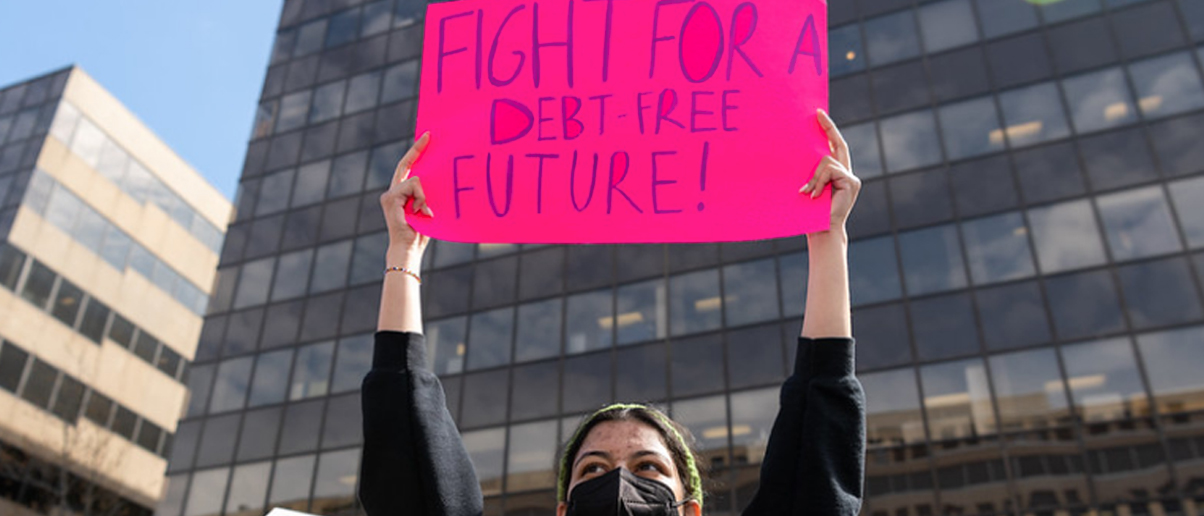
(Mike Ferguson/AAUP via Flickr)
The White House hones in on financial literacy through Trump Accounts as more Zoomers turn to social media influencers amid rising debt.
The gap between Boomers’ and Zoomers’ ability to handle sudden financial hardships widened to 23.1 points — 10% higher than last month, according to NerdWallet’s July Financial Resilience Index published July 21. Meanwhile, the Financial Literacy and Education Commission (FLEC) held a meeting on Monday to discuss improving financial literacy in the digital age.
Both the meeting and NerdWallet’s index come as student loan debt in the U.S. reached a record high of $1.863 trillion, per a July 17 report by the Education Data Initiative. Nearly two-thirds (62%) of Zoomers graduating high school in 2023 intended to go to college, according to a Gallup poll. However, over half (55%) of respondents felt pressured by their parents to enroll.
Additionally, it’s easier than ever before for young Americans to get trapped into cycles of debt. For example, the global Buy-Now-Pay-Later (BNPL) market reached over $560 billion in 2025 with over 380 million users, Chargeflow reported July 16. Around 68% of Zoomers and 76% of Millennials use BNPL, PartnerCentric reported July 10. Meanwhile, around 35% of respondents earning less than $20,000 per year said it’s the only way they can afford groceries.
“I have long believed that the strength of a nation lies as much in the wealth it creates as in the opportunity it extends,” U.S. Treasury Secretary Scott Bessent said during his opening statement to FLEC. “That conviction has guided me throughout my career and animated my work as Treasury Secretary. It’s why one of the first actions I took upon entering office was relaunching Financial Literacy Month. And it’s why I am proud to work alongside each of you to help more Americans participate more confidently in our nation’s economic life.”
Congress established FLEC in 2003 to develop a national financial education website. The commission is composed of twenty-four agency heads, and chaired by the U.S. Secretary of the Treasury.
“Of course, in recent decades, digital platforms and products have redefined how the American people bank, invest, save, spend, and borrow. And the easier it is to participate in our financial system, the more important it becomes to understand how it works,” Bessent said before noting that “many consumers, especially younger Americans, are turning to social media, online communities, and AI for financial advice.”
Approximately 61% of investors aged 18-34 reported making investment decisions off of social media influencers, per an April report by the FINRA Investor Education Foundation that was presented to FLEC during the meeting.
Bessent said Trump Accounts demonstrate what ensuring that financial education keeps pace with financial innovation “looks like in practice,” noting that over 7 million children were enrolled since its July 4 launch and that 86% of them are from families earning less than $200,000. “Every child born during the President’s term can get a stake in the American Dream from day one with a $1,000 seed investment from the U.S. Treasury,” he said.
He also noted that approximately two-thirds of Gen Z Americans “fail to answer more than half of basic financial literacy questions.”
“We can move those figures toward zero by creating a new class of shareholders. Trump Accounts will unleash a financial literacy boom. The daily movements of the market will now be personally meaningful to millions. American families, left on the sidelines of Wall Street for too long, will finally understand what a piece of the action feels like,” Bessent said.
Bessent told the commission that the Trump Accounts app will include fifteen modules developed by the U.S. Department of the Treasury, tailored to each age group.
FLEC held a 4-member panel after multiple members made their remarks.
Comptroller Jonathan Gould, a member of FLEC, said the Trump Accounts will help combat “socialism and other poisonous ideologies.”
“As Secretary Bessent has said, ‘for Americans to believe in capitalism, they need the opportunity to participate in it,'” Gould said at the meeting. “Banks have an important role to play in this effort as a strong market economy depends on informed consumers who understand the concepts of saving, responsible borrowing, and investing. Expanding financial literacy is therefore not only good for families and communities, but it also advances a broader culture of ownership and economic opportunity that strengthens our financial system and reinforces the principles of free enterprise.”
One of the panelists, Next Gen Personal Finance (NGPF) Educational Outreach Director Yanely Espinal, recommended that the commission create a scoring tool where a student pastes in a link to a piece of content and gets a grade from A+ to F on disclosure, sourcing, balance and pressure.
“This is a story about how our institutions never taught young people to make savvy financial choices, so finfluencers [finance influencers] stepped up to fill the gap,” Espinal told the DCNF when asked about the history of financial content creation.
Espinal said that YouTube’s Partner Program and Instagram gave ordinary people a way to build and monetize an audience without brand partners as early as 2007-2010. Amid the rise of zero-commission trading, stimulus checks, lockdowns, meme stocks, and a crypto “bull run” in 2020-2021, millions of people opened their first brokerage account with no financial education.
“On the older social media platforms you needed a following to reach anyone, but then TikTok changed that. A college student with 200 followers can now reach a million people with one 30-second video about picking stocks,” Espinal said. “If that student is being paid to promote stocks, disclosure is required, but enforcement is thin enough that it still feels like the Wild West when it comes to knowing who’s getting paid.”
Espinal said the cost is the “biggest” benefit of this development.
“A CFP or Certified Financial Planner charges hundreds of dollars an hour or won’t take you on as a client without a minimum in assets. Finfluencer content is free anywhere you connect to WiFi,” Espinal said.
“Creators also broke the taboo around talking about money, which is a really healthy generational shift. They post real salary numbers and real debt figures out loud, which families and institutions rarely ever did in the past. Young people appreciate that kind of transparency and ‘realness,’ Espinal said. “Hearing about credit from someone three years ahead of you lands differently than hearing it from a parent or a teacher a full generation up. That’s why so many young people relate to near-peer finfluencers.”
However, Espinal also said that there are some negative aspects of financial content creation.
“The core problem is that reach has become more important than credibility. The algorithms give you an incentive for posting more content, but it runs directly away from good advice. Algorithms reward certainty and excitement, not accuracy,” Espinal said. “‘Buy low-cost, diversified funds and hold them for decades’ is content that generally performs poorly. ‘How I made thousands day trading’ performs really well.”
“Then there’s the money behind the scenes and not in the content. Polymarket was just sued over its influencer campaigns,” Espinal added. “Reporters found close to 500 posts promoting the platform with no disclosure that the creators were paid, and hundreds of thousands of dollars routed to them through a personal PayPal account. In some of the videos, the winning bets were simulated. How is a teenager scrolling before bed supposed to know they’re looking at an ad, let alone a fabricated one?”
Some of those negative aspects reflect a gap in American financial culture that can be bridged.
“When it comes to undisclosed advertising, we’ve built rules and enforcement from the top down, catching violators after the fact. What we never built is the reflex that lets young people spot red flags themselves,” Espinal said. “Enforcement reaches a fraction of the problem, years late. When a student is taught to ask, ‘Who paid for this?,’ they are empowered to spot red flags in real time, for free.”
Espinal told the DCNF that NGPF advocates for requiring a personal finance to be taught in every public high school in America. Thirty states require such a course for high school graduation as of Oct. 2025, according to NGPF.
Espinal recommended asking yourself the following questions when seeking financial advice online: 1) “Does this creator get paid, and how?”, 2) “Do they ever show the downside?”, 3) “Can I trace the claim back to a primary source?”, and 4) “Is there urgency?”
“Urgency is a sales technique. It is never a teaching technique,” Espinal warned.
All content created by the Daily Caller News Foundation, an independent and nonpartisan newswire service, is available without charge to any legitimate news publisher that can provide a large audience. All republished articles must include our logo, our reporter’s byline and their DCNF affiliation. For any questions about our guidelines or partnering with us, please contact [email protected].