

Politics
Professor Testifies Against Taxpayer-Funded Smithsonian’s Alleged Anti-America Agenda
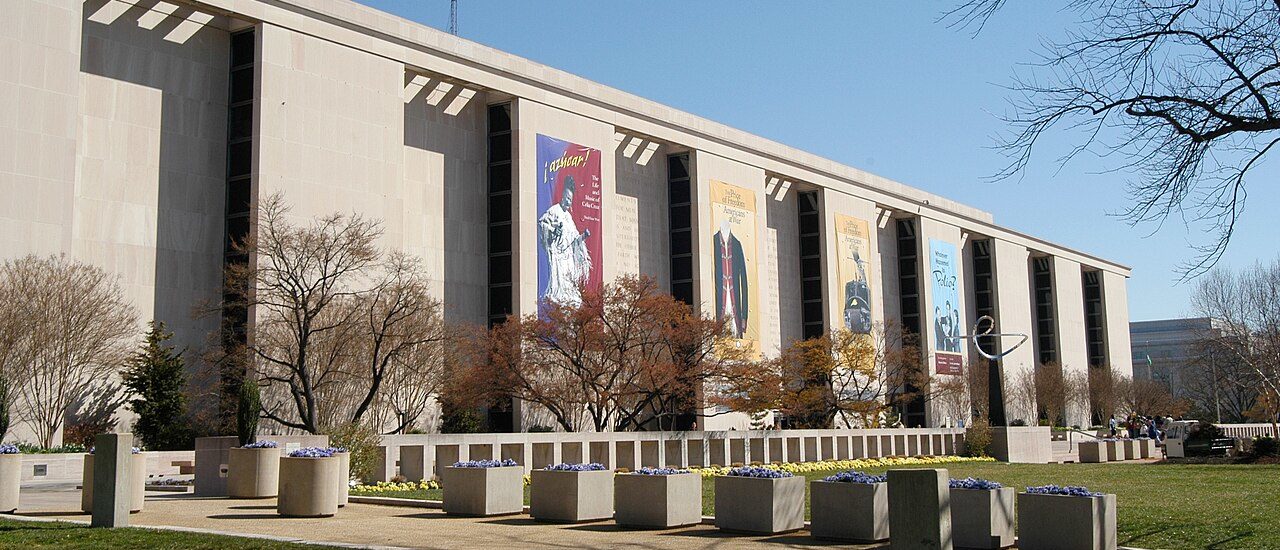
G. Edward Johnson, CC BY 4.0 <https://creativecommons.org/licenses/by/4.0>, via Wikimedia Commons
A Hillsdale College professor testified before a House subcommittee about the alleged anti-American agenda of the National Museum of American History.
Matthew Spalding testified Tuesday before the House Committee on Oversight and Government Reform’s Subcommittee on Delivering on Government Efficiency about “efforts by the National Museum of American History (NMAH) to replace the story of America’s past with an activist ideology aimed at transforming its future,” according to a Hillsdale College press release.
“[T]he National Museum of American History is no longer the nation’s museum of American history,” Spalding, the dean of the Van Andel Graduate School of Government at Hillsdale College and professor of Constitutional Government, said at the committee’s hearing, according to the release.
The hearing, titled “Rewriting American History: Examining the Smithsonian’s Efforts to Reshape the Past,” examined efforts by the taxpayer-funded Washington, D.C. museum “and the broader Smithsonian Institution to promote divisive, inappropriate, and factually inaccurate programming on U.S. history,” according to the Committee’s press release. The hearing follows the July 4 release of a 162-page report from the White House about NMAH’s failures, titled “Saving America’s Story.”
The report found that the NMAH leadership “has explicitly adopted an ideological framework that no longer treats the American story as a shared national inheritance to be taught or celebrated, but as a political instrument to divide, dispirit, and discourage our citizens.”
“The real crime here, premeditated and followed through, is that America’s story — the well-established narrative of main characters and key events long at the center of American self-understanding — has been so reframed, jettisoned, decentered, deconstructed, and ‘problematized’ that it no longer exists in recognizable form,” Spalding said during the hearing.
Two exhibits at the NMAH, “American Democracy: A Great Leap of Faith” and “Many Voices, One Nation,” specifically highlight the social change the museum is hoping to make, according to both the White House report and Spalding.
“American Democracy: A Great Leap of Faith” references the Declaration of Independence, but then claims that “Americans also inherited a belief in social hierarchy and institutions that perpetuated inequality,” according to the report. “While the exhibit does not offer a history of how America came to create the Declaration of Independence, it does show “the Nation’s failures as a democracy and popular resistance to alleged systemic flaws.”
One part of the exhibit features the words “slavery,” “privilege,” and “rights of women” in large print, with “free press,” citizenship,” and “rights of man” in much smaller print, according to the report.
“Our work is governed by the Smithsonian standards of scholarship, accuracy, independence and nonpartisanship. The museum does not take sides in America’s political debates. We preserve and document the evidence of American life in all of its breadth, so that the public can encounter the past and draw their own conclusions,” Anthea Hartig director of NMAH said at the hearing.
The “Many Voices, One Nation” exhibit claims that “[t]here is no single American culture, language, or narrative,” and fails to provide a coherent narrative of American history, the report notes. Instead, it “pieces together alleged examples of Americans oppressing immigrants and other groups” claiming to explain the journey that “maps the cultural geography of the unique and complex stories that animate” the phrase, “Out of many, one.”
“The two exhibits together reframe the American narrative. The key figures of early American history are set aside, and the key events are decontextualized to avoid the presentation of a coherent or chronological story by which those individuals and events are central,” Spalding said at the hearing.
Mike Gonzalez, Senior Fellow at The Heritage Foundation, also testified about the failures of MNAH and its leadership. Subcommittee Chairman Tim Burchett and Texas Rep. Brandon Gill notably questioned Hartig.
“America’s history belongs neither to liberals nor conservatives,” Spalding testified to the committee. “It belongs to the American people. It should be told, warts and all, so that visitors understand the basic chronological narrative and see how the nation got to where it is today. Nothing integral to that history should be erased or whitewashed. But social transformation should not be the objective.”
Many changes came to the museum when Hartig became its director in 2019.
Spalding warned about the changes of the strategic plan in the Museum in recent years. The previous plan had the mission of exploring “the infinite richness and complexity of American history” and helping “people understand the past in order to make sense of the present and shape a more humane future,” but the new plan’s mission, established under Hartig, is about “[e]mpowering people to create a more just and compassionate future by exploring, preserving, and sharing the complexity of our past.”
The professor noted that the new mission replaced “American History” with “our past.”
“The nation was founded on the great paradox of a dynamic form of republican democracy based on the supremacy of white, landed men and the institution of chattel slavery. What then is our task?” Hartig asked in a May 2020 press release, titled in part “In Slavery’s Shadow: George Floyd and American Legacies.”
“At the National Museum of American History, we work to reframe the traditional celebratory narrative of U.S. history for visitors to our museum and digital spaces. Hosting and facilitating dynamic public programming and national reckonings is critical for us to help all Americans make sense of these tragically difficult times,” she continued.
The NMAH established The Center for Restorative History in February 2026 to address “the needs of historically harmed communities,” Spalding noted from Center’s own explanatory document. These communities are “black, indigenous, and other people of color,” and “lesbian, gay, bisexual, transgender, queer and more,” and the root cause of these harms is “systemic oppression.”
“This is not a history based on established facts and known reality. Indeed, it is not history at all. This is ideology, a systematic framework for interpreting society and instigating an agenda for change,” Spalding said in his testimony.
All content created by the Daily Caller News Foundation, an independent and nonpartisan newswire service, is available without charge to any legitimate news publisher that can provide a large audience. All republished articles must include our logo, our reporter’s byline and their DCNF affiliation. For any questions about our guidelines or partnering with us, please contact [email protected].