

Legal/Law/Criminal Justice and Reform
Samuel Alito Shreds Blue State’s ‘Spirit Of Aloha’ Legal Defense In ‘Vampire Rule’ Gun Ruling
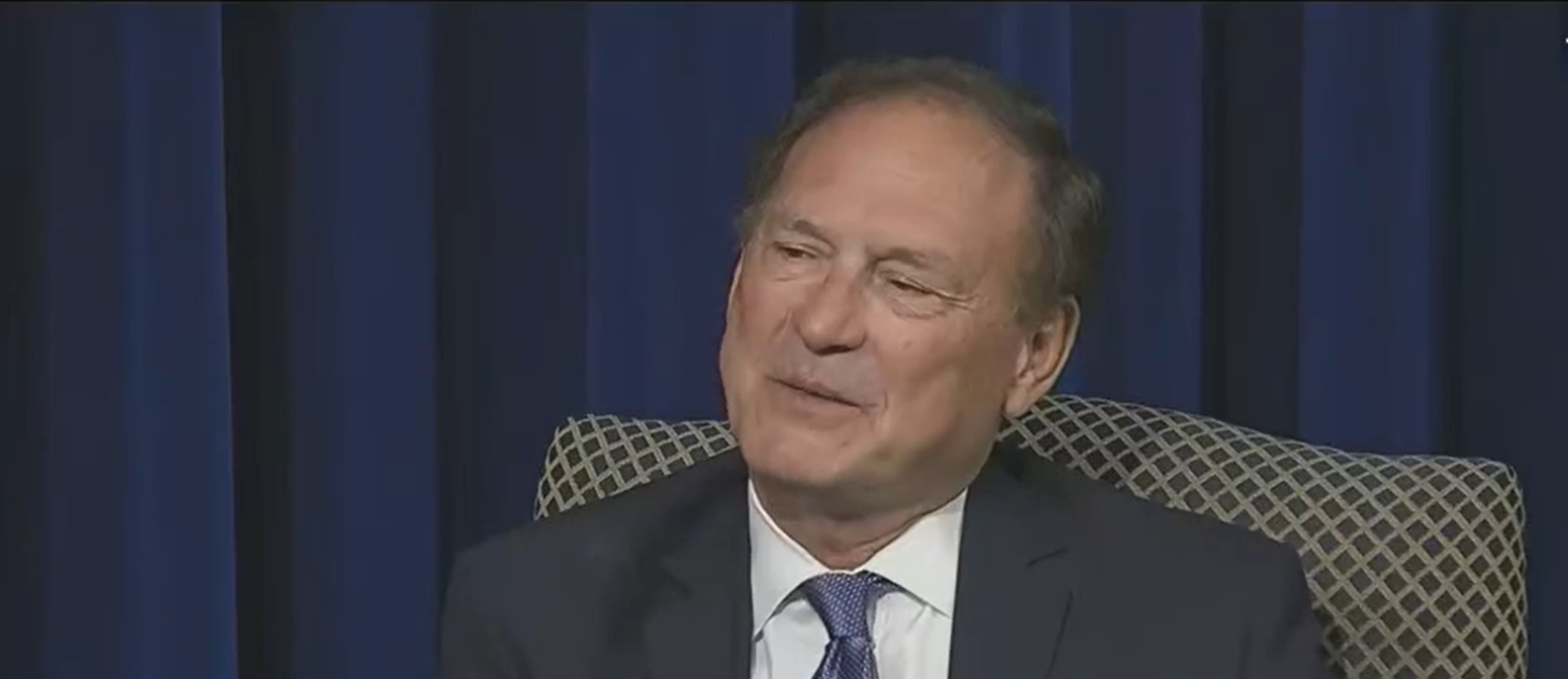
Supreme Court Justice Samuel Alito (Screen Capture/CSPAN)
Supreme Court Associate Justice Samuel Alito derided legal arguments presented by Hawaii in an opinion released Thursday that invalidated a state law targeting concealed carry gun owners.
The high court ruled in Wolford v. Lopez that the state’s law requiring private property owners who wished to allow concealed carry on the premises to clearly post signs that carrying guns was allowed was unconstitutional. In the majority opinion, Alito slammed attorneys representing Hawaii for citing a Louisiana law passed shortly after the Civil War to justify the restrictions in the “vampire law” while also taking aim at a 2024 state Supreme Court ruling that cited the “spirit of aloha.”
Alito took aim at the Hawaii Supreme Court over its effort to ignore the Supreme Court’s rulings in Heller, McDonald and Bruen. In the 2024 ruling, the Hawaii Supreme Court invoked the “spirit of Aloha.”
“The Second Amendment has the same meaning in all parts of the United States,” Alito wrote in response to the Hawaii Supreme Court ruling, which the Supreme Court allowed to stand on a technicality. “It cannot give way to ‘the spirit of Aloha’ in Hawaii, any more than it can yield to the spirit of the Big Apple (Bruen) or the Windy City (McDonald). It applies in the same way to our 50th State (where about 8% of adults possess guns) and our 49th State (where the figure is roughly 59%). Merely local attitudes can neither shrink nor inflate the meaning of fundamental Bill of Rights guarantees that apply to the States through the Fourteenth Amendment.”
“The spirit of Aloha clashes with a federally-mandated lifestyle that lets citizens walk around with deadly weapons during day-to-day activities,” the Hawaii Supreme Court opinion in Hawaii v. Wilson said. “The history of the Hawaiian Islands does not include a society where armed people move about the community to possibly combat the deadly aims of others.”
Louisiana’s Black Codes were a set of restrictive laws enacted in late 1865 by the state’s provisional legislature shortly after the Civil War and the abolition of slavery via the 13th Amendment, according to the History.com. These codes aimed to control the labor, movement and freedoms of newly emancipated African Americans, effectively seeking to restore a system akin to servitude by requiring labor contracts, limiting property rights, restricting assembly and mobility, and—crucially for Second Amendment concerns—severely limiting black people’s ability to keep and bear arms.
Specific provisions prohibited black individuals from carrying firearms or weapons without special written permission from employers or authorities, with penalties including forfeiture, fines or forced labor, according to the National African American Gun Association (NAAGA).
“Regardless of this provision’s pedigree, it has no probative value for present purposes. As we have said, in considering the probative value of a historical analogue, we must consider whether it was widespread, well-known, and widely accepted,” Alito wrote about the state’s citation of the Louisiana law. “Because this statute was neither widespread nor widely accepted, it carries no weight. We could stop there, but there is another reason for rejecting Hawaii’s reliance on this statute. It was adopted by the Louisiana Legislature between the end of the Civil War and the beginning of Reconstruction. When the war ended, the legislatures in defeated Confederate States quickly enacted so-called Black Codes that aimed to perpetuate the subjugation of blacks. The statute Hawaii cites was part of Louisiana’s Black Code, and it provided a tool for disarming blacks and thus leaving them defenseless against attacks.”
Writing for the Supreme Court’s 6-3 majority in Wolford v. Lopez, Justice Samuel Alito said the Second Amendment “cannot give way to the spirit of Aloha” in Hawaii.
The opinion struck down a Hawaii law requiring concealed-carry permit holders to get express permission before… pic.twitter.com/NOCPKnmq6H
— Daily Caller (@DailyCaller) June 25, 2026
“As we laid out in McDonald, the right to keep and bear arms was crucially important for vulnerable blacks during this period,” Alito continued. “And this was well-understood by the Republicans in Congress who were responsible for drafting, approving, and securing the ratification of the Fourteenth Amendment. The Republican Party Platforms of 1856 and 1860 called for protection of the right to keep and bear arms for self-defense. Unless we put history entirely out of our minds, Hawaii’s claim that this tainted artifact illuminates the original understanding of the right to keep and bear arms cannot be taken seriously.”
The Supreme Court completely rejects the argument advanced by Hawaii and some other states that local customs matter to historical tradition.
And that makes sense, because what we care about is a *national* tradition. pic.twitter.com/EZYphfzSYZ
— SAF (@2AFDN) June 25, 2026
In a concurring opinion, Associate Justice Amy Coney Barrett also appeared to cast shade on the state’s argument using Louisiana’s Black Codes.
“Even if Hawaii is right that the how is analogous, it also must identify an analogous why. The Black Codes were enacted to subordinate newly freed slaves. Hawaii obviously does not contend that its law promotes an analogous interest. So its law and the default rules in the Black Codes are not ‘relevantly similar,’” Barrett wrote. “Most would take that as a compliment.”
“The State of Hawaii’s use of Louisiana’s Black Code to justify their broad carry ban can only be likened to grasping at straws,” Second Amendment Foundation Executive Director Adam Kraut told the Daily Caller News Foundation. “Justice Alito, in the majority opinion, rightly notes that unless we entirely ignore history, Hawaii’s claim that this repugnant law illuminates the understanding of the right to bear arms cannot be given any credence.”
All content created by the Daily Caller News Foundation, an independent and nonpartisan newswire service, is available without charge to any legitimate news publisher that can provide a large audience. All republished articles must include our logo, our reporter’s byline and their DCNF affiliation. For any questions about our guidelines or partnering with us, please contact [email protected].