

Legal/Law/Criminal Justice and Reform
2A Orgs Pop Champagne Corks Over Unanimous Supreme Court Ruling Paring Back Gun Law
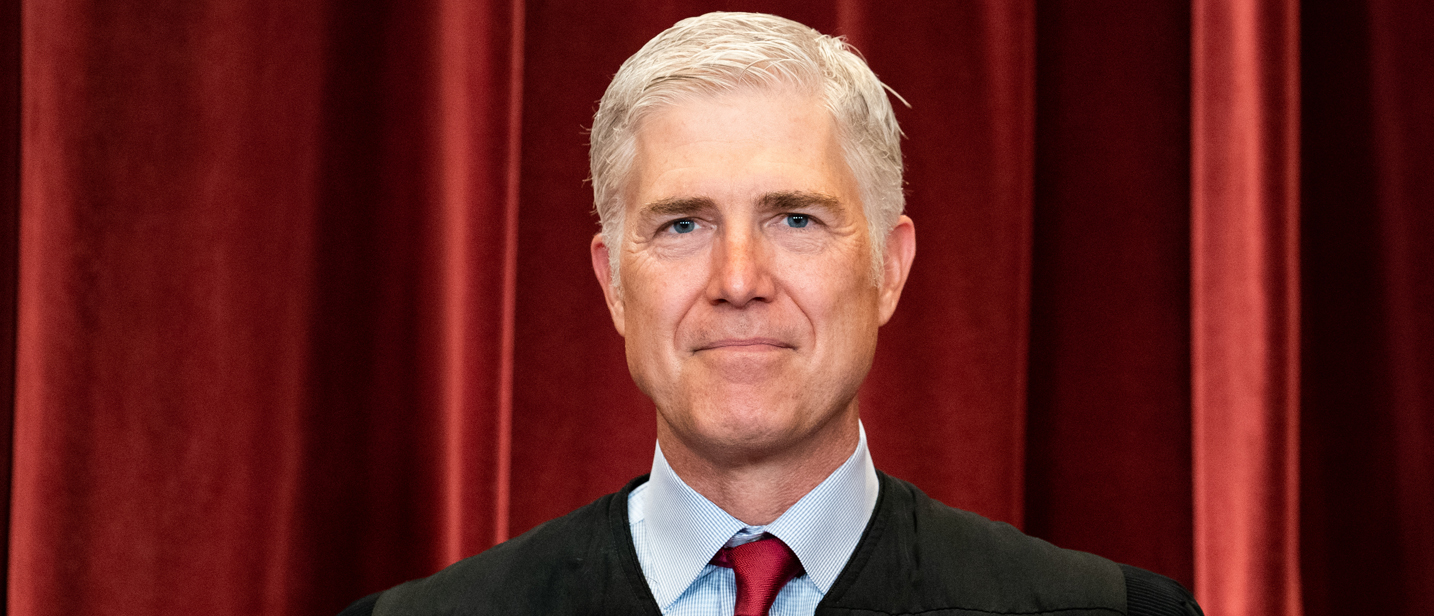
Photo by: Fred Schilling, Collection of the Supreme Court of the United States
Pro-Second Amendment groups praised the Supreme Court’s unanimous decision Thursday that pared back the applicability of a federal law prohibiting marijuana users from possessing firearms.
The Supreme Court ruled Thursday in Hemani v. United States that a regular marijuana user could not be prosecuted under 18 USC 922(g)(3), in a 9-0 decision authored by Associate Justice Neil Gorsuch. Second Amendment Foundation Executive Director Adam Kraut praised the decision when contacted by the Daily Caller News Foundation.
“We’re pleased with today’s decision, albeit it was a narrow one, it confirms that, you know, just on its face, that 922(g)(3) poses problems with regulating people who are not a danger to society based on their use of a substance and in this particular context, a substance of the federal government, despite saying that it prohibits people for a lifetime of firearms possession, the federal government has relaxed its grip on marijuana-related prosecutions and other things,” Kraut told the DCNF.
In a 9-0 Opinion, the Supreme Court has thrown out the 922(g)(3) conviction of an individual convicted of possessing a firearm while being an unlawful user of drugs. The Court has held that without more evidence that an individual is rendered unusually dangerous by their unlawful… pic.twitter.com/hDllynC3n6
— SAF (@2AFDN) June 18, 2026
Hemani was charged with possessing a firearm while being an unlawful user of marijuana, which lower federal courts had dismissed on Second Amendment grounds. According to court documents, Hemani was prosecuted on the gun charge for being a user of controlled substances after he admitted to being a regular user of marijuana after he handed over a firearm he owned to federal agents conducting a terrorism investigation. The Department of Justice did not file any terrorism charges against Hemani.
In his opinion, Gorsuch wrote that in the narrow case applying to Hemani and other users of marijuana, the prohibition was not in line with historical regulations permitted under the Second Amendment.
“The government invites us to draw an analogy between its present regulation and historical laws addressing habitual drunkards,” Gorsuch wrote in the opinion. “Those laws, the government contends, demonstrate a tradition of firearm regulation consistent with its effort to disarm any regular user of any controlled substance without any further showing. But the government’s analogy fails under every measure it asks us to consider: The historical laws on which it relies targeted different kinds of people, did so for different reasons, and operated in different ways. And faced with all these shortcomings in the government’s submission, we cannot say it has carried its conceded burden of showing its prosecution of Mr. Hemani complies with the Second Amendment.”
SAF, the National Rifle Association and other gun rights groups filed amicus (“friend of the court”) briefs in the case, according to SCOTUSBlog.
“The Supreme Court holds that the federal law prohibiting certain drug users from possessing firearms violates the Second Amendment. GOA & @GunFoundation are proud to have filed an amicus supporting the Second Amendment in this case,” Gun Owners of America posted on X.
“Today’s unanimous Supreme Court decision in United States v. Hemani is a major victory for the Second Amendment and peaceable gun owners across Americam,” NRA-ILA Executive Director John Commerford said in a statement provided to the DCNF. “The Court correctly rejected the government’s attempt to disarm millions of responsible citizens—without any pre-deprivation process—based solely on their status as occasional marijuana users.”
“As the NRA emphasized in our amicus brief, no one should be deprived of their God-given right to keep and bear arms for engaging in nonviolent conduct, and there is no historical justification for doing so,” Commerford continued.
Today’s SCOTUS decision in U.S. v. Hemani is great news for our lawsuit challenging Illinois’s FOID Card requirement.
Today’s case involved a federal law that makes it a crime for marijuana users to possess a firearm. The government tried to justify this by pointing to…
— Jacob Huebert (@JacobHuebert) June 18, 2026
New Civil Liberties Alliance Senior Litigation Counsel Jacob Huebert hailed the ruling on X Thursday, saying it could affect the group’s legal challenge to Illinois’ firearms licensing requirements. NCLA filed suit to invalidate the state’s FOID scheme in May.
“In Illinois, it’s like that, but worse: everyone is disarmed, by default, on suspicion that they might be disqualified–and each person has to prove his or her eligibility to the Illinois State Police before so much as touching any gun,” Huebert posted. “That’s not how constitutional rights are supposed to work, and it violates both the Second Amendment and the right not to be deprived of liberty without due process of law. We look forward to seeing the courts strike it down, just as the Court struck down the federal marijuana-user ban today.”
Anti-Second Amendment groups argued that the lower court rulings should be overturned, including Everytown for Gun Safety, which was one of the gun-control organizations that filed briefs before the court.
“Consideration of the full historical record, including post-ratification evidence, establishes that Section 922(g)(3) sits at the intersection of multiple regulatory traditions. The law is consistent with the traditions of disarming the habitually intoxicated; disarming those who present a particular risk of harm when armed; and disarming those ‘who have demonstrated disrespect for legal norms of society,’” Everytown said in its brief.
All content created by the Daily Caller News Foundation, an independent and nonpartisan newswire service, is available without charge to any legitimate news publisher that can provide a large audience. All republished articles must include our logo, our reporter’s byline and their DCNF affiliation. For any questions about our guidelines or partnering with us, please contact [email protected].