

Politics
Lawmakers Up In Arms Over Proposed ‘Jazz Hands Monument’ Designed For War On Terror Vets
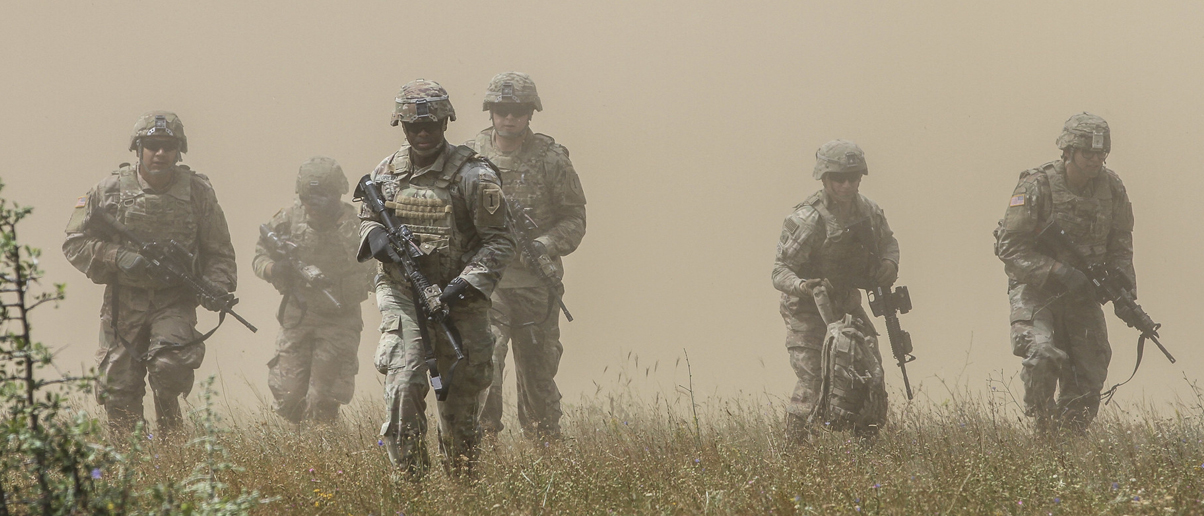
(U.S. Army photo by Staff Sgt. True Thao)
Like the armed conflicts it seeks to commemorate, a design for a planned memorial unveiled Wednesday provoked strong reactions and criticism over its perceived treatment of the sacrifice of U.S. service members and their loved ones.
President Donald Trump in August 2017 signed the Global War on Terrorism War Memorial Act. It authorized the small group of veterans, spouses, and supporters who in 2015 organized the nonprofit Global War on Terrorism Memorial Foundation “to commemorate and honor the members of the Armed Forces that served on active duty in support of the Global War on Terrorism” upon federal land in the District of Columbia. The law also defines the Global War on Terrorism (GWOT) as “any contingency operation conducted by the Armed Forces in response to the terrorist attacks of September 11, 2001, or other terrorist attack.” Of the more than 3.5 million U.S. service members deployed, over 7,000 were killed in such conflicts in Afghanistan and Iraq through August 2021; at least 30,000 other American service members and veterans have died by suicide, according to Brown University’s Costs of War project.
The live virtual event unveiling the proposed memorial featured recorded remarks by the Foundation’s honorary chairman, former President George W. Bush, who championed the memorial as “a lasting tribute to the men and women who made the ultimate sacrifice after 9/11 to make America safer and stronger.”
“Building this memorial is an act of remembrance and unity,” the forty-third commander in chief stated. “Visiting this memorial will be an act of gratitude and respect. We must always honor those who answered the call and served, care for those who bear the wounds of war, and uphold the freedoms they defended. The Global War on Terrorism Memorial helps us fulfill a solemn duty.”
Foundation President and CEO Michael “Rod” Rodríguez, who served 21 years in the U.S. Army as a Green Beret, then summarized the design process. Beginning in 2018, 20,000 Americans — including Gold Star families — from every state, as well as veterans of every service branch and conflict since World War II, gave their varied input to set a foundation of “inspiration” for the design team led by Japanese architect Kengo Kuma, 71, to build upon.
“Throughout history, societies have built sacred places to welcome their warriors home, places where a grateful people can say, ‘We see you. We honor you. You are not forgotten.’ The GWOT generations deserve that same enduring tribute,” Rodríguez states in a Wednesday press release. “Today, we take one step closer to welcoming them home.”
Kuma, who lost a close friend in the World Trade Center during the Sept. 11 attacks, hopes to create “an enduring tribute” to those who served which “will help the entire world contemplate the war of global significance that has followed that day of sorrow and the experiences of those who have participated in it.”
“Our role was not to impose a design, but to listen,” Kuma states in the press release. “The voices of those who served and the families who stood beside them became our source of inspiration. We wanted to create a place of reflection and connection, a living Memorial where nature, light, and the materials of this war come together as an embrace for a grateful Nation.”
The design envisions visitors entering a Congressionally-approved triangular plot of the National Mall via a marble “path of honor” — symbolizing endurance and freedom — framed by and connecting to the Lincoln Memorial, Vietnam Veterans Memorial, and Desert Shield and Desert Storm Memorial. “Sacred stone and steel relics” of the Sept. 11 attacks at each of the path’s entrances will serve as a “reminder of where the journey began,” while the “weight of war and also the experiences carried by warriors and their families” are depicted by the impression of both filled and empty footprints into the path. Walking alongside those from a shallow reflecting pool of water, visitors will likewise be able to leave their own footprints as signs of healing “reconnection” to those loved and lost.
The memorial’s ampitheater structure itself consists of steel reclaimed from the GWOT covered in natural vegetation and formed into the shape of a suspended ribbon, embracing the earth below. Meanwhile, the filtering of light through the assembly will contrast with the shadows it casts, “revealing stories, memories, and moments of connection, even in the darkest places.” Furthermore, the orientation of the ribbons embrace aligns with Section 60 of the nearby Arlington National Cemetery, the final resting place for many of the GWOT’s warriors.
Today, on the ground where the Memorial will stand, Gold Star families, veterans, and supporters gathered as Taps played across @TheNationalMall.
We will build this Memorial because their names deserve a place to be spoken. pic.twitter.com/NG8L1iglyz
— Global War on Terrorism Memorial Foundation (@GWOTMF) May 25, 2026
“This is a living memorial to an ongoing war,” the segment detailing the memorial elements concludes. “A place to gather, heal, connect, and remember. It’s a sacred place of honor.”
Despite the noble intent of the Memorial, however, several lawmakers sharply criticized how the veterans themselves or their sacrifice were not apparently the focus of the seemingly abstract design.
In the days and weeks ahead, we’ll be sharing more about the initial design concept and meaning behind the GWOT Memorial.
One of the most important questions is how we will honor the fallen. Watch to see how we will ensure every sacrifice is remembered and no one is left behind. pic.twitter.com/5nXuS242Ue
— Global War on Terrorism Memorial Foundation (@GWOTMF) June 12, 2026
“This proposal is a disgrace,” Republican Indiana Sen. Jim Banks, a Supply Corps Officer in the U.S. Navy Reserve who deployed to Afghanistan from 2014 to 2015, posted Thursday to X. “Thousands of heroic Americans sacrificed everything in service to our nation during the Global War on Terror. I served in Afghanistan. These were real people with real stories. They deserve to be honored with dignity, not disconnected abstract art.”
This proposal is a disgrace.
Thousands of heroic Americans sacrificed everything in service to our nation during the Global War on Terror.
I served in Afghanistan. These were real people with real stories.
They deserve to be honored with dignity, not disconnected abstract art. https://t.co/QtY3sCuLUu
— Senator Jim Banks (@SenatorBanks) June 11, 2026
“There is now bipartisan/ bicameral [sic] to stop this proposed Jazz Hands monument to our fallen brothers and sisters,” Republican Wisconsin Rep. Derrick Van Orden, a retired U.S. Navy SEAL, declared, blasting the proposed memorial’s design.
To be Chrystal Clear.
There is now bipartisan/ bicameral to stop this proposed Jazz Hands monument to our fallen brothers and sisters.
You are now officially on notice @GWOTMF, you will be head organizationally and personally accountable if you proceed with abomination.… pic.twitter.com/fezqPh7RJ1
— Derrick Van Orden (@derrickvanorden) June 11, 2026
The Daily Caller News Foundation (DCNF) reached out to other lawmakers who sponsored legislation authorizing the Memorial long before Wednesday’s release of the design, including former Republican Wisconsin Rep. Mike Gallagher, Democratic Massachusetts Rep. Seth Moulton, and Democratic Colorado Rep. Jason Crow. The DCNF also attempted to contact current members of the Senate who served in Iraq or Afghanistan. The White House, the Office of the Vice President, and the Catholic Archdiocese for the Military Services, USA did not respond to requests for comment.
Other initial reactions, while not disputing the need for such a memorial, conveyed disappointment.
“This design is a disappointing landscape feature better suited to a hotel courtyard or mini golf course than a monument to the courageous men and women who fought and the lives lost to radical Islamic terrorism,” Republican Utah Sen. Mike Lee wrote, adding his wishes for an American designer to develop the Memorial.
This design is a disappointing landscape feature better suited to a hotel courtyard or mini golf course than a monument to the courageous men and women who fought and the lives lost to radical Islamic terrorism.
There are American designers ready and willing to inspire their… https://t.co/gu9yaumAtC
— Mike Lee (@SenMikeLee) June 11, 2026
Likewise, Dr. Shaun Rieley, an enlisted infantryman in the Army National Guard who served tours in Iraq and Guantanamo Bay, Cuba in support of the GWOT, told the DCNF the design was both a “disappointment” and “unintelligible” in that it required significant explanation to be understood.
“Memorials should be clear in their meaning—they should not require extensive explanation to be understood,” Rieley, who has a background working in veteran policy and teaches political theory at a college in the D.C. area, observed. “But secondly, and more fundamentally, it seems to be missing one of the most distinctive features that a war memorial should possess.”
“Long ago the philosopher Aristotle highlighted the virtue of courage as that which is most characteristically displayed on the battlefield. War always contains tragic elements, of course, but it also enables a kind of human greatness: great acts of courage, commitment, patriotism, and sacrifice,” he concluded. “As important as reflection and healing are, the task of a war memorial is, primarily, to call to mind these acts that are attendant to war. The World War I and, to a lesser extent, World War II memorials exemplify this model. They capture the trauma, yes, but also the heroism of those wars. Veterans of the Global War on Terror deserve no less.”
The Memorial appears to be on step 15 of the 24-step process to be established: refinement of the selected concept design prior to submission with an environmental assessment to federal stakeholders. As fundraising and programming efforts continue — and after the design is inevitably revised — an official groundbreaking is projected for 2027, while construction is expected to conclude by the end of 2028.
All content created by the Daily Caller News Foundation, an independent and nonpartisan newswire service, is available without charge to any legitimate news publisher that can provide a large audience. All republished articles must include our logo, our reporter’s byline and their DCNF affiliation. For any questions about our guidelines or partnering with us, please contact [email protected].