

Commentary: Big Tent Ideas
What One Illinois Town Says About The Current State Of America
(Official White House Photo by Adam Schultz)
Walk into any diner in America and listen. You’ll hear it: not anger exactly, but tired frustration. People working harder than five years ago and somehow falling further behind. Rent that doesn’t quit. Groceries that keep rising. A parent who skips the doctor because the copay doesn’t fit the budget this month.
For a long time, Washington’s answer was an impassioned speech — and not much else.
But the bills kept coming, the factories kept closing and the promises kept not quite arriving. People noticed. They always do.
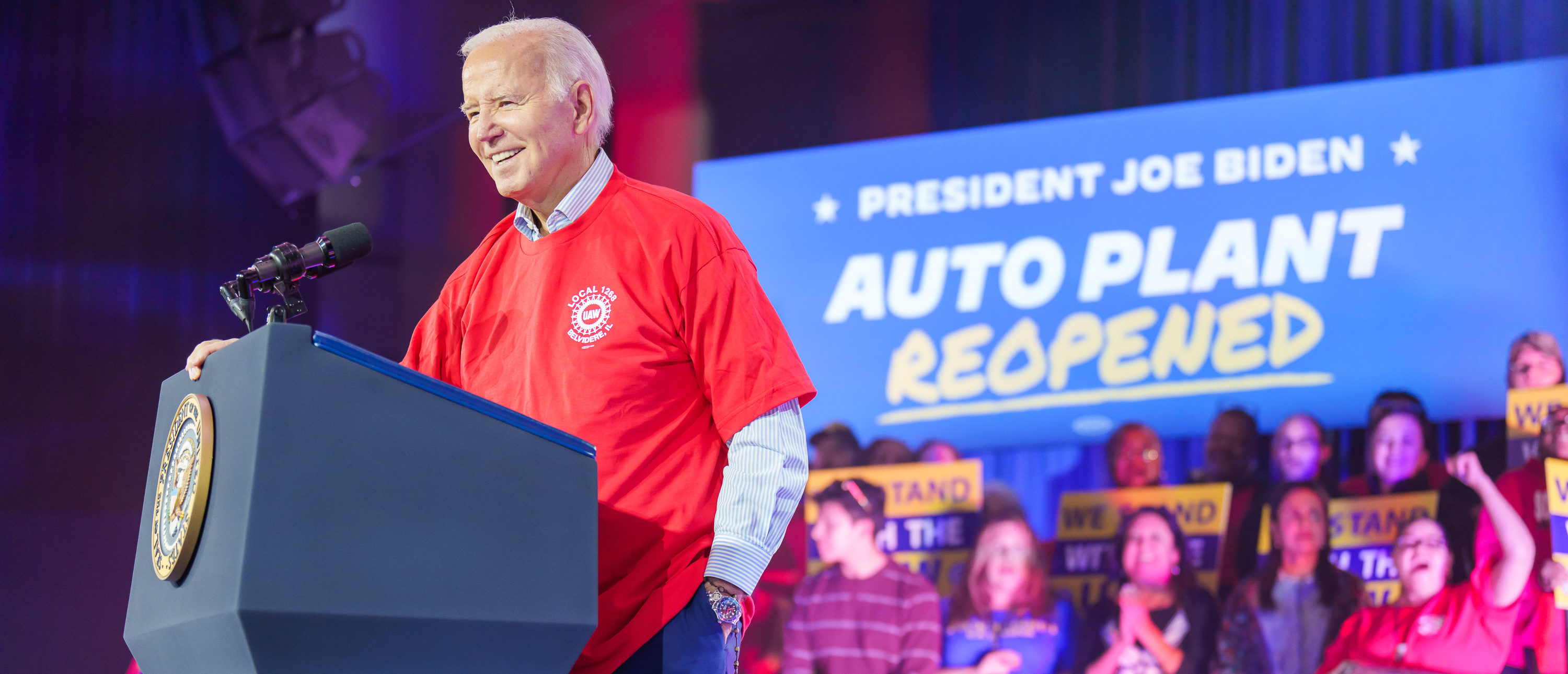
Consider Belvidere, Illinois: 25,000 people, 70 miles northwest of Chicago. In February 2023, Stellantis shut its assembly plant there, eliminating roughly 1,000 jobs in a community where they were everything. The plant sat idle for two years.
Then in October 2025, Stellantis announced a $613 million investment to reopen it, supporting 3,300 jobs building the Jeep Cherokee and Compass. For workers who spent two years waiting, that wasn’t a statistic. It was a lifeline.
Belvidere is one town. There are thousands of others still waiting.
Something is different now. Not perfect, not finished, but different. The Trump administration came in with an actual governing philosophy: that the country’s problems have solutions if anyone is serious enough to pursue them, that decline is a choice and not a destiny and that government exists to serve the people.
Some of the early bets are paying off, though the gains haven’t reached everyone yet and that gap deserves honesty. Economic policy works upstream of lived experience. Investment announcements precede factory openings, factory openings precede paychecks, and paychecks precede the moment a family exhales.
The sequence is real. It just takes longer than a campaign promise.
The administration’s economic agenda rests on four pillars.
- The first is tax policy structured to reward work and attract investment, designed to grow an economy that reaches working families and small businesses, not just those at the top of the capital structure.
- The second is deregulation. Executive Order 14192, signed in January 2025, mandates that agencies repeal ten existing regulations for every new one introduced — removing layers of federal compliance that accumulated over decades until the cumulative burden became its own kind of tax, one that fell hardest on small businesses without armies of lawyers to manage them.
- The third is energy. For years, Americans overpaid at the pump and on utility bills while domestic producers were treated as the problem. An energy agenda built around abundant, secure, domestic supply isn’t just an environmental question. When energy is expensive, everything is expensive.
- The fourth is trade, and this is where the strategy gets both bold and genuinely contested. Tariffs carry real costs. They can raise consumer prices, invite retaliation and disrupt supply chains. Those tradeoffs are worth taking seriously. But the argument for strategic tariffs isn’t that they’re painless. It’s that the status quo had costs too, quietly absorbed by American workers for decades. Foreign nations used tariffs and non-tariff barriers freely against American goods: Canada’s 245% tariffs on cheese, India’s restrictions on U.S. agricultural and auto exports, all while enjoying open access to our markets. The U.S. Trade Representative’s 2025 National Trade Estimate Report documents that asymmetry in detail. It didn’t fix itself under the previous approach. Tariffs are leverage — not to start a trade war, but to end an unfair one.
Is it working? The leading indicators are encouraging, though honest observers should acknowledge the picture is evolving. Companies have announced over $1.2 trillion in new U.S. manufacturing investment commitments, spanning semiconductors, pharmaceuticals and advanced manufacturing.
The U.S. set a record 13.6 million barrels of crude oil per day in 2025, the fourth consecutive year of record-high total energy production. Real average hourly earnings grew through much of 2025, though recent months have shown renewed pressure from inflation, a reminder that headline numbers don’t always match what families feel at the checkout counter.
That gap is measured in lives the headlines don’t reach. Veterans who came home to nothing. Families carrying debt that compounds faster than wages grow. Communities where the plant closed and nothing came to replace it—until, sometimes, it does.
Americans don’t want much.
Safe neighborhoods. Jobs that pay enough to live on. Schools worth sending their kids to. Healthcare that doesn’t require a second mortgage. The chance to build something and pass it on. These aren’t partisan desires. They’re what people want from a country they still love.
Washington would do well to remember that.
The real test of any economic agenda isn’t whether economists or politicians declare success. It’s whether towns like Belvidere come back to life, whether families can breathe again and whether the people who’ve waited the longest can finally feel the country working for them too.
Deborah A. Wilson is a Georgetown University Law graduate and practicing lawyer in Northern Virginia. She is the author of The Seam, Secrets Beneath the North Pole (speculative fiction novel). James Carter is a policy advisor with America’s Economy First. He previously served as director of the Center for American Prosperity at the America First Policy Institute and as deputy undersecretary at the U.S. Department of Labor.
The views and opinions expressed in this commentary are those of the author and do not reflect the official position of the Daily Caller News Foundation.
All content created by the Daily Caller News Foundation, an independent and nonpartisan newswire service, is available without charge to any legitimate news publisher that can provide a large audience. All republished articles must include our logo, our reporter’s byline and their DCNF affiliation. For any questions about our guidelines or partnering with us, please contact [email protected].