

Foreign Affairs
Chinese Supertanker Glides Through Hormuz Blockade As White House Touts ‘Good’ Talks In Beijing
Official White House Photo by Daniel Torok
The Chinese supertanker Yuan Hua Hu sailed through the Strait of Hormuz while laden with crude oil on Wednesday.
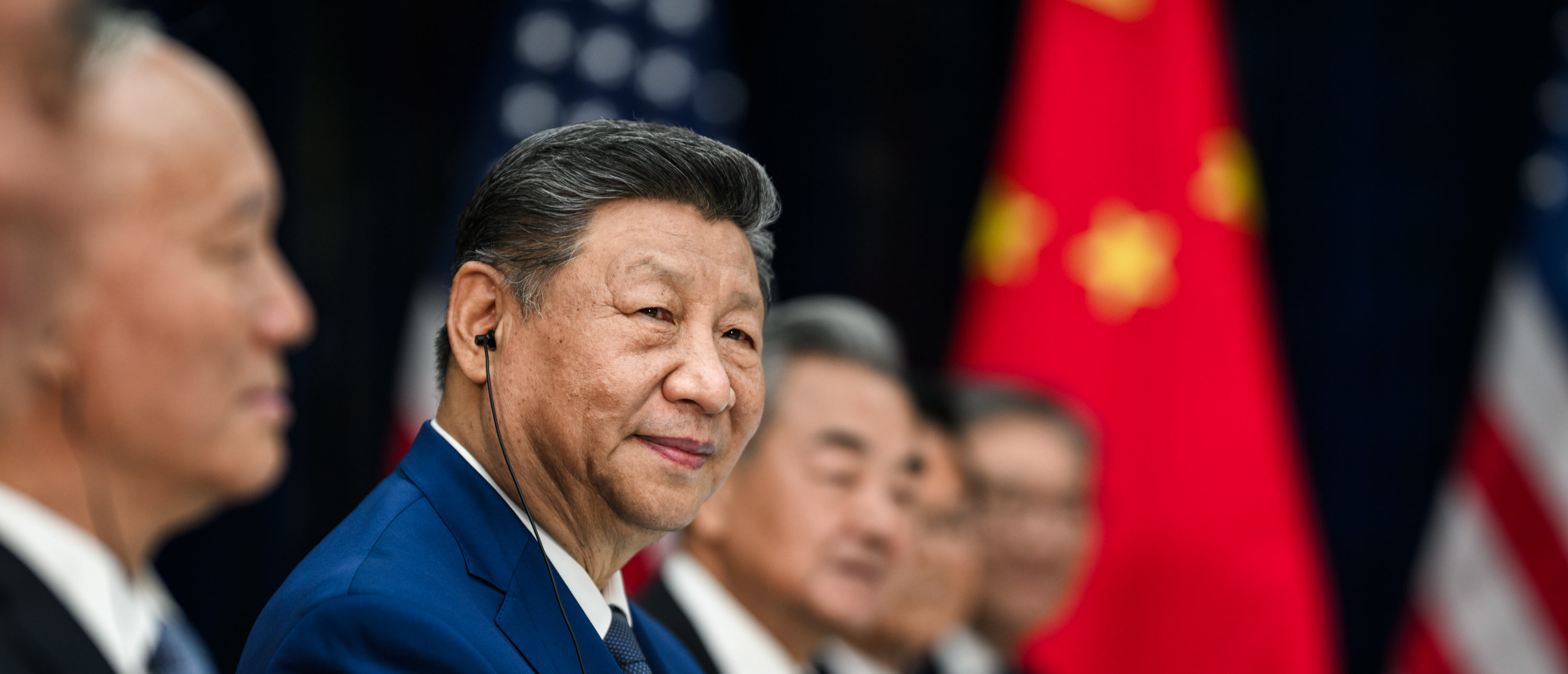
The vessel traversed the strait as President Donald Trump and Chinese President Xi Jinping are meeting in China this week to negotiate on trade, the Strait of Hormuz and Taiwan. The ship had been stranded in the Strait of Hormuz for over two months, as the Iran War continues to strangle international shipping through the strait.
The supertanker has over 2 million barrels of crude oil on board and is heading to China’s Zhoushan port, according to Reuters, citing Kpler ship-tracking data. The tanker has exited the Gulf of Oman and is now sailing through the Arabian Sea, according to tracking data from MarineTraffic.com.
The Yuan Hua Hu is not only Chinese-owned, but it also sails under the flag of China, according to tracking data from MarineTraffic.com. It is not uncommon for oil tankers and other shipping vessels to sail under the flags of nations other than those of their owners.
The practice of flying the flag of a country other than the country of ownership is called a flag of convenience (FOC). “An FOC registry offers shipowners cheap registration fees, and low or no taxes,” according to the International Transport Workers’ Federation.
Some economic experts told the Daily Caller News Foundation that this is a net positive for the global economy.
“At this point, and because the oil market is global, any energy getting out of the region is a net positive,” E.J. Antoni, the Heritage Foundation’s chief economist at the Thomas A. Roe Institute, told the DCNF. “At the moment, it seems more likely that China and Iran are securing their own trade as opposed to a broader reopening of the waterway. Due to the global nature of the oil market, closing the strait has not only affected nations like China, whose imports previously flowed through that region, but everyone else.”
The Department of State did not immediately respond to a request for comment.
Some economists told the DCNF that the Strait of Hormuz is a key vulnerability for China.
“China reportedly gets over 40% of its oil from Iran through the Strait, so it’s very important to China — when it flows,” J.D. Foster, a former senior fellow in the economics of fiscal policy at the Heritage Foundation, told the DCNF. “Iran has no leverage since the oil isn’t flowing and Iran needs the money.
“Moreover, Iran was selling the oil to China because few others … would buy it,” Foster added. “The U.S. has a little leverage with China, but China understands this is almost certainly a short-term problem.”
As the U.S. blockade on Iranian ports and vessels continues, Iran risks permanent damage to its oil wells.
“Iran would soon find an excuse to end the dueling blockades because they are rapidly running out of storage capacity for the oil they are still pumping,” Foster told the DCNF. “When storage is exhausted, they can either continue pumping into open spaces thereby polluting their lands and waterways, end the blockade to get the oil shipped, or shut down their wells. Trouble is, shutting down a traditional oil well generally does enormous damage to the well, slowing or even curtailing its future production.”
The DCNF previously reported on the issues that surround overflowing oil storage, including loss of oil pressure in wells, paraffin wax that can clog pipelines and environmental hazards.
‘Trump Had A Good Meeting’
As the vessel continues on its voyage, Trump and Xi continue to negotiate on the Strait of Hormuz. A White House official told the DCNF that the meeting has been “good” so far.
“President Trump had a good meeting with President Xi of China,” the White House official told the DCNF. “The two sides discussed ways to enhance economic cooperation between our two countries, including expanding market access for American businesses into China and increasing Chinese investment into our industries … President Xi also made clear China’s opposition to the militarization of the Strait and any effort to charge a toll for its use, and he expressed interest in purchasing more American oil to reduce China’s dependence on the Strait in the future. Both countries agreed that Iran can never have a nuclear weapon.”
“It seems likely this passage by a Chinese flagged VLCC represents an olive branch by President Trump to Xi Jinping as their summit convened in Beijing,” energy public policy analyst David Blackmon told the DCNF. “China, which has been heavily reliant on Persian Gulf crude to meet its energy needs, has been hit harder than most other nations by the standoff over the Strait of Hormuz.”
The Yuan Hua Hu is owned by COSCO Shipping Energy Transportation, according to the company’s fleet website, which classifies the ship as a very large crude carrier.
“Many Asian countries, including China, are already importing oil from other sources, like the U.S. We are currently draining the strategic petroleum reserve at a record rate and sending almost all of it to Asia,” Antoni told the DCNF. “While it is viable to continue this for a few more weeks, it is not by any means a long-term solution. Increasing production, which will take time, is the only answer for replacing oil that previously came from the Gulf.”
The U.S. Strategic Petroleum Reserve has decreased by nearly 9 million barrels in the last two months, according to tradingeconomics.com.
The Strait of Hormuz could become irrelevant in the future, but that is not likely to happen anytime soon, Foster told the DCNF.
“Far more likely is that China will help finance alternative pipeline routes to bypass the Strait,” Foster told the DCNF. “In any event, there are no short-term alternatives of note.”
The vessel departed from Iraq’s Al Basrah Port; it is not beholden to the current limitations enforced by the U.S. blockade on vessels transiting the Strait of Hormuz based on statements from U.S. Central Command (CENTCOM).
“The blockade will be enforced impartially against vessels of all nations entering or departing Iranian ports and coastal areas, including all Iranian ports on the Arabian Gulf and Gulf of Oman,” CENTCOM said in a press release on April 12. “CENTCOM forces will not impede freedom of navigation for vessels transiting the Strait of Hormuz to and from non-Iranian ports.”
The COSCO website also lists the deadweight tonnage of the vessel on the website as over 300,000 tons. Deadweight tonnage includes cargo, fuel, fresh water, ballast water, crew, provisions, and stores and equipment.
“Most analysts seem to be seriously underestimating all the knock-on effects of this conflict and the disruptions it has caused to global oil markets,” Antoni told the DCNF. “Things are going to get worse before they get better, and the impact goes far beyond energy.”
All content created by the Daily Caller News Foundation, an independent and nonpartisan newswire service, is available without charge to any legitimate news publisher that can provide a large audience. All republished articles must include our logo, our reporter’s byline and their DCNF affiliation. For any questions about our guidelines or partnering with us, please contact [email protected].