

Commentary: Big Tent Ideas
JAMES CARTER And TIMOTHY MANEY: Washington’s Budget Process Is Broken. Fix It Now.
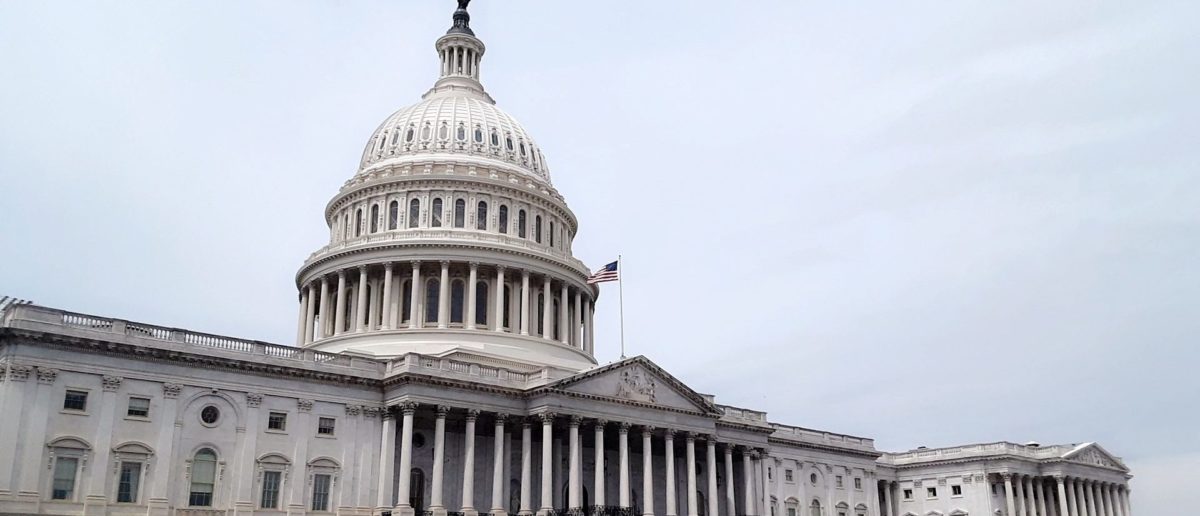
Wikimedia Commons/Public/Jessica Rodriguez Rivas
The federal government spent $7 trillion last year. That works out to roughly $222,000 per second — a pace that would have made even the most reckless Gilded Age railroad baron blush. And yet, in Washington, the response has largely been a shrug.
That shrug has a price tag. The federal debt now exceeds the size of the entire U.S. economy. Annual deficits are running at nearly $2 trillion and climbing. Interest payments alone, the tab for borrowing money just to pay for past borrowing, consumed $970 billion last year. That is more than triple what the Congressional Budget Office projected just four years earlier for fiscal year 2025.
CBO Director Phillip Swagel warns the country is caught in “a slow spiral … of rising debt and rising payments on the debt.” Slow, yes. But still a spiral.
None of this happened by accident. It happened because the federal budget process, the architecture that is supposed to impose order on Washington’s fiscal decisions, is, to use a technical term, a complete mess.
The framework currently governing how Congress spends your money was designed in 1974. That’s the era of ABBA, bell-bottoms, and rotary phones.
The Congressional Budget and Impoundment Control Act was Congress’s answer to perceived executive overreach. Passed in response to President Nixon’s refusal to spend money lawmakers had appropriated, it aimed to give Congress better tools for managing the federal budget.
Today, it is largely a ceremonial document. Budget resolutions are routinely delayed or abandoned. Individual appropriations bills, which are supposed to be passed one at a time, on a fixed schedule, instead get crammed into massive, last-minute omnibus packages negotiated in the dark. Continuing resolutions, once a last resort, have become standard operating procedure.
The result is predictable: less transparency, less accountability, and more spending. In fact, federal spending last year was 57.6 percent higher than in fiscal year 2019. That is not a rounding error. That is a structural failure.
To understand just how broken the process is, consider what then-Kentucky House Democrat Budget Chairman John Yarmouth was caught on tape in 2021 saying: “We [the federal government] don’t have to balance our checkbook. We are like the banker in Monopoly. We create the money. We hand out the money everyone else plays the game with. …. [That means you] can basically do whatever you want, spend whatever you want.”
Sadly, this is not a fringe view. It is the operating philosophy that produced $9.1 trillion in cumulative deficits over the last five years (fiscal 2021-25) alone.
But despair is not a fiscal policy. Reform is.
The path forward is not uncharted. During the debt-ceiling battles of the early 2010s, the bipartisan Joint Select Committee on Deficit Reduction, known as the Super Committee, debated concrete proposals for spending caps, appropriations reforms, and deficit-reduction targets backed by automatic enforcement. The politics ultimately failed. The ideas did not.
Those ideas deserve revival, and then some. A genuinely reformed budget process would do what the current one conspicuously fails to do: treat fiscal resources as scarce, not infinite. That means forcing lawmakers to weigh real tradeoffs among national priorities rather than papering over hard choices with borrowed money. It means giving serious attention to the economic consequences of spending and tax decisions before they are made, not after. It means holding policymakers accountable for missed deadlines and broken targets, enhancing transparency so the public can see what is actually being decided, and protecting minority voices from being steamrolled in the rush to pass the next omnibus.
It means crafting a framework that can attract bipartisan support, because reform that cannot pass is just a white paper.
Critically, it would stop pretending the problem is limited to discretionary spending. Mandatory programs and interest costs are the fastest-growing parts of the budget. Any reform that ignores them is not a reform. It is a press release.
Fiscal instability is a slow-moving threat. Markets notice. Allies notice. Adversaries notice.
The 1974 budget process had a long run. Fifty years is long enough. The framework meant to impose discipline now enables the very dysfunction it was built to prevent.
It is time to replace it — not with incremental tweaks, but with a modern system that enforces accountability, demands tradeoffs, and treats the public’s money as if it isn’t Monopoly money.
Because it isn’t.
James Carter is a Principal with Navigators Global. He headed President-elect Donald Trump’s tax team during the 2016-2017 transition. Previously, he served as a Deputy Assistant Secretary of the Treasury (2002-2006).
Timothy Maney is a board member of Zenith Intelligence Group. He previously directed and managed the Federal Budget and Appropriations portfolios for the U.S. Chamber from 2000-2024. Previously, he served as the Chief Investigator for the Census Subcommittee (1998-2000).
The views and opinions expressed in this commentary are those of the author and do not reflect the official position of the Daily Caller News Foundation.
(Featured Image Media Credit: Jessica Rodriguez Rivas/Wikimedia Commons)
All content created by the Daily Caller News Foundation, an independent and nonpartisan newswire service, is available without charge to any legitimate news publisher that can provide a large audience. All republished articles must include our logo, our reporter’s byline and their DCNF affiliation. For any questions about our guidelines or partnering with us, please contact [email protected].