

Commentary: Big Tent Ideas
BRANDON WEICHERT: Trump’s Iran Gamble Could End In A Desert One Catastrophe
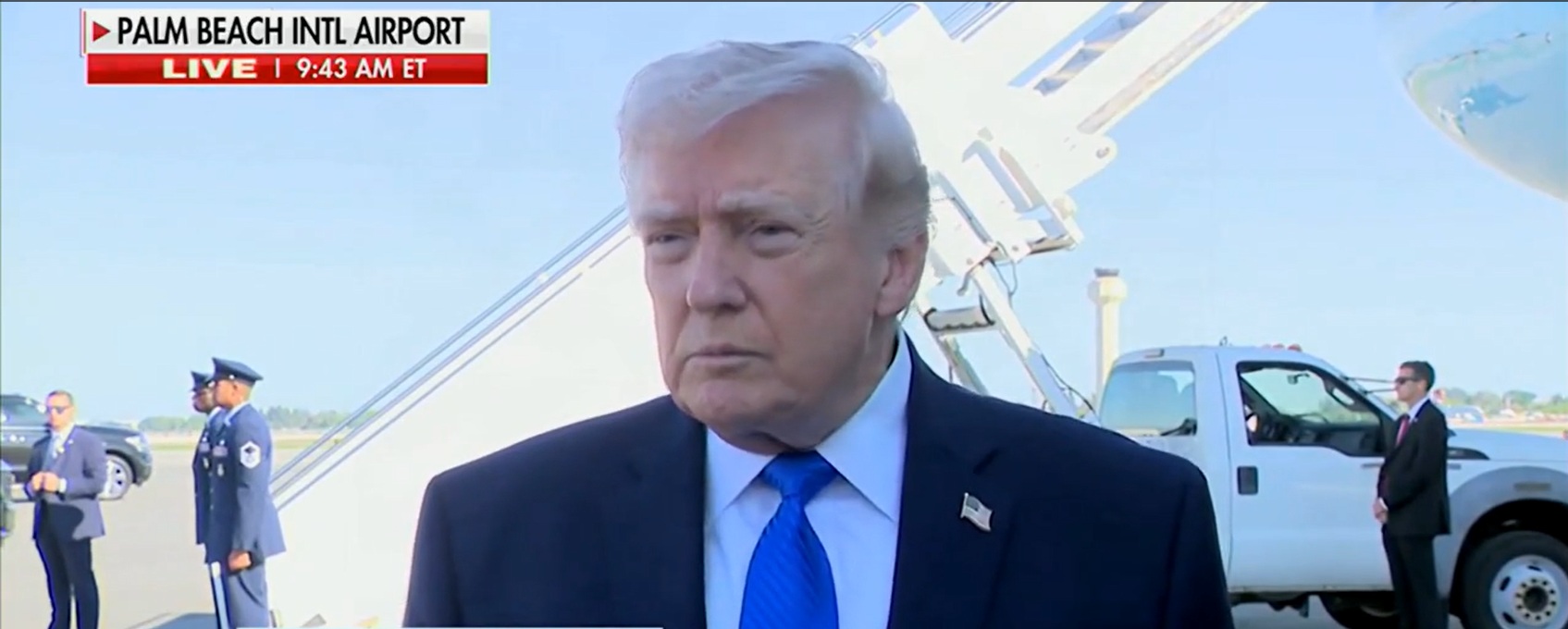
Screenshot/Rumble/Fox News
Editor’s note: Big Tent Ideas always aims to provide balancing perspectives on the hottest issues of the day. Below is a column from Brandon J. Weichert, where he argues against putting boots on the ground in Iran and against the U.S. taking Kharg Island. You can find a counterpoint here, where Ed Woodson argues otherwise.
As the world enters the second month of the Iran War, President Donald J. Trump has ordered more than 20,000 troops into the Middle East. Few are willing to consider that the 47th president, who campaigned against new Mideast wars, might want to send ground troops into the region. However, the movement of forces into the area suggests that the president has chosen to escalate once again.
The Troop Surge No One Wants To Admit
Regarding ground troops, Trump has deployed two Marine Expeditionary Units and the U.S. Army’s 82nd Airborne Rangers. He has also ordered A-10 Warthogs and AH-64 Apache attack helicopters into the region. Both the A-10 and the Apache are known as Close Air Support platforms. Essentially, they fly low and slowly orbit the battlefield where U.S. ground forces are fighting, providing continuous air cover.
These units would not be moved to the Middle East in such numbers if the president were not planning to send them to Iran. Additionally, a third aircraft carrier, the USS George H.W. Bush, is heading into the area of responsibility for U.S Central Command.
Although the USS Gerald R. Ford has been relocated to Croatia, it remains nearby, indicating that the U.S. Navy wants to keep three carriers in the area. This suggests an escalation is happening. The only escalation left is ground troops or nuclear weapons, but we’re not quite there yet.
This Isn’t Posturing — It’s Escalation
Of course, the question of where the U.S. will deploy troops is completely different. It has turned into a real guessing game on social media. Will the Americans send forces to Kharg Island or to one of the other islands along Iran’s coast with the contested Strait of Hormuz? Will the U.S. land in Baluchistan, where the locals are supposedly trying to break away from Iran?
Or will the president order a swift deployment of paratroopers into one of the suspected Iranian nuclear facilities, such as Natanz or Fordow, to secure the uranium from Iran’s nuclear weapons program?
If it is already likely that the president will soon escalate with ground forces into Iran, it is important to understand his reasoning. Since his first run for president in 2016, Trump has consistently opposed Iran gaining nuclear weapons.
Targeting The Nuclear Heart Of Iran
Last year, Trump involved the United States in the 12-Day War between Iran and Israel when he launched airstrikes against suspected Iranian nuclear weapons sites. In fact, Trump’s reason for involving the U.S. in the 12-Day War was to remove what the 47th president saw as an Iranian nuclear weapons threat to the world.
As the ongoing Iran War continues, Trump has maintained that America’s involvement is to prevent the Iranians from successfully developing a nuclear weapons arsenal that could threaten the world.
Given this consistent pattern and the fact that Trump has essentially told the rest of the world they must handle reopening the Strait of Hormuz, it is unlikely he will attempt a landing along the Iranian coast. Instead, Trump believes he must eliminate the alleged Iranian nuclear threat. Therefore, he will land American forces at one of the suspected Iranian nuclear sites.
The option that Trump is probably leaning towards is the most dangerous of all the landings he might attempt.
Unlike landing on Kharg Island or somewhere along Iran’s coastline, the Americans will fly hundreds of troops deep into Iranian airspace. The president recently explained that the United States and Israeli air forces have spent the last few weeks destroying Iran’s air defense network.
This hasn’t been proven true.
A Plan That Defies Reality
However, Iran’s air defenses have been weakened. We can tell this because U.S. and Israeli warplanes continue to fly sorties into the country. Still, the Iranians maintain a substantial air defense capability, and those American planes carrying U.S. troops deep into Iran’s territory will be serious targets.
From there, the 82nd Airborne will parachute into the middle of the country. They will establish a perimeter while Iranian ground forces, Islamic Revolutionary Guard Corps fighters, missiles, and drones all attempt to target the American forces.
Next, the U.S. forces on the ground will try to build a runway while being under attack. Heavy excavation equipment will be flown into the position the 82nd Airborne secured. With those excavators—still under fire—the Americans will punch through 90 meters of reinforced mountain rock and extract 450kg of highly enriched uranium.
Desert One All Over Again
Then, the U.S. forces will load that uranium onto waiting planes and fly the enriched uranium out of Iran.
If the proposed operation sounds insane, it’s because it is insane. Furthermore, this mission shares similarities with other major U.S. failures, such as the Battle of Ia Drang at the start of the Vietnam War and President Jimmy Carter’s disastrous Operation Eagle Claw, the failed attempt to use U.S. Special Forces to rescue American hostages in Iran in 1980.
Flying Into A Kill Zone
Sending a small group of light infantry units into the core of a tough region in Iran to chase some reckless uranium hunt while under heavy fire isn’t a solid battle plan. It’s madness. Not only is it extremely risky and unlikely to succeed, but the entire mission also seems disconnected from any real US interests.
And that’s the most important aspect here. Whether Iran wanted to build a nuclear weapons arsenal for itself is not really the issue. Even the Israelis have admitted that Iran’s potential nuclear weapons program is not their main reason for attacking Iran. U.S. intelligence claimed that the Iranians had given up work on their nuclear weapons program. Meanwhile, Tehran had repeatedly agreed to meet with the Americans and negotiate with Washington about that potential nuclear weapons program.
Even if the Iranians were developing a nuclear weapons arsenal, the chances that it could match what either the Israelis or Americans possess are ridiculous.
Containment Was Already Working
Furthermore, the U.S. and its regional allies, thanks to the Abraham Accords, were already containing Iran. There was no need to risk a major war to meet Washington’s goals of stopping Iran’s expansion or its pursuit of advanced nuclear weapons. However, with the outbreak of the war, the Abraham Accords have collapsed, and Iran seems on track to become a stronger nuclear power, while the Americans risk being driven out of the region entirely.
Nothing about this war has benefited the American people or aligned with U.S. national interests. If the president authorizes sending U.S. forces into Iran, it will be a bloody conflict. Such a reckless mission will oppose U.S. interests and put many brave Americans at risk of being killed or captured by Iran.
All Risk, No Reward For America
Trump has found himself trapped in an escalation cycle.
Clearly, the Iran War was not entirely Trump’s idea. It was an Israeli plan designed to advance Israeli interests at the expense of everyone else. Now that the Americans are stuck in another Middle Eastern quagmire, the president does not want to look weak. He is not seeking de-escalation under the current circumstances.
So, Trump aims to climb the escalation ladder even higher. With each step up, the Iranians secure big wins against the Americans, turning the entire conflict into a quagmire that devastates the global economy, halts the world’s energy production, destroys the Arab States and Israel, and consumes Trump’s second term. Deploying troops in Iran will only solidify Iran’s gains and further weaken the United States strategically.
Certainly, that does not serve America’s interests.
Brandon J. Weichert is the Senior National Security Editor at 19FortyFive.com. He previously served in the same role at The National Interest. Weichert’s writings on national security are available in the NatSec Guy section of Emerald.TV and he can be followed @WeTheBrandon on Twitter/X. The author of four bestselling books on national security, most recently “A Disaster of Our Own Making: How the West Lost Ukraine,” Weichert has been described as a “Panic-and-anxiety-inducing scholar who tells us that which we don’t want to hear but must know.”
The views and opinions expressed in this commentary are those of the author and do not reflect the official position of the Daily Caller News Foundation.
(Featured Image Media Credit: Screenshot/Rumble/Fox News)
All content created by the Daily Caller News Foundation, an independent and nonpartisan newswire service, is available without charge to any legitimate news publisher that can provide a large audience. All republished articles must include our logo, our reporter’s byline and their DCNF affiliation. For any questions about our guidelines or partnering with us, please contact [email protected].