

Politics
Supreme Court Soon To Consider Who Gets To Be An American Citizen
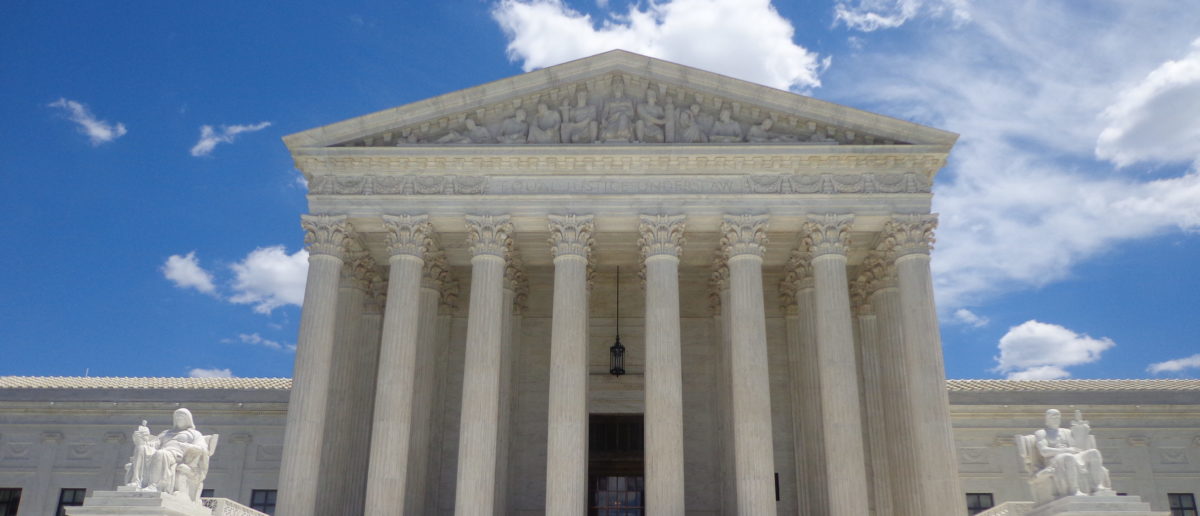
Yellow/3467/Creative Commons/Flickr
The Supreme Court will hear a case Wednesday that could reshape what it means to be an American citizen.
Birthright citizenship has been on a fast-track to the Supreme Court since President Donald Trump signed his day-one executive order ending guaranteed citizenship for children of illegal aliens or migrants on temporary visas, which quickly faced legal challenges.
A June 2025 ruling on the Trump administration’s appeal of nationwide injunctions against the order offered some clues about how certain justices might approach the issue, though the Court did not rule on the EO’s merits. Rather, the majority held in United States v. CASA that “universal injunctions” district court judges had been using to stop the president’s policies from taking effect likely exceeded the authority granted to federal courts.
Hours after the decision came down, left-wing groups filed new class action lawsuits on behalf of migrant babies who would be ineligible for citizenship under Trump’s order. The administration petitioned the justices to hear the case in September after lower courts found the order unconstitutional, and the justices agreed to take it up in December.
Trump’s Case Against Automatic Birthright Citizenship
The Trump administration argues the Citizenship Clause of the Fourteenth Amendment was meant to apply to “newly freed slaves and their children—not to the children of temporary visitors or illegal aliens.” That’s because illegal aliens are not “subject to the jurisdiction” of the United States under the administration’s reading of the clause.
“The ‘main object’ of the Citizenship Clause was to grant citizenship to freed slaves and their children, whose allegiance to the United States had generally been established through generations of parental domicile,” the administration’s reply brief states. “By contrast, aliens who are just passing through the United States, and those who cross our borders illegally, lack ties of allegiance and do not obtain the ‘priceless and profound gift’ of citizenship for their children.”
An expansive view of birthright citizenship has incentivized illegal entry and encouraged “birth tourism,” the government notes. The United States is one of only about 30 countries without restrictions: even the United Kingdom walked back near-automatic birthright citizenship in 1983, according to the brief.
In 2023, between 225,000 and 250,000 children were born to illegal migrant parents in the U.S., along with 70,000 born to temporary visitors, according to estimates from the Center for Immigration Studies (CIS).
Where Others Stand
Opponents suing the administration claim Trump’s order is a “radical rewriting” of the Citizenship Clause.
“The government is asking for nothing less than a remaking of our Nation’s constitutional foundations,” challengers backed by the American Civil Liberties Union (ACLU) and National Association for the Advancement of Colored People (NAACP) argue. “The Order may be formally prospective, applying to tens of thousands of children born every month, and devastating families around the country.”
A major tension between the two positions is how past precedent and English common law should shape how citizenship is viewed.
The Supreme Court held in its 1898 United States v. Wong Kim Ark decision that children “born of resident aliens” are U.S. citizens. Wong Kim Ark’s parents were lawful residents denied citizenship under the Chinese Exclusion Act.
The Wong Kim Ark case reinforced the English common law understanding that “the rule was citizenship by birth, regardless of parental nationality or immigration status,” opponents argue in their brief. However, the government contends the case did not address the question of illegal or temporary resident aliens.
Wong Kim Ark “addressed the status of ‘a child born in the United States’ to aliens with ‘a permanent domicile and residence’ in the country,” the administration argues, writing the parents’ domicile was described as a “stipulated fact” in the case.
“But that fact played a central role in the Court’s legal analysis,” the administration contends. “The Court referred to the parents’ domicile more than 20 times.”
“The parents’ domicile as one of the ‘stipulated facts’ of the case, but that fact played a central role in the Court’s legal analysis,” the administration argues. “The Court referred to the parents’ domicile more than 20 times.”
Republican Missouri Sen. Eric Schmitt and Republican Texas Rep. Chip Roy likewise argue in a brief backing the administration that the English common law doctrine of Jus soli “is fundamentally incompatible with the republican principles of a nation founded by free citizens who declared, and then won, their independence from the Crown.”
States are split nearly in half on birthright citizenship: those led by Democratic attorneys general generally oppose Trump’s order, while states led by Republican attorneys general are backing the administration.
“Recent years have seen an influx of illegal aliens—over 9 million overwhelming our nation’s infrastructure and its capacity to assimilate,” a brief led by Tennessee, Iowa and 23 other states explains. “States spend tens of billions of dollars annually on the public education of aliens within their borders.”
‘Selling Citizenships’
An unfavorable ruling may not be received well by the president, who wrote Monday on Truth Social that “Dumb Judges and Justices will not a great Country make.”
“The World is getting rich selling citizenships to our Country, while at the same time laughing at how STUPID our U.S. Court System has become (TARIFFS!)” Trump wrote Monday.
The Supreme Court struck down Trump’s International Emergency Economic Powers Act (IEEPA) tariffs in February. Trump said his two appointees who sided with the majority — Justice Neil Gorsuch and Amy Coney Barrett — ‘”sicken” him Wednesday at the National Republican Congressional Committee, according to CNBC.
Several justices gave strong indications during oral arguments in CASA last year that they believe birthright citizenship has roots in prior court precedent.
Showing the order is constitutional is “an impossible task in light of the Constitution’s text, history, this Court’s precedents, federal law, and Executive Branch practice,” Justice Sonia Sotomayor wrote in a dissent last year joined by Justices Elena Kagan and Ketanji Brown Jackson.
All content created by the Daily Caller News Foundation, an independent and nonpartisan newswire service, is available without charge to any legitimate news publisher that can provide a large audience. All republished articles must include our logo, our reporter’s byline and their DCNF affiliation. For any questions about our guidelines or partnering with us, please contact [email protected].