

Exclusives
EXCLUSIVE: Key MAHA Initiative Can Save Consumers, Businesses 26x The Money, Report Shows
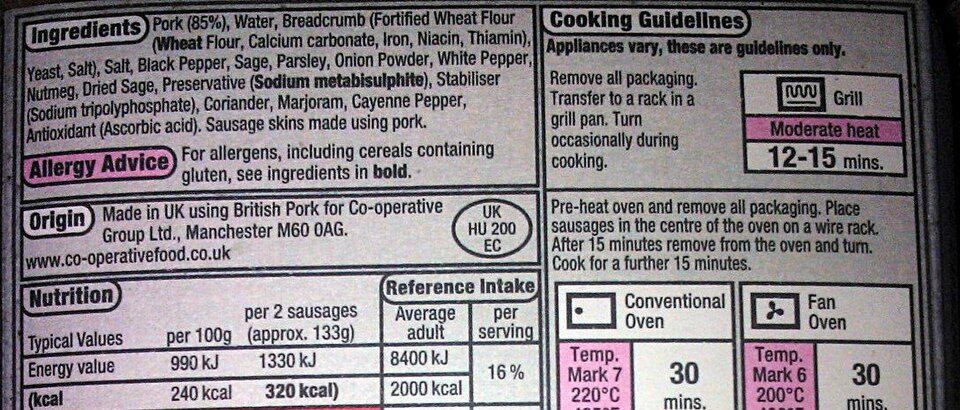
No machine-readable author provided. Malcomburetta assumed (based on copyright claims)., Public domain, via Wikimedia Commons
Adopting a nationwide food-labeling standard supported by the “Make America Healthy Again” (MAHA) movement could save American businesses significant amounts of money, according to a Job Creators Network (JCN) report released Tuesday.
The new report, first obtained by the Daily Caller News Foundation, estimates that updating food labels to comply with 50 state-specific mandates would cost U.S. businesses 26 times more money than it would cost them to use one MAHA standard nationwide. If one national standard is adopted, the estimated average cost for companies to update their existing food labels would be much less expensive at about $14.8 million, compared to an estimated $381 million total if companies were required to comply with 50 different state-specific standards, according to JCN’s analysis.
“The survey results paint a pretty clear picture,” Dr. Lloyd Corder, an adjunct professor at Carnegie Mellon and the University of Pittsburgh who prepared JCN’s report, said in a statement provided to the DCNF. “A patchwork of state requirements for food labels will create huge financial burdens for businesses big and small—costs that will inevitably roll downhill to consumers in the form of higher prices.”
“If affordability is the goal, a transparent federal ‘MAHA’ standard is the way to go,” Corder continued.
When asked whether they would prefer one national food labeling standard or 50 state-specific standards, 100% of respondents said they prefer a national standard, the survey shows. JCN’s report also notes that a state-by-state labeling system would likely “significantly raise consumer prices.”
“State-specific food labeling regulations—as opposed to a clear, consistent nationwide framework—are well-intentioned but will have an outsized negative impact on small businesses,” JCN CEO Alfredo Ortiz said in a statement.
“Small businesses operate on razor thin budget margins and often don’t have the extra resources to comply with costly government mandates,” Ortiz added. “It means fewer jobs, less economic opportunity, and anemic growth.”
The majority of respondents, 95%, say they update their labels periodically, with 69% saying they do it “less than annually,” compared to 27% who “make changes annually” and 11% who make them “more frequently than annually,” per the survey. The report also shows that 100% of companies said they generally make updates because of changes to product ingredients, compared to 94% who say they make updates because of new government regulations and 82% who say they do it due to brand or marketing updates.
Most respondents, 65%, said it takes them four months or longer to update a label, according to the survey.
Additionally, JCN also warns in their report that the adoption of state-specific labeling requirements could negatively impact U.S. businesses and consumers. Ninety-four percent of companies said such state-specific labeling requirements would generate problems such as legal compliance issues, more complex packaging and label design and package suppliers declining to do production for smaller volume runs, the survey found.
Health and Human Services Secretary Robert F. Kennedy Jr. said during a Feb. 27 podcast interview on “The Joe Rogan Experience” that the U.S. will have a federal definition for ultra-processed foods by this April, Food Safety Magazine reported.
“By April, [the U.S. Food and Drug Administration] will have a federal definition of ultra-processed foods for the first time in history,” Kennedy told Rogan, per the outlet. “And as soon as we do that, we’re going to do front-of-package food labeling.”
Nonprofit group Americans for Ingredient Transparency (AFIT) has recently pushed for federal legislation to create a single standard for ingredient transparency in the U.S., Food Business News reported in October 2025. AFIT says on their website that consumer health in the U.S. is “a national interest and should not change according to state lines.”
Additionally, Texas and Louisiana both implemented laws in June 2025 which mandate warning labels on packaging for foods that contain certain additives or dyes, according to Kelley Drye & Warren LLP.
The JCN report relies on survey data collected from 40 companies that manage more than 5.5 million packaging labels and over 300,000 products. The survey’s respondents include grocery stores, wholesale distributors and packaging manufacturers.
All content created by the Daily Caller News Foundation, an independent and nonpartisan newswire service, is available without charge to any legitimate news publisher that can provide a large audience. All republished articles must include our logo, our reporter’s byline and their DCNF affiliation. For any questions about our guidelines or partnering with us, please contact [email protected].