

Commentary: Big Tent Ideas
KENNETH RAPOZA: Canada Has Joined Opposition To US
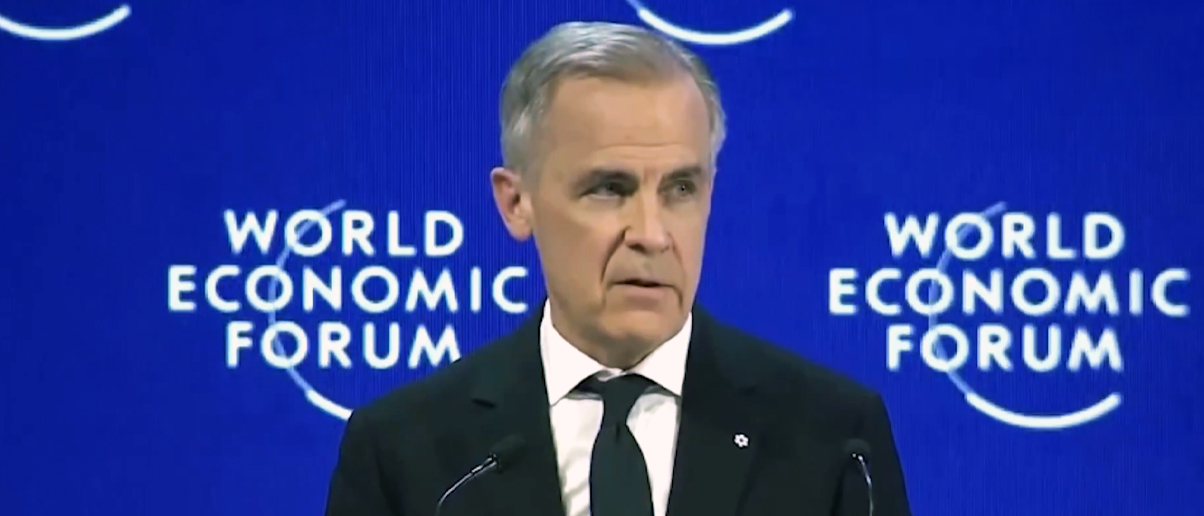
Canadian Prime Minister Mark Carney (via Mark Carney/X)
Unlike Mexico, Canada has been moving away from the United States since 2017, with recent realignments serving as counters to Trump. Prime Minister Mark Carney’s speech at Davos explains it all, even though he refused to name the target of his angst, which is us.
Carney’s speech about the “middle powers” at the World Economic Forum recently was simple: stop pretending there is a liberal international order that works. It was always international lawfare led by the most powerful Western nations, he said. We were all bullies imposing the will of the globalist liberal order upon the plebs of the developing world. Do as we say or face the consequences. He put a new spin on it, aimed at the Europeans primarily. Less powerful countries in that old order are “facing the consequences.”
Carney’s prescription is that these middle powers, of which Canada is one, must treat “integration” with larger powers as a vulnerability when integration is used as leverage.
“Middle powers must act together because if we’re not at the table, we’re on the menu,” he said.
Whose menu, you might ask?
It can’t be China’s because they just reached a tariff-reset/partnership-style arrangement with them, something Mexico would never dream of doing.
The menu he is referring to is Chef Trump’s menu at Café Americano. Canada opposes Trump, with Carney coming out of Davos as the Western opposition’s Frosty the Globalist.
Canada ‘Joins The EU,’ Signs Trade Pact With China
Successive Canadian governments have aligned themselves with Europe, and aggressively so since Trump came to town. If they could join the EU, they would.
In 2017, Justin Trudeau signed the Comprehensive Economic and Trade Agreement with the European Union, a free trade deal (FTA) in the works since the Obama years. Canada likely got the idea from Mexico, who initiated a free trade deal with the EU to diversify away from the U.S. in the late 1990s. The Mexico-EU agreement went into effect in the year 2000, making Mexico an early mover and essentially opening NAFTA up to European automakers who gained duty free access to the U.S.
The Canada-EU FTA went into force during Trump 1.0. Carney has been busy signing new deals with Europe in Trump 2.0, designed to strategically align with Brussels. This is a not-so-quiet decoupling.
In June, Canada and the European Union signed a new Security and Defense Partnership deal. It was the first formal security pact between the EU and an Americas-based partner.
Later in the year, Canada agreed to participate in the EU’s Security Action for Europe (SAFE) initiative — part of Europe’s “we need an army” mantra sparked by Trump who has been telling them to fund their own wars and increase their defense spending. SAFE, however, does not include the U.S. It is a €150 billion defense procurement and industrial cooperation program under the EU’s Readiness 2030 plan. The EU does not want to have to increase its defense budget only to purchase more U.S. defense goods, so it is recruiting Canada.
Carney started 2026 by announcing a trade pact with China, the country that has triggered the new hemispheric America First trade policy, and the entire strategic investment and tariff agenda. Trump initially praised the deal and congratulated Carney, but changed his mind after Davos and threatened 100% tariffs – a threat that speaks precisely to Carney’s “middle powers” speech.
That’s also American veto power if countries, especially Canada and Mexico, do not align with the new hemispheric strategy of the U.S. as outlined in the November National Security Strategy.
The Three-Legged Stool And The Future Of The USMCA
The “rules-based international world order” – of which all Western governments are a part – is run by three power centers: London, Brussels and Washington. But that order is now off balance under Trump. I call it the “three-legged stool” of the Western globalist regime. Trump sawed off one of its legs to go America First. Brussels and London need a third, even if it is not a powerhouse, to keep things in balance. That’s Canada.
What does this mean for the future of USMCA?
The North American trade deal faces a joint review this summer. It will not look like it does today. Though the old USMCA, rewritten under Trump 1.0, already doesn’t look the same with 50% tariffs on steel and aluminum and quotas likely in the future.
China will be more of a sticking point than the EU, which Trump sees as an ally. If Canada is willing to be used as a breeding ground for Chinese multinationals to set up shop, receive state support back home, and make goods bound for the U.S. duty free, then the Canadian-U.S. free trade deal is in big trouble. USMCA could potentially be given up for two separate agreements instead.
Negotiations begin July 1. The Trump administration will likely use the review to formalize its new hemispheric hierarchy and constrain Canada’s China relations, especially in critical minerals, strategic investment, and supply chains.
Carney kicked off the USMCA debate post-Davos; a debate that for now is not going in Canada’s favor even if the Europeans love him.
Kenneth Rapoza is an analyst with the Coalition for a Prosperous America. He is a former journalist covering Brazil for the WSJ and later the BRIC countries for Forbes.
The views and opinions expressed in this commentary are those of the author and do not reflect the official position of the Daily Caller News Foundation.
(Featured Image Media Credit: via Mark Carney/X)
All content created by the Daily Caller News Foundation, an independent and nonpartisan newswire service, is available without charge to any legitimate news publisher that can provide a large audience. All republished articles must include our logo, our reporter’s byline and their DCNF affiliation. For any questions about our guidelines or partnering with us, please contact [email protected].