

National Defense
Trump Says Hormuz Strikes Were ‘Just A Love Tap,’ Ceasefire In Effect
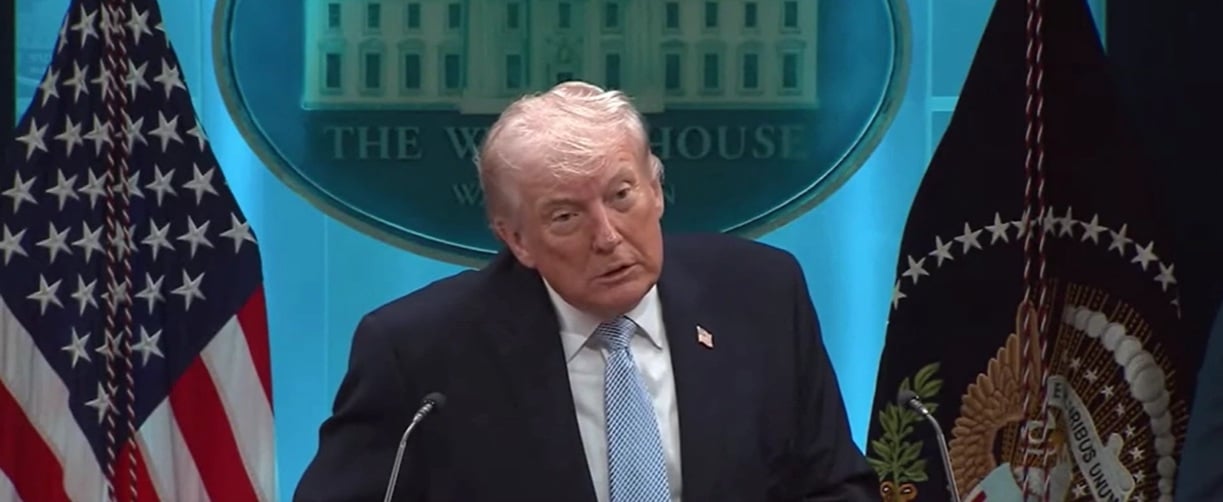
Screenshot/White House/Rumble
President Donald Trump told reporters on Thursday that the strikes on the Iranian regime were “just a love tap” and that the cease-fire remains in effect.
The U.S. military ran three destroyers through the Strait of Hormuz after striking Iran’s southern port city of Bandar Abbas and Qeshm Island on Thursday, according to U.S. Central Command (CENTCOM). The U.S. military action came after the Islamic Revolutionary Guard Corps launched 15 ballistic and cruise missiles at Fujairah Port in the United Arab Emirates.
“Our military is unbelievable, they’re doing an unbelievable job,” Trump told reporters on Thursday, the New York Post reported. “We’re negotiating with the Iranians. We have, you probably heard, we took our three destroyers, and we rammed them through some pretty big stuff today, and we knocked the hell out of them. The destroyers weren’t hurt in any way, and the people weren’t hurt. But they were firing at us, and we were firing back at them. And our firepower was a hell of a lot stronger than theirs, and they knocked the hell out of them.”
“It’s just a love tap,” Trump told ABC News reporter Rachel Scott in a phone call.
An unconfirmed image from Press TV, an Iranian state-backed media outlet, in an X post depicts the “pretty big stuff” that Trump mentioned in his remarks to reporters.
The full video, posted by the Iranian IRIB News Agency, allegedly depicts an anti-ship ballistic missile being fired at a U.S. destroyer. Members of the Islamic Revolutionary Guard Corps can be heard chanting “Allahu Akbar” in the background.
The destroyers that transited the strait were the USS Truxtun (DDG 103), USS Rafael Peralta (DDG 115) and USS Mason (DDG 87), according to CENTCOM.
The assault on the destroyers included “multiple missiles, drones and small boats,” CENTCOM said in a press release on Thursday.
‘The Atmosphere Is Calm’
The Iranian-flagged Sea Star III and Sevda oil tankers were struck by a U.S. Navy F/A-18 Super Hornet from the USS George H.W. Bush by “firing precision munitions into their smokestacks,” according to a Friday press release from CENTCOM. The ships were disabled and were no longer able to make it to Iranian ports.
The current U.S. naval blockade is responsible for stopping more than 70 tankers from entering or exiting Iranian ports that could ferry over 166 million barrels of oil worth over $13 billion, CENTCOM stated in an X post on Friday.
The Hasna, another Iranian-flagged oil tanker, was strafed by an F/A-18 Super Hornet from the USS Abraham Lincoln on Wednesday, per CENTCOM’s Friday press release. The unladen tanker was struck on the rudder by several 20-millimeter cannon rounds, crippling the vessel.
“If you fire at a U.S. Navy ship, what are we supposed to do?” Secretary of State Marco Rubio said to reporters on Friday, the Associated Press reported. “Say, oh, there’s a ceasefire, we’re not gonna shoot down your drone? That’s a stupid question. That’s a stupid position to take. Of course, we fired back at them. They were shooting at us. That’s what I would expect to do. Only stupid countries don’t shoot back when you’re shot at.”
The cease-fire has resumed, the Iranian Tasnim News Agency reported, citing an Iranian military source.
“After the hostile action made by the American terrorists against Iranian oil tankers, Iran’s navy carried out attacks in response to the violation of the ceasefire and the American terrorism,” an Iranian military source told Tasnim. “The clashes have been stopped and the atmosphere is calm.”
However, the Iranian military source told Tasnim that the hostilities could resume quickly if U.S. naval assets attempt to traverse the Strait of Hormuz again.
China has officially entered the dialogue with Israel and Iran to mediate the conflict in an attempt to create peace in the region.
“The situation in the Gulf and Middle East is at a crucial juncture of whether peace will get a chance,” Chinese Foreign Ministry spokesperson Lin Jian said during a press conference on Friday. “China maintains communication with all parties, including Iran. Our aim is clear, that is, to de-escalate tensions and promote the end of the conflict and realization of peace.”
The attacks on Iranian oil tankers, Bandar Abbas and Qeshm Island may have caused an environmental hazard. Satellite images obtained by Reuters depict a possible oil spill in the Persian Gulf after the airstrikes from the U.S. military took place.
Oil prices remain relatively high when compared with the outbreak of the conflict. WTI crude oil futures closed at $67 on Feb. 27, the night before the conflict began, compared with over $95 as of this writing, according to the CNBC market tracker.
“U.S. forces in the Middle East remain committed to full enforcement of the blockade of vessels entering or leaving Iran,” said Adm. Brad Cooper, CENTCOM commander, in a press release on Friday. “Our highly trained men and women in uniform are doing incredible work.”
All content created by the Daily Caller News Foundation, an independent and nonpartisan newswire service, is available without charge to any legitimate news publisher that can provide a large audience. All republished articles must include our logo, our reporter’s byline and their DCNF affiliation. For any questions about our guidelines or partnering with us, please contact [email protected].