

National Defense
Iran War Gets New Name As Ceasefire Sits On Razor’s Edge
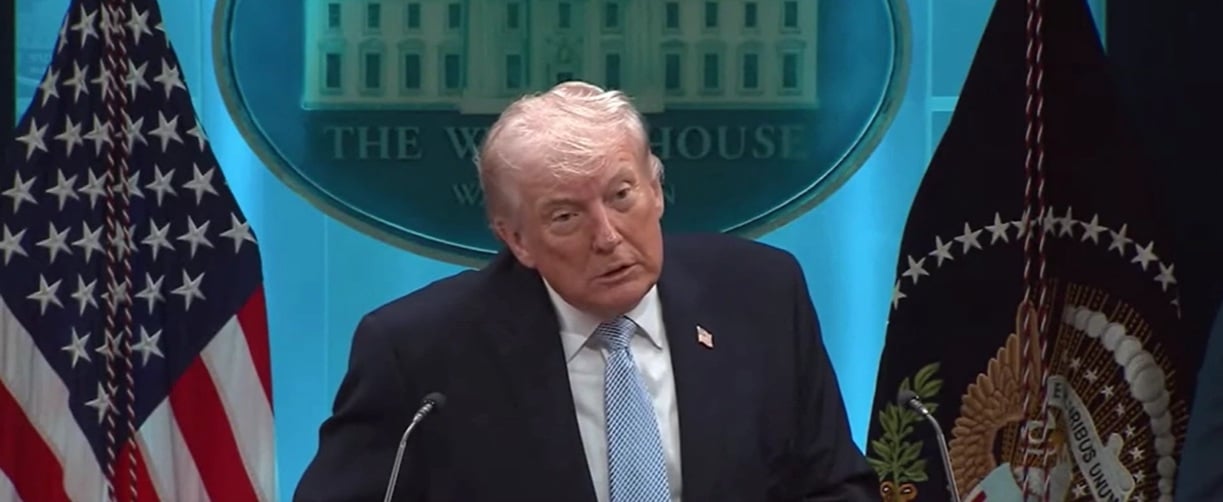
Screenshot/White House/Rumble
It remains unclear whether the ceasefire in the Iran war that took effect on April 8 has ended after less than a month in light of recent developments.
The Islamic Revolutionary Guard Corps began a new bombardment Monday, firing ballistic missiles and drones at the United Arab Emirates (UAE), a key U.S. ally in the Middle East. The attack came after U.S. Central Command (CENTCOM) announced a new operation in the theater, dubbed Project Freedom, in a press release on Sunday.
“The ceasefire is over,” Senior National Security Editor Brandon Weichert told the Daily Caller News Foundation. “That’s how I’m reading it.”
CENTCOM declined to say whether the ceasefire remains in effect.
“I wouldn’t go into the details of whether the ceasefire is over or not,” CENTCOM head Adm. Brad Cooper said to reporters on Monday.
“Iran has taken some shots at unrelated Nations with respect to the Ship Movement, PROJECT FREEDOM, including a South Korean Cargo Ship,” President Donald Trump said in a post on Truth Social. “Perhaps it’s time for South Korea to come and join the mission! We’ve shot down seven small Boats or, as they like to call them, ‘fast’ Boats. It’s all they have left. Other than the South Korean Ship, there has been, at this moment, no damage going through the Strait.”
“Secretary of War Pete Hegseth and Chairman of the Joint Chiefs of Staff, Dan Caine, will have a News Conference tomorrow morning,” Trump added. “Thank you for your attention to this matter!”
The president’s Truth Social post came less than an hour after the UAEs’ Ministry of Defence said in a post on X that it was under incoming fire from the Iranian regime.
“The UAE’s air defenses are currently dealing with missile attacks and incoming drones from Iran … the UAE air defense systems intercepting ballistic missiles, cruise missiles, and drones,” the United Arab Emirates Ministry of Defense stated in a post on X.
The U.S. military destroyed six Iranian boats, Cooper told reporters Monday, as the developments unfolded. Cooper said that the U.S. has cleared an “effective pathway” through the strait.
However, maritime traffic in the region seems to show a different story, some observers pointed out.
“Following the announcement of the U.S.-led “Project Freedom,” vessel traffic in the Strait of Hormuz remains at a trickle, and the majority of vessels that are transiting are using the Iranian traffic separation scheme and not the ‘Project Freedom’ corridor closer to Oman,” OSINTdefender, a popular open source intelligence X account posted on Monday, along with a video of the documented maritime traffic from marinetraffic.com.
“Real negotiations, a real end to the conflict, would be basically a sign of defeat for the Trump administration,” Weichert told the DCNF. “I think Trump is right in this way, in assuming that it would be viewed as a defeat by the rest of the world on some level, given how committed we are to this fight.”
“I do not believe the air war alone, or even a blockade plus an air war, will lead to the end of that regime in Iran,” the National Security Editor added. “They hardened their regime and decentralized their power so that they could continue to be combat effective, even after we began attacking command and control of the regime.”
The United Kingdom Maritime Trade Operations (UKMTO) has also warned of possible threats lurking in the shallow waters in and around the Strait of Hormuz.
“[Ship] Masters should consider … The proximity and dangers of any reported mines or threats along intended transit routes,” UKMTO announced on Monday.
Iran “absolutely” violated the ceasefire, Republican Sen. Lindsey Graham said in an interview with The Wall Street Journal.
Weichert told the DCNF that an invasion of Iran would be needed to topple the regime, which the U.S. military cannot achieve with the current manpower levels. Although U.S. officials have flirted with the concept of a draft, which could provide the manpower necessary to commit to an invasion.
“President Trump, wisely, does not remove options off of the table,” White House Press Secretary Karoline Leavitt said when asked about the possibility of a draft in an interview with Maria Bartiromo on Fox News. “It’s not part of the current plan right now.”
“They have had this conversation, and on a very kind of basic level,” Weichert told the DCNF. “It’s a conversation that they would have to have, because we don’t have the forces available to build up and basically to even do what we did in Iraq in 2003.”
Nearly 1.3 million Americans, civilian and military, served in Iraq from 2003 to 2011, according to the Obama administration.
“I don’t think it will come to pass because of the fact that Congress is not going to let this happen,” Weichert told the DCNF. “They are fully well aware that this will end their political careers if they institute a draft.”
The U.S. Defense Casualty Analysis System states that a total of 13 American servicemen and servicewomen were killed and over 400 were wounded in Operation Epic Fury as of May 4, 2026. Future casualties will likely be listed under Project Freedom.
“I think the President is delusional,” Weichert told the DCNF. “The Trump administration is not at all serious about any off-ramp.”
All content created by the Daily Caller News Foundation, an independent and nonpartisan newswire service, is available without charge to any legitimate news publisher that can provide a large audience. All republished articles must include our logo, our reporter’s byline and their DCNF affiliation. For any questions about our guidelines or partnering with us, please contact [email protected].