

Politics
Trump’s Ploy To Blow Off Congress Over Iran War Not Playing Well With Legal Scholars
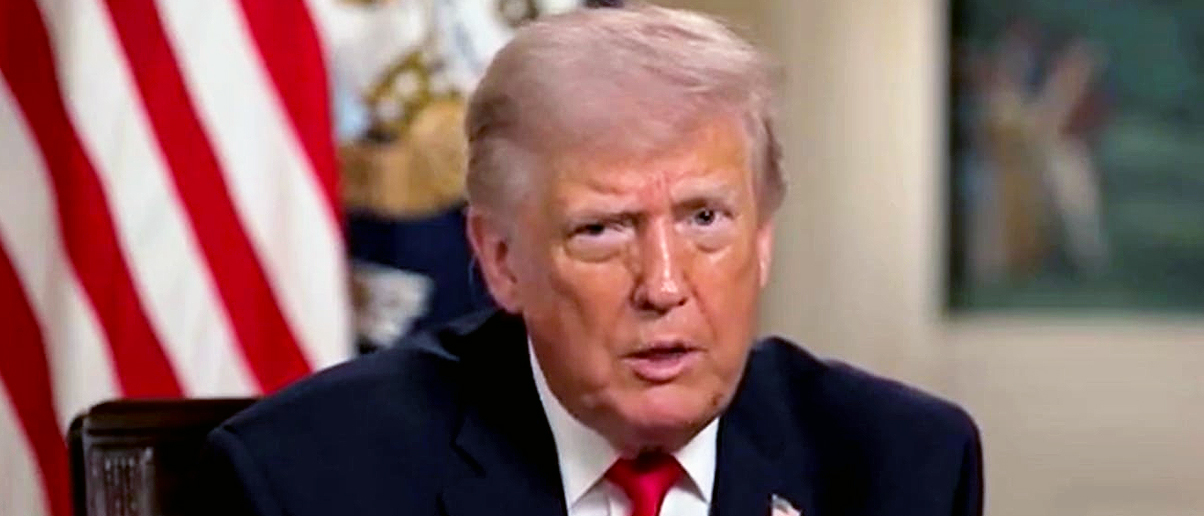
Screenshot/Rumble/Fox Business
President Donald Trump told lawmakers in a Friday letter that the Iran war had been “terminated,” as the 60-day deadline to obtain approval from Congress passed, prompting legal analysts to raise questions.
Trump’s letter to Congress comes shortly after Secretary of War Pete Hegseth said the ongoing ceasefire in Iran could reset the timeline for congressional approval. “The hostilities that began on Feb. 28, 2026, have terminated,” Trump stated in the letter addressed to Congress, obtained by POLITICO.
Legal experts have pushed back on the claim that a ceasefire would reset the war powers timeline.
“The issue is whether the United States is still using the U.S. armed forces in connection with the conflict.” Curtis Bradley, a University of Chicago law professor and scholar of constitutional war powers, told the Daily Caller News Foundation. “Given that the U.S. military is imposing a blockade on the Strait of Hormuz, it seems to me that the armed forces are still being used in the conflict.”
Bradley stated, “The fact that the United States has paused its bombing does not mean that the conflict has ended,” adding that he is unaware of “any precedent in support of the claim that a temporary ceasefire pauses the War Powers Resolution clock.”
Bradley did note that previous administrations have advanced similar arguments. He pointed to Libya during the Obama administration, where the U.S. was engaged in bombing operations over 60 days, arguing they were not engaging in “hostilities” under the War Powers Resolution.
We are in a ceasefire right now, which our understanding means the 60-day clock pauses, or stops in a ceasefire,” Hegseth said during a Senate Armed Services Committee hearing Thursday.
At the onset of the war, the administration did not seek prior congressional authorization but instead relied on the presidential powers as commander-in-chief under Article II of the Constitution and the War Powers Resolution.
The resolution, first adopted in 1973, requires the president to notify Congress within 48 hours of introducing U.S. forces into hostilities. It also generally requires the withdrawal of those forces within 60 days unless Congress authorizes the action, with the possibility of 30-day extension. Congress enacted the measure after overriding President Richard Nixon’s veto.
The bill does not explicitly address whether a pause in hostilities or a ceasefire resets the 60-day clock, leaving it open to interpretation and setting up a broader debate over the powers of the commander-in-chief.
“It’s never been, as you know, most people consider it [The War Powers Act] totally unconstitutional.” Trump told reporters Friday when asked about whether plans to ask Congress for approval, adding, “Also, we had a ceasefire, so that gives you additional time.”
The DCNF asked the Department of War whether it believes a ceasefire resets the War Powers clock and, if so, what legal basis supports that interpretation.
The Department of War referred the DCNF to the White House for comment.
The White House responded to the DCNF pointing to the newly released letter to Congress.
“We have serious constitutional concerns, and we don’t want to layer them with additional statutory concerns,” Democratic Virginia Senator Tim Kaine stated during the Senate Armed Services Committee hearing on Thursday.
Tess Bridgeman a former National Security Council lawyer and co-editor-in-chief of Just Security told the DCNF that the administration’s comment is “not credible,” further noting that the United States “remains engaged in military operations” that “clearly constitute ‘hostilities’ even under the executive branch’s elastic definition.”
Bridgeman also noted that while the War Powers Resolution does not explicitly define “hostilities,” its legislative history suggests that Congress intended for them to be “broader, not narrower, than a state of armed conflict.”
She further added that the current situation is “not a close call,” arguing that ongoing U.S. military activity and the continued risk to American forces mean hostilities are still underway even under the executive branch’s interpretation of the law.
Republican House Speaker Mike Johnson seemed to defend Hegseth’s comments.
“I don’t think we have an active, kinetic military bombing, firing or anything like that. Right now, we are trying to broker a peace,” Johnson told NBC News on Thursday, further adding, “We are not at war.”
All content created by the Daily Caller News Foundation, an independent and nonpartisan newswire service, is available without charge to any legitimate news publisher that can provide a large audience. All republished articles must include our logo, our reporter’s byline and their DCNF affiliation. For any questions about our guidelines or partnering with us, please contact [email protected].