

National Defense
The American Military Is Blowing Its Load In Iran — And China Is Noticing
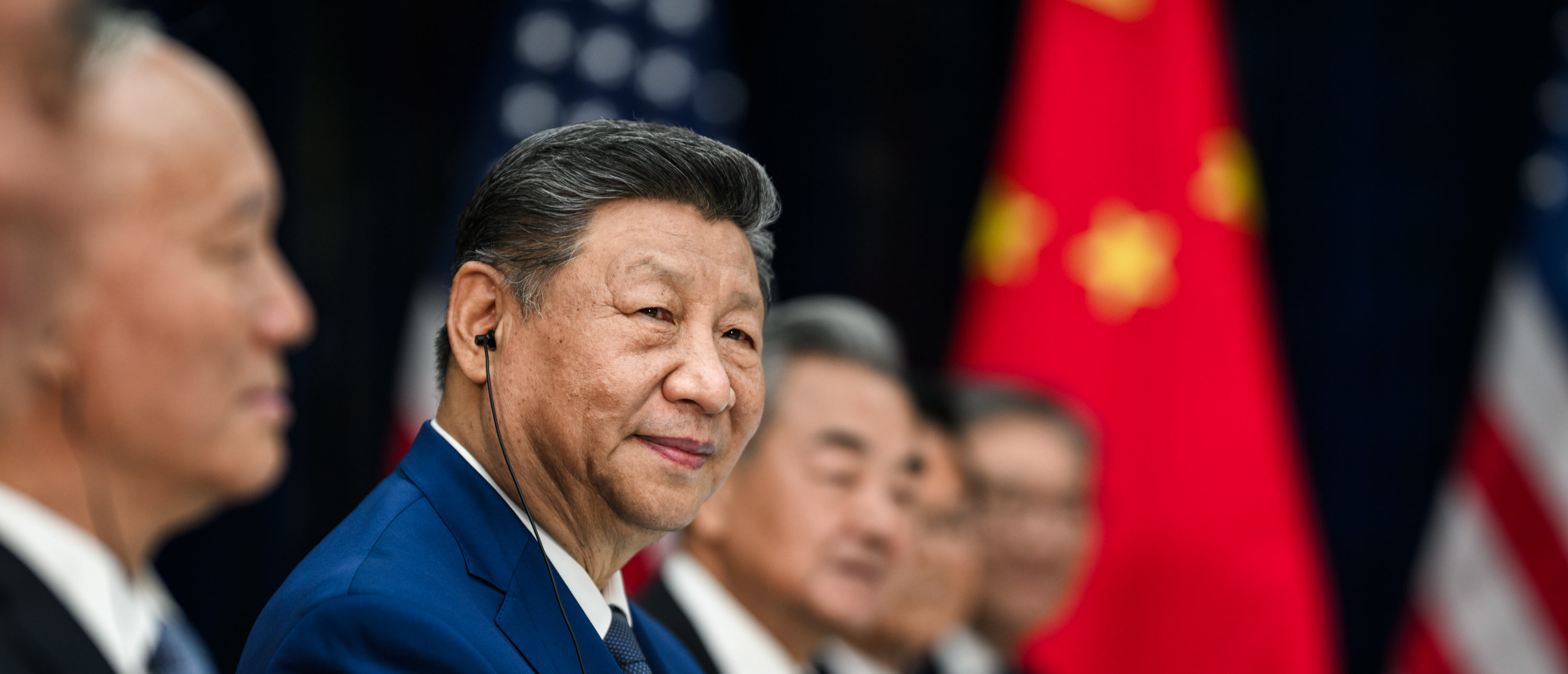
Official White House Photo by Daniel Torok
As the U.S. military continuously depletes its assets in the war with Iran, China is taking notes.
The U.S. is pulling munitions from key locations that defend its allies in Asia, according to U.S. Army generals, while Chinese analysts are taking notice of the weakened U.S. footing in the region. The redistribution of arms for the Iran war adds to an already strained stockpile that has spent years feeding Ukraine’s defense against Russia.
Former congressional staffer and geopolitical analyst Brandon Weichert told the Daily Caller News Foundation that these munitions will be hard to replace once expended.
“The biggest problem is that once they’re gone, once they’re out of the INDOPACOM area of responsibility … we don’t get replacements because the defense industrial base is so sclerotic that it will take, if we stop the war tomorrow, around four or more years to replenish all of those systems that we have depleted,” Weichert told the DCNF.
Weichert told the DCNF that this critical time, when the U.S. will be lacking munitions, has emboldened China to conduct exercises near the Philippines, Japan and Taiwan.
“I do think we are definitely closer than we’ve ever been to some kind of a conflict with China over one of those three areas I listed,” Weichert told the DCNF. “China kind of doesn’t have to do anything right now militarily. They can just watch us burn ourselves out … wherein the American people don’t want to fight anything anymore for any reason, such as a contingency over Taiwan or the Philippines or even over Japan.”
Chinese naval assets surrounding Taiwan nearly doubled their presence from their usual strength of around 50 vessels to more than 100 in early April, and the country just seized a small sandbank in the South China Sea, according to the BBC.
“The United States of America has the most powerful military in the world, fully loaded with more than enough weapons and munitions, in stockpiles here at home and all around the globe, to effectively defend the homeland and achieve any military operation directed by the Commander-in-Chief.” Karoline Leavitt said in a statement provided to the DCNF by the White House.
The Department of War (DOW) didn’t respond to a request for comment.
‘Might Be Too Good To Pass’
China has quickly risen to become the preeminent global adversary of the United States, leveraging its economic power and growing gross domestic product to enable a buildup of military assets and the militarization of the South China Sea.
“The truth is, for the last 30 years or so, China has, by default, risen to the second-largest economy in GDP terms, the largest economy in purchasing power parity terms, largely because they have not gotten involved in foreign military adventures and instead focused everything on its own development and in increasing its level of global trade,” Weichert told the DCNF.
Chinese strategists and academics are sharing their thoughts on the repositioning of both the U.S. and China in the Asian theater, the South China Morning Post reported.
“The United States is actively or passively selling off imperial assets,” Wu Xinbo, deputy secretary-general of the Shanghai Institute for International Strategic Studies, said in an article on WeChat. He argued that China’s goal should be to acquire those assets at the “lowest cost.”
State-backed Chinese news outlets, such as Xinhua News, have reported on the extensive depletion of U.S. missile stockpiles, DCNF translations show.
Retired Australian Maj. Gen. Mick Ryan said Trump puts China in an uncomfortable situation, likening him to the notoriously unpredictable Gen. Stonewall Jackson from the U.S. Civil War during an interview with Radio Free Europe.
“He is very unpredictable, and the Chinese are uneasy about that unpredictability,” Ryan said during the interview with RFE. “Trump is very unlike any of his predecessors, and the Chinese can’t really wargame what his reaction to any kind of event might be because he just really is all over the place when it comes to his responses.”
But that doesn’t mean Beijing isn’t looking for opportunities to exercise its power while the U.S. remains laser focused on the Middle East, according to Ryan.
“I don’t think that means he’s [Xi Jinping] going to instinctively want to invade Taiwan next week, but I think he will be looking for opportunities,” the retired major general said. “A Trump administration, which has degraded its military munition stockpiles because of this war and is potentially distracted by a bitter Congressional elections campaign through October into November, might be distracted enough that the Chinese could see an opening that might be too good to pass.”
Democrats such as Sen. Richard Blumenthal have recently latched onto the topic of munition redistribution as a way to attack the Trump administration.
“I am tremendously concerned about the impact of the transfer, the drawdown of munitions and capabilities to the Middle East [from Asia],” Blumenthal said during a Senate committee hearing on April 21. “I’m under the impression that the impact has been serious.”
‘Xi Jinping Does Nothing, Still Wins’
Since the Iran war began, the U.S. military has used somewhere between 45% and 61% of its Patriot missiles, according to a CSIS report. Between 1,060 and 1,430 of the 2,330 Patriot missiles in the stockpile have been expended.
U.S. THAAD system stockpiles have been heavily depleted in the Iran war, too.
Between 52% and 80% of the THAAD munitions stockpiles have already been expended in the Iran war, according to the CSIS report, which states that between 190 and 290 of the 360 THAAD munitions in the stockpile have been depleted so far, citing data from the 2027 defense budget.
It can take up to 53 months for THAAD interceptors to be produced, according to CSIS, while Patriots have an average delivery time of 42 months.
U.S. Army Gen. Xavier Brunson denied that Terminal High Altitude Area Defense (THAAD) batteries had been moved off the Korean Peninsula when asked by Sen. Gary Peters at the hearing. However, Brunson conceded that munitions and radars had been moved from Asia to the Middle East during the hearing.
“We’ve not moved any THAAD systems,” Brunson said. “We’re sending munitions forward … there were previous moves where radars were taken forward. This was in advance of Midnight Hammer. Some of those things have not come back yet.”
The strain on U.S. munitions stockpiles goes far beyond the war in Iran. The Russo-Ukrainian conflict has expended a significant amount of the U.S. stockpile.
Ukraine is using more munitions than the U.S. military industrial base could replenish, Jens Stoltenberg, the North American Treaty Organization (NATO) Secretary-General, said on Feb. 13, 2023, during a press conference.
The DOW even opened a new factory in Texas to produce 155 millimeter howitzer shells for the Ukrainians, according to New York Times reporting. Notably, the factory initially relied on Turkish laborers.
In the 12-day war that erupted on June 13, 2025, the U.S. military expended more than 150 THAAD interceptors, according to a report by CSIS.
Data from the 2027 defense budget show that the total missile procurement budget request for the U.S. Army in 2027 is $36.6 billion, while the enacted budget for U.S. Army missile procurement in 2026 was $7.2 billion.
Experts have stated that China’s recent military actions could be more than training. They could be a sign of invasion preparations.
“China continues to pursue its rapid military buildup and modernization,” The commander of the U.S. Indo-Pacific Command, Adm. Samuel Paparo, stated in his witness testimony to the Senate hearing. “Beijing will not rule out the use of force against Taiwan; its increasingly aggressive actions near Taiwan serve not just as exercises but as rehearsals for potential forced unification.”
While these figures and statements are concerning to Americans, the consequences of this conflict reach far beyond U.S. military stockpiles.
Economist Jeffrey Sachs said Friday during an appearance on “The Tucker Carlson Show” that he believes if Israeli Prime Minister Benjamin Netanyahu and President Donald Trump decide to escalate the conflict, it will affect the globe.
“I believe we will see a different world four weeks from now,” Sachs said. “A world that is profoundly damaged. The world economy in crisis.”
“There’s a meme … Xi Jinping does nothing, still wins,” Weichert told the DCNF. “I’m not rooting for them.”
All content created by the Daily Caller News Foundation, an independent and nonpartisan newswire service, is available without charge to any legitimate news publisher that can provide a large audience. All republished articles must include our logo, our reporter’s byline and their DCNF affiliation. For any questions about our guidelines or partnering with us, please contact [email protected].