

National Defense
F-15 Pilot Rescue Or Failed Uranium Heist?
U.S. Air Force/Flickr
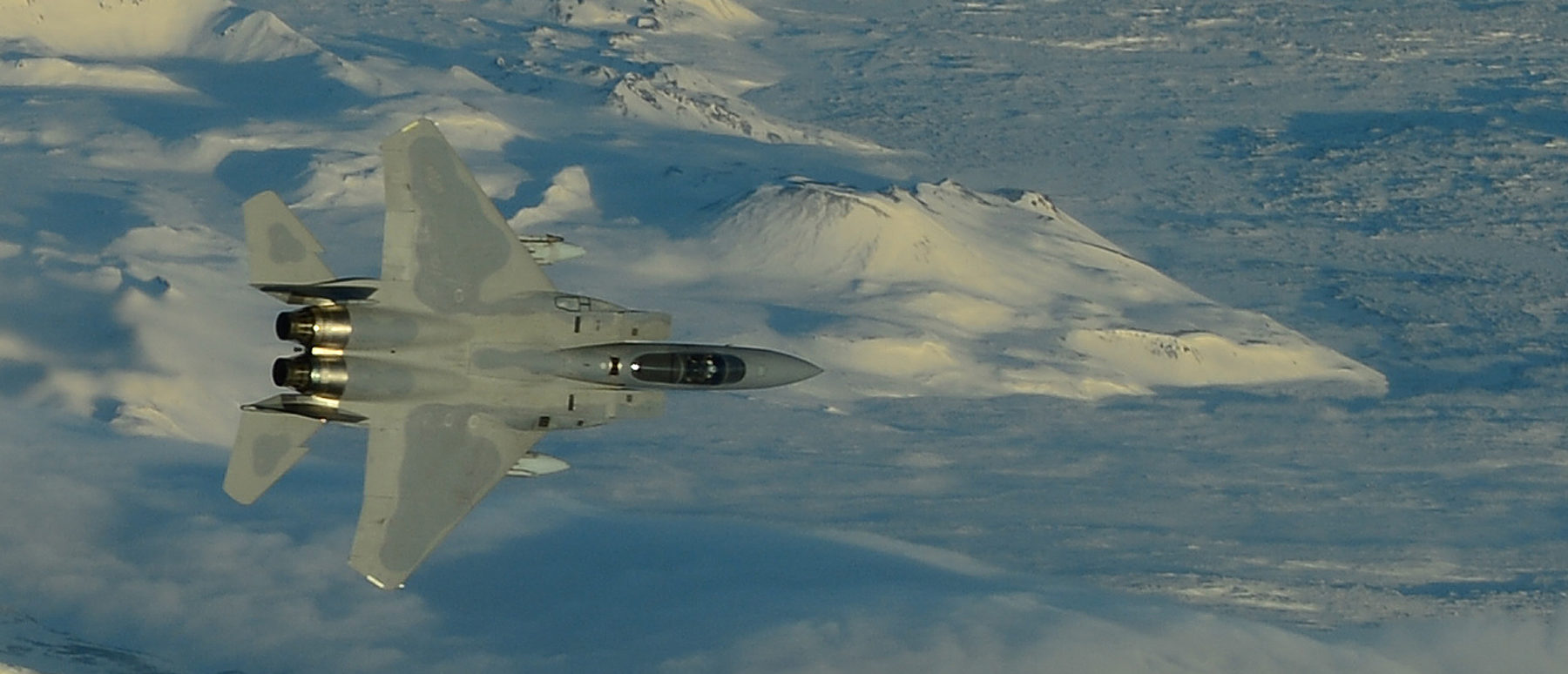
The United States military announced the completion of a massive joint operation to rescue two downed F-15 fighter jet pilots, offering few details. But some, including the Iranian government, are suggesting that the rescue operation was the result of a botched uranium heist.
President Donald Trump received a briefing regarding a ground force operation in conjunction with an airlift to seize nuclear material from the Iranian regime, The Wall Street Journal reported on March 29, citing anonymous sources familiar with the matter. The briefing occurred days before the plane was shot down by Iranian air defense near the proposed operational area, according to a U.S. Central Command (CENTCOM) press release.
“The U.S. lost many aircraft. Partially because of an attempt to rescue two crew from the F-15, but also the subsequent operation, which was probably an operation to try and take the enriched uranium from Isfahan nuclear facility,” Alastair Crooke, a former British Diplomat and ranking MI6 official, said on an episode of The Tucker Carlson Show.
“That went wrong,” Crooke said. “And there was an ambush. And many planes and helicopters were destroyed in that process. And it failed.”
“I think that was what Trump was very much counting on, that they could do a Maduro, do a Venezuela,” Crooke told Carlson. “The special forces would go in one night over Easter weekend when the markets were closed . . . and take it [the enriched uranium].”
The Isfahan Nuclear Technology/Research Center may have been a target, according to the WSJ, citing International Atomic Energy Agency Director General Rafael Mariano Grossi. Notably, one of the F-15s went down 30 miles south of the city of Isfahan, according to reporting by the BBC.
Excavation equipment may not have even been needed for the proposed operation. Spy satellites have imagery of the Iranian regime moving excavation equipment to Isfahan, where it began to access the underground tunnels, U.S. officials familiar with the matter told The New York Times.
Both the F-15 rescue mission and the proposed uranium heist required the use of C-130 transport aircraft, UH-60 helicopters and ground forces in the area of operation. There is also a significant overlap in the operational area, given that the pilot went down in an area that was in proximity to Isfahan, a possible target for the proposed uranium heist.
“The possibility that this was a deception operation to steal enriched uranium should not be ignored at all,” Iran’s foreign ministry spokesman, Esmaeil Baqaei, said during a press conference, CGTN reported.
The proposed uranium heist operation reported on March 29 by the WSJ necessitated similar tactics and equipment used for the F-15 pilot rescue, including the concept of cargo aircraft landing and taking off in Iranian deserts.
Former congressional staff member and national security expert, Brandon Weichert, also said that he finds the theory to be likely in a post on X.
I’m increasingly of this opinion, too. And I think it’s a blessing that it went so haphazardly because it might have shocked Trump out of his Mark Levin induced torpor enough to come around and recognize how damaging he was to the US these last several weeks. https://t.co/g1LVLOR5XK
— Brandon Weichert (@WeTheBrandon) April 8, 2026
When asked about these remarkable similarities, U.S. CENTCOM declined to answer all of the Daily Caller News Foundation’s questions and instead referred to a recent press release on the matter.
‘WE GOT HIM!’
The rescue mission cost the United States military one A-10 Warthog close air support plane, according to reporting by CBS. Allegedly, two C-130 Hercules transport aircraft and two UH-60 Blackhawk helicopters were also lost, based on an announcement by the state-backed Iranian Fars News Agency. CENTCOM hasn’t confirmed the lost aircraft.
The mission was heavily laden with troops and equipment, using “about 100 Special Operations forces,” according to the New York Times. These operators became stranded when their C-130 transport aircraft could no longer take off from where they landed. The operators were later airlifted from the area after the F-15 pilots had already been rescued, according to the New York Times.
Many questions remain unanswered regarding this operation and the strong similarities that it shares with the proposed uranium heist, given that the rescue operation required the usage of “about 100 Special Operations forces,” and the proximity to the Isfahan facility.
The Isfahan Nuclear Technology/Research Center is important because it is Iran’s largest nuclear facility. The underground facility contains reactors that can be used to enrich uranium.
President Donald Trump celebrated the success of the rescue operation with a Truth Social post that read, “WE GOT HIM!”
This is not the first time American aircraft have been lost in rescue missions involving Iran. A failed hostage rescue mission during the Iran hostage crisis that occurred during the Jimmy Carter administration, formally known as Operation Eagle Claw, resulted in the collision of a helicopter with a transport aircraft that was ferrying personnel and fuel in the mission area.
The resulting fire killed eight service members, according to reporting from The Atlantic. The failure of Operation Eagle Claw resulted in the resignation of Secretary of State Cyrus Vance. Although the hostages were eventually rescued, Operation Eagle Claw is known in history as a failure, and not the reason that the hostages were rescued.
The hostages were only recovered through peaceful negotiations that were mediated by the Algerians. These negotiations later became known in history as the Algiers Accords. The hostages suffered for 444 days in captivity and even received beatings, according to Mark Bowden’s book Guests of the Ayatollah: The First Battle in America’s War with Militant Islam.
As of today, the conflict in Iran has a very uncertain future. President Donald Trump recently sent out a Truth Social post that claimed, “A whole civilization will die tonight, never to be brought back again. I don’t want that to happen, but it probably will.”
A few hours later, the Iranians reached a deal for a temporary ceasefire with the United States through mediators in Pakistan. President Trump posted on Truth Social to commemorate the successful negotiations almost immediately, “I agree to suspend the bombing and attack of Iran for a period of two weeks.”
This agreement does not mean the war is over. The conflict could easily resume at the conclusion of the agreement on April 21. Secretary of War Pete Hegseth said “we’ll be hanging around” after the announcement of the ceasefire, signaling that the U.S. military has no plans to leave the area.
The agreement appears to be on shaky ground as Israel recently renewed their aerial bombardment campaign against Lebanon, according to reporting by the BBC. Iran also continued their strikes on other gulf nations. The Ministry of Interior in Bahrain confirmed this in an announcement on X.
MOI: Civil Defence extinguished a fire in the facility as a result of the Iranian aggression. No injuries were reported.
— Ministry of Interior (@moi_bahrain) April 8, 2026
The Ministry of Defense in the United Arab Emirates announced in a post on X that since the ceasefire, they have received attacks from “17 ballistic missiles and 35 drones.”
تعلن وزارة الدفاع أن الاعتداءات الإيرانية السافرة منذ بدء سريان الهدنة بلغت 17 صاروخ باليستي و 35 طائرة مسيرة، ونجحت الدفاعات الجوية في التعامل معها.#وزارة_الدفاع #وزارة_الدفاع_الإماراتية#MOD#UAEMinistryOfDefence pic.twitter.com/AfHSsTa7VG
— وزارة الدفاع |MOD UAE (@modgovae) April 8, 2026
Iran has an arsenal of supersonic and even hypersonic missiles that have yet to be unleashed in large numbers. Limited use of these weapons has been conducted according to PBS reporting on Iran’s paramilitary Revolutionary Guard, but not at scale. However, PBS was skeptical of this claim.
All content created by the Daily Caller News Foundation, an independent and nonpartisan newswire service, is available without charge to any legitimate news publisher that can provide a large audience. All republished articles must include our logo, our reporter’s byline and their DCNF affiliation. For any questions about our guidelines or partnering with us, please contact [email protected].