

Commentary: Big Tent Ideas
NICOLE KELLY And STEVE ROBERTS: Save Election Day
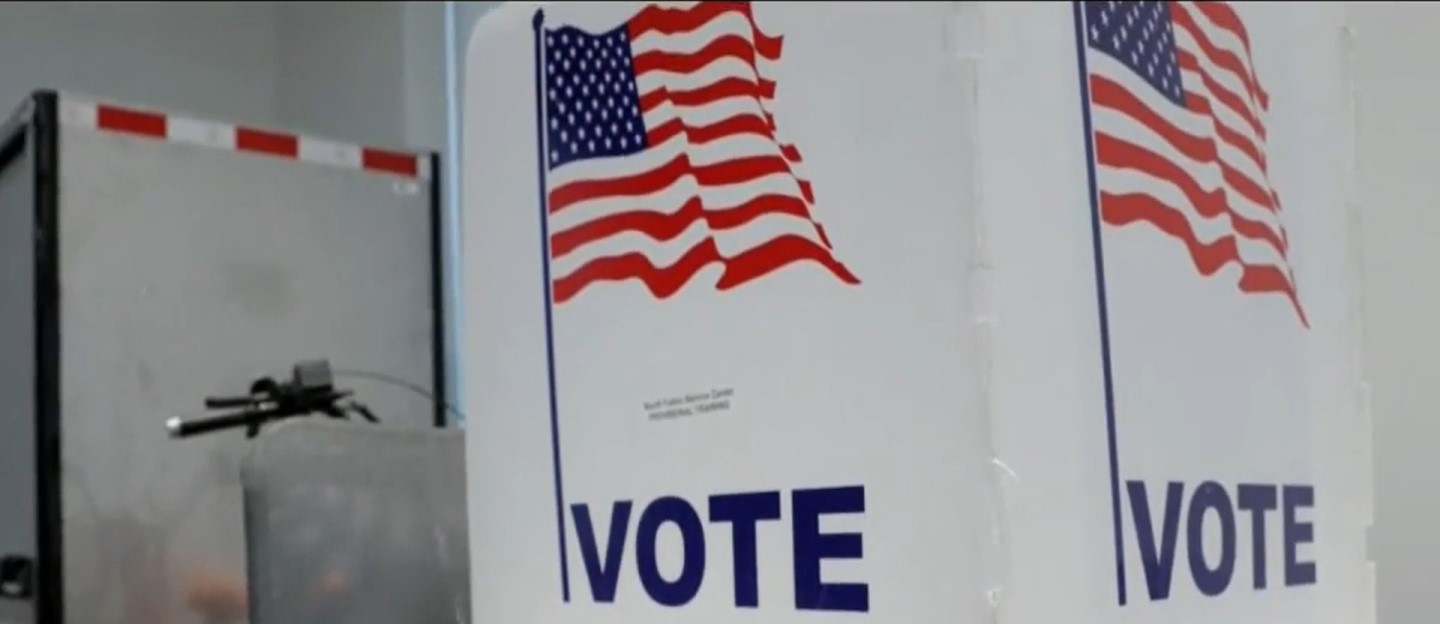
A voting booth in 2022. (Screen Capture/PBS NewsHour)
Democracy is a fragile thing. Its fundamental premise – government selected by the governed – requires a reliable, trustworthy system of choosing its leaders. As America celebrates the anniversary of its 250th year, this foundational promise faces a renewed threat from flawed election systems that erode public trust.
The latest attacks on Election Day security include the U.S. Postal Service’s revelation that postmark dates aren’t a guarantee of when something was mailed. Yet a promising countermove is on the horizon: the Supreme Court’s recent oral arguments in Watson v. RNC. If the Court rules as widely expected, the decision will eliminate post-election day ballot receipt periods, encourage a return to timely Election Day results, and help shift the country away from the widespread reliance on mail-in ballots.
However, even if the Supreme Court makes a move towards restoring Election Day to its former glory, it’s time for states to seize the moment and enact further sweeping reforms to safeguard the integrity of our votes.
The USPS’s new diktat, effective Dec. 24, 2025, is a glaring symptom of the broader chaos inherent in widespread use of mail-in voting, a COVID-era change across states that has far outlasted its usefulness. USPS has categorically announced that mail, including ballots, may not receive a postmark on the same day it’s dropped off. Problematically, states that allow mail-in ballots to arrive after Election Day generally rely on postmark dates to determine whether a ballot can be counted.
But without reliable postmarking practices, this will cause major issues in those states. For states that are ahead of the trend and do not accept ballots after Election Day (i.e. Florida, Ohio, Texas, others), the postmarking change is seemingly irrelevant. Either it has arrived on the first Tuesday after the first Monday of November, or it hasn’t. Yet, for states with weak election administration laws that allow the ballots received after Election Day to be counted – provided that the ballot was postmarked by the close of polls on Election Day (i.e. Nevada) –– this direct failure to follow long-held practice regarding same-day postmarks adds another level of issues.
Specifically, the USPS notes that “while the presence of a postmark on a mailpiece confirms that the Postal Service was in possession of the mailpiece on the date of the postmark’s inscription, the postmark date does not inherently or necessarily align with the date on which the Postal Service first accepted possession of the mailpiece.” Such systemic unreliability, –introduced by an agency of the federal government, invites doubt, delays, and disputes, fueling the very cynicism that undermines faith in our electoral process.
Mail-in ballots have long been fraught with issues beyond just postmarking mishaps. From chain-of-custody vulnerabilities to the potential for wrongdoing through universal mass mailings, this method stretches the safeguards of voting to their breaking point. We’ve seen chaotic late-night ballot dumps in states like Nevada and Pennsylvania, where extended counting periods breed suspicion and legal battles.
However, in states where ballots are cast and tallied on Election Day, results are swift, transparent, and far less prone to manipulation or error. Voters can go to bed on Election Night likely knowing who won the election, rather than waiting days or weeks later to get a clear read on the winner as mail ballots continue to trickle in.
Public sentiment overwhelmingly demands change. Polls consistently show that a staggering 95% of Republicans and nearly 70% of Democrats support requiring photo voter ID to ensure only eligible citizens vote. President Donald Trump’s March 2025 Executive Order on election integrity provides a clear blueprint: mandate photo ID, drastically limit mail-in voting to those who truly need it (like the military or disabled), eliminate grace periods that invite post-Election Day mischief, and rigorously clean voter rolls to remove duplicates, deceased individuals, and non-citizens.
With his latest Executive Order on elections, Trump continues to champion meaningful election reforms that place a clear emphasis on fortifying the security of mail voting and upholding the fundamental principle that every ballot must come from a verified American citizen, while empowering states to implement even stronger safeguards.
Yet, in a system with a sharply divided Congress, states must lead the way on election administration issues. By embracing reforms that prioritize security, speed, and simplicity, states can restore confidence in their elections and ensure they reflect the true will of the people.
Nicole Kelly is a Senior Counsel at Lex Politica, and the President/ CEO of Save Election Day. Steve Roberts is a partner and co-chair of the political law practice at Lex Politica, and the General Counsel/ COO of Save Election Day.
The views and opinions expressed in this commentary are those of the author and do not reflect the official position of the Daily Caller News Foundation.
(Featured Image Media Credit: (Screen Capture/PBS NewsHour)
All content created by the Daily Caller News Foundation, an independent and nonpartisan newswire service, is available without charge to any legitimate news publisher that can provide a large audience. All republished articles must include our logo, our reporter’s byline and their DCNF affiliation. For any questions about our guidelines or partnering with us, please contact [email protected].