

Legal/Law/Criminal Justice and Reform
Supreme Court Seems Open To Taking Away Key Election Rule Beloved By Dems
Wikimedia Commons
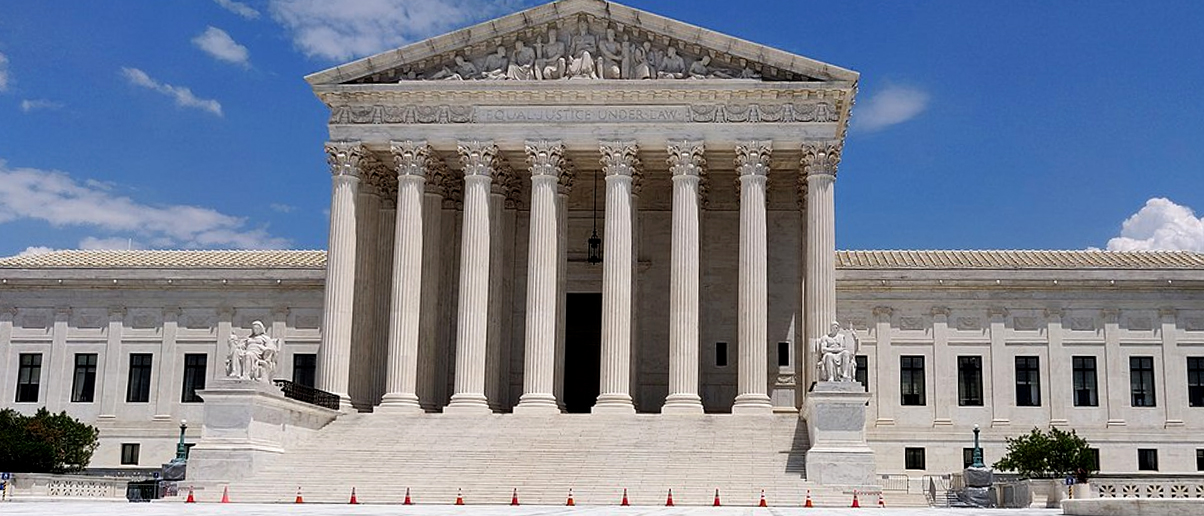
The Supreme Court seemed open Monday to cracking down on states’ ability to accept mail-in ballots that arrive late.
Several justices seemed concerned about the “slippery slope” of counting ballots received after Election Day, raising questions about who can receive ballots and how to address perceptions of fraud.
“When do I know whether or not a choice is final?” Justice Clarence Thomas asked Mississippi Solicitor General Scott Stewart.
Under Mississippi law, mail-in absentee ballots can be counted up to five days after Election Day. Both the Trump administration and the Republican National Committee (RNC) argue that federal statute setting election day prevents states from accepting ballots received after that day.
While Mississippi’s law requires ballots to be postmarked by Election Day, several justices highlighted how the logic could enable states to allow a neighbor, family member or even a political party operative to receive the ballots instead of the post office. Justice Neil Gorsuch also raised the possibility of voters trying to recall their mail-in ballots before delivery to election officials, even in a way that “swings the election” in the final days of a campaign.
“If history teaches anything… it’s that as soon as something is allowed, it will happen eventually,” Gorsuch noted.
After Steward agreed voters would not be “disenfranchised” by enforcing an Election Day deadline, Justice Brett Kavanaugh asked how much the “appearance” of fraud should factor into their decision.
“If the apparent winner the morning after the election ends up losing due to late-arriving ballots, charges of a rigged election could explode,” he said, quoting a law professor.
“If you have to have a deadline, which you acknowledged, and having a deadline of November 3 rather than November 10 for receipts doesn’t disenfranchise anyone, why wouldn’t it make more sense to take account, in some respect, of that concern as we think about how the text and history fit together?” Kavanaugh questioned.
Eighty-three percent of likely voters believe mail-in ballots should not be received after Election Day, according to a survey by the Honest Elections Project. Democratic party officials have embraced mail-in voting and opposed legal efforts challenging restrictions since 2020, when 58% of Democrats voted by mail during the presidential election, according to the Elections Performance Index.
“We have lots of phrases that involve two words, the last of which, the second of which is day. Labor Day, Memorial Day, George Washington’s birthday, Independence Day and Election Day,” Alito said. “They’re all particular days.”
“If I have nothing more to look at than the phrase ‘Election Day,’ I think, this is the day in which everything is going to take place,” he said, seeking to drill down on how the phrase would be interpreted at different points historically.
In 1845, Congress set federal Election Day as the first Tuesday following the first Monday in November out of concern about fraud resulting from different days in different states.
Mississippi argues there is no historical evidence that federal law requires ballots to be received by Election Day, though states may have viewed it as good policy. Paul Clement, defending the RNC’s position, said it is striking the lengths states went to ensure soldiers’ ballots were received in “official custody” by Election Day during the Civil War.
“They did it because they thought that’s what an election means,” Clement said.
Justices Sonia Sotomayor and Ketanji Brown Jackson emphasized that the question of late-arriving mail ballots is not a decision for the courts to decide, but for Congress.
Jackson noted that Congress is currently considering the “Make Elections Great Again Act,” which would require receipt of ballots on Election Day.
President Donald Trump’s focus has been the Save America Act, which still faces Republican opposition in the Senate, primarily from Sens. Lisa Murkowski of Alaska and Thom Tillis of North Carolina. Tillis warned against eliminating or weakening the filibuster to pass the bill on Thursday.
Trump said Sunday night that he wouldn’t make a deal with Democrats on U.S. Department of Homeland Security (DHS) funding unless they vote to pass the Save America Act.
In February, the RNC also asked the Supreme Court to take up a case involving undated or misdated mail-in ballots.
All content created by the Daily Caller News Foundation, an independent and nonpartisan newswire service, is available without charge to any legitimate news publisher that can provide a large audience. All republished articles must include our logo, our reporter’s byline and their DCNF affiliation. For any questions about our guidelines or partnering with us, please contact [email protected].