

Commentary: Big Tent Ideas
JAMES CARTER And JACOB CHOE: Trump’s Doctrine, Rubio’s Moment And How America Got Serious About Iran
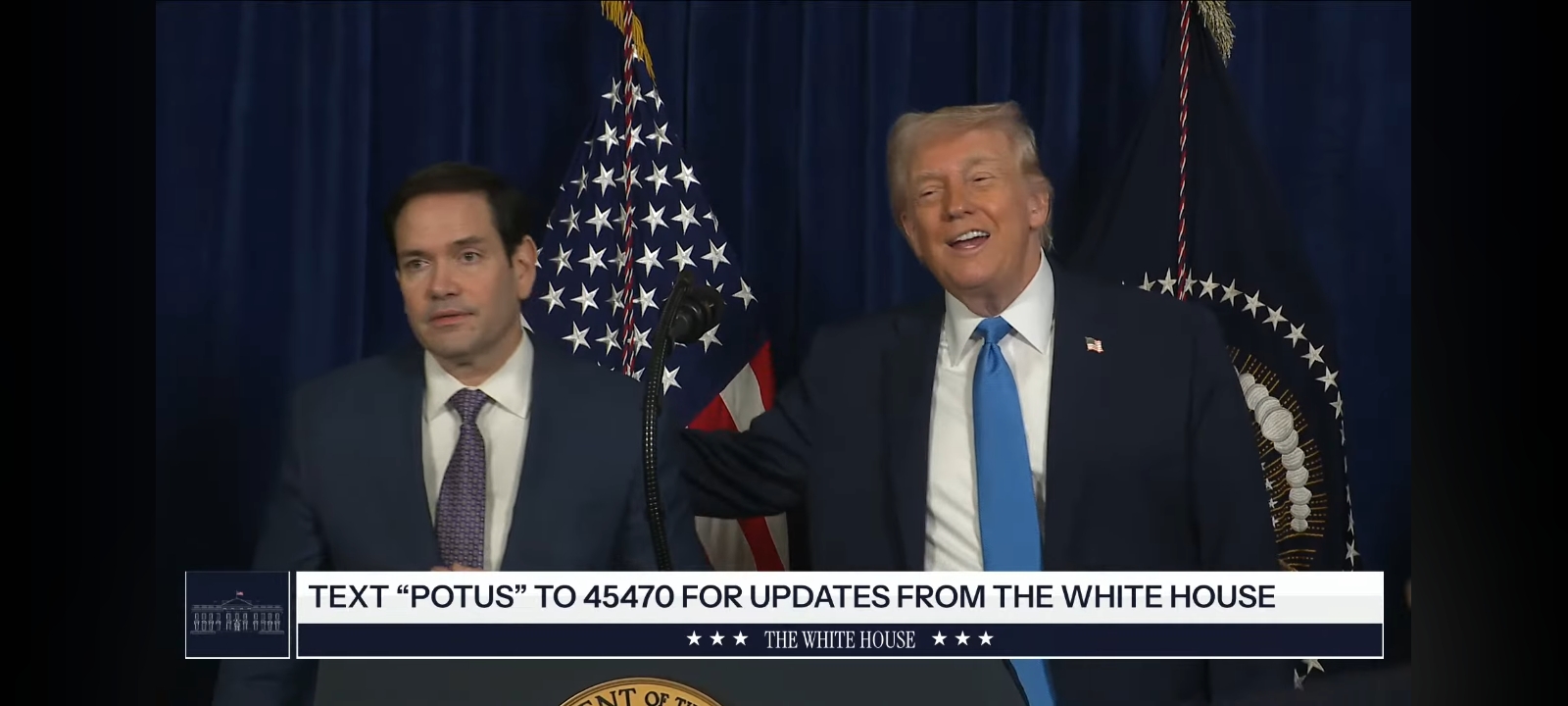
President Donald Trump and Secretary of State Marco Rubio [Screenshot/YouTube/The White House]
Washington has a habit of dressing up failure as sophistication.
Thirty years of engagement with Iran — the diplomacy, the frameworks, the endless European intermediaries — produced a regime with more centrifuges, more proxies, and more confidence than when the process started. The foreign policy establishment responded to each setback by calling for more of the same, with better manners.
Trump looked at that record and didn’t find it complicated. He found it embarrassing.
That instinct — blunt, impatient with credentialed excuse-making — drove the maximum pressure campaign, the JCPOA withdrawal, and ultimately Operation Midnight Hammer. You can argue about the sequencing or the risks. What’s harder to argue with, at this point, is the trajectory. Iran’s nuclear sites are rubble. Its proxy network is the weakest it’s been in a decade. The regime that spent years believing it could outlast American attention is now having a different conversation.
None of that happened because the establishment came around. It happened because Trump didn’t need it to.
Rubio brought something different to this — not strategic vision, which Trump had, but the apparatus to make it executable. The months of ally briefings before the first strike. The legal designations, the message discipline, the quiet work of ensuring that when the moment came, the coalition was there and the justification was airtight.
That kind of groundwork isn’t glamorous. It also doesn’t make headlines. It’s what separates a successful military campaign from a successful military action that collapses diplomatically three weeks later.
The critics call this managerial pragmatism, which in Washington is meant to damn with faint praise. But look at what the alternative produced.
Libya was a humanitarian intervention that created a humanitarian catastrophe. The ISIS vacuum didn’t appear from nowhere — it was the predictable result of a withdrawal that prioritized the appearance of ending a war over the reality of what would fill the space. Afghanistan ended with the Taliban holding American equipment and the foreign policy community writing essays about lessons learned.
These weren’t failures of execution. They were failures of judgment — specifically, the judgment that good intentions and institutional process could substitute for clarity about what you actually want to achieve.
Trump knew what he wanted and said so. In foreign policy circles that passes for naivety. In Iran it passed for deterrence.
The Kissinger comparison will get made — it always does when American foreign policy shows signs of coherence. It’s partially apt and mostly misleading. Kissinger worked through opacity, back channels, and deliberate ambiguity. Trump’s approach is almost the inverse: state your intentions loudly, make the costs of resistance concrete, and follow through.
Less elegant. Considerably more legible. Whether legibility turns out to be a strategic asset or a liability is probably the most interesting question about this moment — and one nobody can answer yet.
What’s clear is that the assumptions keeping Iran’s program alive for 30 years are gone. The assumption that the regime would moderate with engagement. That Europe could broker something durable. That military options were too destabilizing to seriously consider.
Trump didn’t argue his way past those assumptions. He just stopped honoring them.
Rubio’s job now is to build something that lasts. The foundation is stronger than it’s been in decades — Iran’s capabilities degraded, its proxies weakened, its assumptions shattered. That’s not a starting point previous administrations managed to reach.
The hard work remains. But for the first time in 30 years, America is doing that work from a position of strength rather than wishful thinking.
That’s the difference. And it didn’t happen by accident.
James Carter served as Deputy Undersecretary for International Affairs at the U.S. Department of Labor (2006-07) and as the Director of the America First Policy Institute’s Center for American Prosperity (2021-23). Jacob Choe is a member of the Bretton Woods Committee and serves as the Eurasia Center’s Asia Program Director.
The views and opinions expressed in this commentary are those of the author and do not reflect the official position of the Daily Caller News Foundation.
(Featured Image Media Credit: President Donald Trump and Secretary of State Marco Rubio, Screenshot/YouTube/The White House)
All content created by the Daily Caller News Foundation, an independent and nonpartisan newswire service, is available without charge to any legitimate news publisher that can provide a large audience. All republished articles must include our logo, our reporter’s byline and their DCNF affiliation. For any questions about our guidelines or partnering with us, please contact [email protected].