

Politics
No Healthcare Deal In Sight As Parties Nuke Each Other’s Plans
(Screenshot via C-SPAN)
Senate Democrats and Republicans each shot down the other’s healthcare proposal on Thursday, underscoring how divided the parties remain as the boosted Obamacare subsidies are set to expire at the end of the year.
The Senate voted on a Democrat plan to extend the enhanced Affordable Care Act (ACA) subsidies for three years, as well as a Republican alternative centered on expanded Health Savings Accounts (HSAs). Both measures failed after party leaders declared the opposing proposals “dead on arrival,” leaving little room for a healthcare deal to materialize before the year’s end.
The Democratic proposal was part of the agreement that secured their votes to end the monthlong government shutdown. Their plan would offer a three-year clean extension of the enhanced Obamacare subsidies — enacted in 2021 by Democrats without a single GOP vote — and is estimated to add $350 billion to the national debt over a decade.
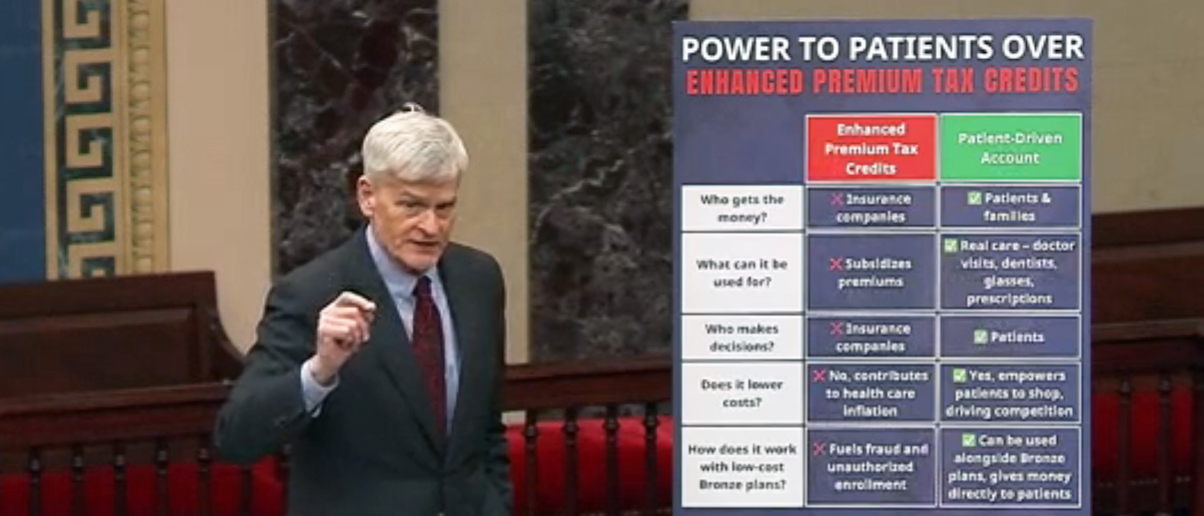
The GOP bill — the Health Care Freedom for Patients Act — is sponsored by Sens. Bill Cassidy, chair of the Senate Health, Education, Labor and Pensions (HELP) Committee, and Finance Committee chair Mike Crapo. Under the plan, roughly $1,000 to $1,500 would be deposited into HSAs paired with Bronze or Catastrophic plans on the ACA exchanges, and would not include an extension of the enhanced subsidies.
Senate Republican leadership coalesced around the Cassidy-Crapo proposal, arguing that federal dollars should flow directly to consumers rather than to insurance companies through subsidies. Republicans point to rising insurer profits since the enhanced subsidies were enacted, and note that Obamacare premiums have increased twice as fast as employer-based premiums.
“Democrats want to force families to pay $6,000 out-of-pocket before their insurance kicks in. Republicans want to make health care affordable and put thousands in patients’ pockets to help pay for their out-of-pocket expenses,” Cassidy said ahead of the vote. “Democrats need to stop playing politics with people’s health care and come to the table to find real solutions.”
The Government Accountability Office recently revealed that enrollees with fictitious identities, invalid Social Security numbers, and even deceased individuals are frequently approved for taxpayer-funded subsidies in the ACA marketplace.
“The Democrat bill sends $83 billion directly from the Federal Treasury to insurance companies. And it fails to include a single reform to stop the waste, the fraud, the abuse, or the corruption – because Democrats simply don’t care,” Senate Majority Whip John Barrasso said during a floor speech Wednesday.
Even so, many Republicans acknowledged that neither party’s standalone bill was likely to advance this week.
“In my opinion, trying to take the longer view — and also being as objective as I can — I think the only way that there will be a bill put together reforming the Obamacare exchanges is through the reconciliation bill,” Sen. John Kennedy of Louisiana told reporters on Tuesday. He added that the world would not “spin off its axis” if Republicans failed to vote on their own proposal.
Others, meanwhile, stress the urgency of acting before the subsidies expire on Dec. 31.
“The point is that, right now, people in my state and around the country will not be able to afford health insurance,” Sen. Josh Hawley of Missouri said Tuesday. “We need to think about the human cost of this, I think, and Republicans need to offer an alternative solution.”
Hawley is among several GOP Senators — including Sens. Susan Collins of Maine, Bernie Moreno of Ohio, Lisa Murkowski and Dan Sullivan of Alaska, and Thom Tillis of North Carolina — who have expressed support for extending the subsidies, though they say income caps and other restrictions would be required to secure sufficient backing.
Collins, Murkowski, Sullivan and Hawley voted for the Democratic proposal on Thursday.
In the House, moderate Republican Rep. Brian Fitzpatrick of Pennsylvania joined forces with Democrat Jared Golden of Maine to file a discharge petition Wednesday to force a vote on a two-year extension of enhanced subsidies. At least six Republicans have signed on, but it remains unclear whether the petition can reach the 218 signatures needed, especially as House Minority Leader Hakeem Jeffries continues to push for a three-year extension.
Speaker Mike Johnson has said that Republicans will vote on a healthcare proposal by the end of December, though details are yet to be finalized.
All content created by the Daily Caller News Foundation, an independent and nonpartisan newswire service, is available without charge to any legitimate news publisher that can provide a large audience. All republished articles must include our logo, our reporter’s byline and their DCNF affiliation. For any questions about our guidelines or partnering with us, please contact [email protected].