

Commentary: Big Tent Ideas
JENNY BETH MARTIN: Rubio Rights Ship At State
U.S. Department of State
The State Department is finally undergoing the course correction it has long needed. According to recent reporting from FOX News, Secretary of State Marco Rubio has reinstated and promoted a number of career Foreign Service officers who were denied advancement under the Biden administration’s expansive diversity, equity, and inclusion (DEI) regime. This is a welcome development that should be applauded far beyond Foggy Bottom.
Few federal agencies were as emblematic of DEI excess as was the State Department under Biden-appointed Secretary Antony Blinken. In the Biden years, DEI considerations became an all-purpose filter for hiring, promotion, and even diplomatic posting decisions. Career officials privately grumbled that professional merit, regional expertise, and language skill suddenly took a back seat to bureaucratically defined “representation metrics.” Some employees were told outright that advancement would require them to demonstrate their “lived experience” aligned with the Department’s DEI goals – a standard both nebulous and discriminatory. Others saw promotion boards weighed down by ideological mandates that had little to do with advancing American interests abroad.
Rubio has now begun the process of unwinding that bureaucracy and restoring the meritocratic principles on which the Foreign Service was designed to operate. By reinstating Foreign Service officers improperly sidelined during the DEI heyday, Rubio is sending a clear message: American diplomacy requires capability, not political coloration. Experience, competence, and performance are once again the decisive factors in determining who represents the United States overseas.
This is not merely a personnel matter. It is a question of national strength. A diplomat denied promotion because he or she fails to satisfy an ideological checklist is a diplomat the United States cannot deploy in full force. During an era of rising geopolitical competition – Russia pressing into Eastern Europe, China expanding in the Indo-Pacific, Iran stirring volatility throughout the Middle East – the United States needs its sharpest minds on the front lines, not shunted aside because they do not fit an HR department’s sociopolitical taxonomy.
Rubio has long been a critic of using DEI as a sorting mechanism at the State Department. He even introduced legislation as a U.S. senator called “The Stop Wasteful, Odious, and Kooky Exercises (WOKE) at State Act,” arguing that DEI initiatives substitute political fashion for professional judgment. His early moves at State reflect a logical extension of that critique. Rubio has reportedly instructed senior staff to re-examine promotion decisions made under Biden-era guidance, remove race- and identity-based criteria from internal reviews, and reopen advancement pathways for career officers previously ruled out for reasons that had nothing to do with diplomacy.
Restoring fairness also has a deterrent effect. For years, junior officers watched their mentors receive questionable performance reviews or unexplained promotions-denied notices. That had a corrosive effect on morale – and, worse, it accelerated the flight of talent from a department that already struggles to retain top performers. Rubio’s decision to review and reverse these denials sends a powerful message to the next generation of diplomats: Do the job well and you will be rewarded, regardless of your politics, demographics, or personal background.
Critics, of course, will accuse Rubio of “rolling back diversity.” But this framing misses the point entirely. The question has never been whether America should welcome people of all backgrounds into its diplomatic corps. Of course it should, and it does. The real question is whether diversity should be engineered at the expense of excellence. The answer should be obvious: A world-class diplomatic service is built on merit, not quotas dressed up in ideological language.
The Trump administration’s broader effort to remove DEI requirements from hiring and personnel decisions is overdue. The federal government should not be in the business of requiring ideological conformity from its employees. Nor should it use identity-based criteria as a substitute for performance metrics. True equality – the kind Americans intuitively understand and support – means judging individuals on their capabilities and achievements. The Trump-Rubio team appears committed to restoring that principle across government, starting with one of its most mission-critical agencies.
The State Department has long prided itself on being the guardian of America’s diplomatic professionalism. But professionalism requires standards, and standards require a willingness to reject ideological experiments that weaken institutions. Rubio’s quiet but consequential recalibration is precisely the sort of reform Washington needs more of: targeted, substantive, rooted in constitutional principles, and focused on results rather than headlines.
If the United States is to meet the challenges of a dangerous world, it must deploy its best talent without ideological blinders. Rubio is taking the first steps toward ensuring it can. For that, he deserves credit – and encouragement to keep going. The nation’s diplomats, and the nation itself, will be stronger for it.
Jenny Beth Martin is Honorary Chairman of Tea Party Patriots Action.
The views and opinions expressed in this commentary are those of the author and do not reflect the official position of the Daily Caller News Foundation.
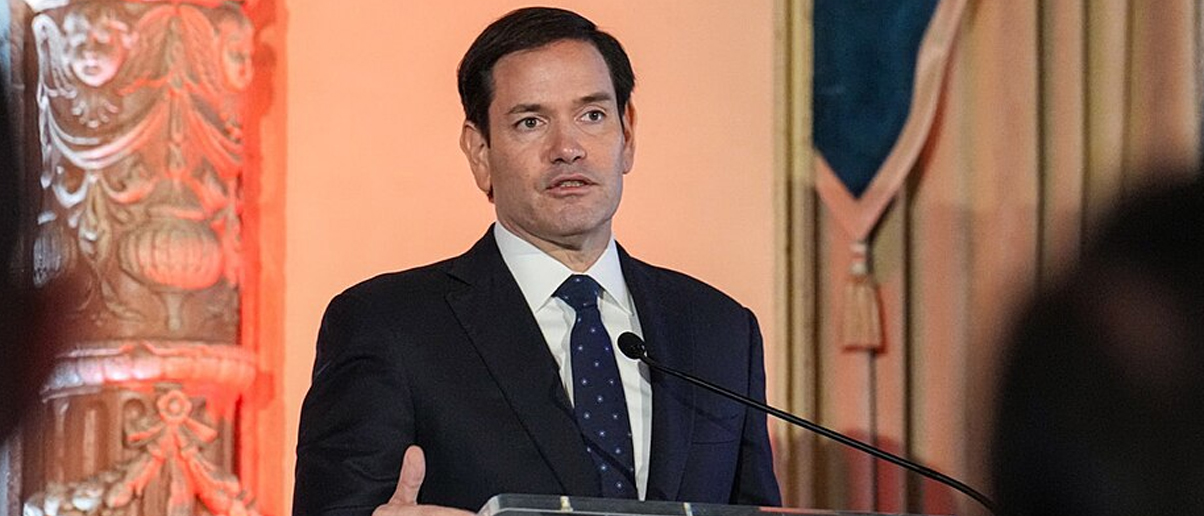
(Featured Image Media Credit: Sec. Marco Rubio via U.S. Department of State)
All content created by the Daily Caller News Foundation, an independent and nonpartisan newswire service, is available without charge to any legitimate news publisher that can provide a large audience. All republished articles must include our logo, our reporter’s byline and their DCNF affiliation. For any questions about our guidelines or partnering with us, please contact [email protected].